
Episode 119: Winter Olympics Takeaways, Building Systems for Flexibility, and Leading with Intentionality
In this week’s episode, we reflect on Olympic moments, flexibility in training, and navigating new seasons with intention. We start with thoughts on the Olympics—from the power of confidence and sportsmanship to the external validation trap and what high-level achievement really represents. Elena shares her “3 Gs” framework for flexibility (grounding, goals, gauge), how she’s embracing cross-country skiing this winter, and why focusing on process over outcome is essential. We then dive into systems for modifying workouts, including practical red/yellow/green light frameworks to reduce decision fatigue and adapt to life stress. Katie expands on intentionality in training—especially postpartum—where the purpose of workouts has shifted toward mental health, recovery, and sustainability rather than performance. We close with honest reflections on early postpartum realities as an athlete, fueling demands, sleep deprivation, and building support systems to navigate this phase. Check it out!
Elena:
Some thoughts on flexibility rules!
I’m coining the 3 Gs: 1) grounding, 2) goals, 3) gauge
First off, it will all be ok.
Second, what’s the goal of the workout? Speed? Time on feet? Mental strength? Practice the muscle of knowing the why then find the option that sounds best.
If time on feet, what sounds fun?
If speed, what kind of speed?
If mental strength, make that the focus– just do it and don’t worry about the pace.
Third, how’s my life stress currently? If feeling good, go for it! If feeling overwhelmed, try and adapt if necessary.
“Show up but don’t judge it”
On a macro level:
How often am I feeling like I’m not doing enough?
What’s my overall mental and physical health score?
Re-evaluate and reset goals if needed
Process over outcome
Really embracing xc skiing as a modality!
Olympics thoughts – a reminder that it’s what we pay the most attention to, but athletes are competing at this level all the time and there’s a lot of politics involved in who and how people get there
Really really easy to get caught up in the external validation game, the label of an olympian, etc.
It is awesome!! And the coolest achievement, but it’s also not everything and it can be stressful to be so close to it and see how much space it takes up in the collective consciousness
Worth asking, what is the olympics really about? Participation? Representation? Achievement? “The best of the best”?
Katie:
Cool Olympics moments:
Jessie Diggins 10km skate ski bronze: Right before she went off the cameras panned her face and she had this huge smile, and Kikkan Randall (commentator and 2018 gold medalist in a xc skiing relay with Jessie) said: “When she smiles, that means she’s dangerous…this is confidence mode”
Reminder that smiling and showing up happy is performance enhancing! And if you don’t feel happy/excited, fake it till you make it!
Also reminds me of the Mark Cavendish strategy -- cues to help you feel/be happy mid race if your mood starts to dip can blunt pain signals
Link to Jessie’s 2018 gold medal win (aka one of the coolest Olympics moments ever)
Lindsey Vonn heartbreaking crash 13 seconds into her race
Ended up getting a lot of blowback for racing on a torn ACL
Turned out that the crash had nothing to do with the ACL
Her performance bubble of a TON of experts had said that racing was ok -- reminder to draw on experts to help guide the info you have and trust your gut/intuition. There will be lots of chatter from various other people about what you should and shouldn’t be doing, and you should let that roll off. Found it very inspiring that Lindsey had no regrets
Could read some excerpts from her post
“While yesterday did not end the way I had hoped, and despite the intense physical pain it caused, I have no regrets. Standing in the starting gate yesterday was an incredible feeling that I will never forget. Knowing I stood there having a chance to win was a victory in and of itself. I also knew that racing was a risk. It always was and always will be an incredibly dangerous sport. And similar to ski racing, we take risks in life. We dream. We love. We jump. And sometimes we fall. Sometimes our hearts are broken. Sometimes we don’t achieve the dreams we know we could have. But that is the also the beauty of life; we can try. I tried. I dreamt. I jumped. I hope if you take away anything from my journey it’s that you all have the courage to dare greatly. Life is too short not to take chances on yourself. Because the only failure in life is not trying. I believe in you, just as you believed in me.”
General thoughts on sportsmanship
Really cool to see so many Olympians congratulating each other at the finish line or on podium (even in 4th place) when it would be really easy to be resentful or feel big emotions about not winning. While those emotions are certainly there, it does seem like sportsmanship is on full display for the vast majority of these athletes (suggesting they are really good humans too)
As hard as it is, think about how tough days in races can also be an opportunity for sportsmanship. It sometimes can make you feel better to lift others up (words of encouragement for competitors on a course, connecting with other racers at finish line, etc.)
On systems for modifying workouts:
Red/yellow/green light system has been helpful for me amidst little sleep -- a system!
<5 hours total sleep in a 24-hour period: red light for training. Keep it ultra easy, walk and mobility if feeling up to it but no hard stimuli.
<6.5 hours total sleep in a 24-hour period: yellow light, go by feel.
>6.5 hours sleep in a 24-hour period: green light assuming no other issues/symptoms.
**Sidebar: these sleep numbers are pretty abysmal and include wakeups every 1-3 hours. I truly would not be able to function on this little sleep for any other reason than keeping my little human alive, so if that isn’t what’s messing with your sleep consider changing the numbers!
A related light system: Do I feel the same or better 24 hours later (in my case in terms of pelvic floor and overall healing)?
Yes: green light
Neutral but tired: ok, stay steadyWorse (more symptomatic, less stable): scale back
Systems like this can help make decisions for us so we don’t have to allocate time/mental energy to making those decisions when we might already be in a compromised mental/emotional state if we are in yellow/red territory. Figure out what systems work for you to build in flexibility!
On intentionality:
Bringing back an old insight that has become a crucial part of postpartum recovery: intentionality
Important to ask yourself at the beginning of a new season, month, week, or even day of training: what is the intention of this workout?
Something new I’m navigating is that the intention of the workouts that I am doing is very different from performance oriented intentions that have guided training for most other eras in life
Currently intentions are:
Doing something for me while putting baby’s needs first
Related: enhancing mental health
Enhancing (and not compromising) physical recovery
Maintaining consistency
Starting with intentionality and purpose has helped structure training in terms of what workouts I do, when I do them, how I ask for support in being able to do them, etc.
Encourage everyone to ask themselves “what is the intention of the workout?” when you get going (and come back to overall guiding purpose in that process) to help you stick to plan, stick to goals, etc.
General postpartum thoughts/challenges:
Postpartum feels significantly harder on my body than pregnancy because I can’t do many of the things that I would want to do if I were going to optimize recovery and performance, like sleep
Pregnancy was a time when I was largely able to treat my body like a temple; that just isn’t really an option right now
Related, I can viscerally feel that my body is diverting 90% of its energy to my baby and the remaining 10% to quasi-keeping me alive on minimal sleep. Hard to identify where the performance piece fits in all of that, at least right now.
A few things I can control amidst the chaos:
Asking for support/help (both with my “people” and my performance bubble of experts)
Having snacks and hydration around me at literally all times as fueling needs are so incredibly high
One of the first calls I made was to set up an appt with a sports dietician who works with PP athletes to figure out how to best set myself up for success
Challenge of the week
Elena: Watch a sport you know nothing about in the olympics!
Katie: Get some sun! Even 10-15 mins in the middle of a work day goes a long way!
Gear pick of the week
Elena: kind of a joke one – the Fi collar
Katie: Working on the home gym setup -- Yes4All kettlebells and Bintiva dumbbells
Episode 118: Post-Event Fueling, Regulating Your Nervous System, and Racing on Zwift and TrainingPeaks Virtual
In this week’s episode, we cover a wide range of athlete questions and training insights, including strength workout progressions, cycling cadence, swim metrics, and scheduling recovery weeks during base season. We also dive deep on several fueling topics, from post-event and next-day fueling needs, to fueling lessons from labor and early postpartum, to why big efforts can raise metabolic demand for days afterward. Jim then breaks down what it means to be “clutch” from an athlete’s perspective, explaining how regulating your nervous system, focusing on process, and building confidence in low-pressure training can translate to better race-day execution. We close with an honest update on Zwift vs. TrainingPeaks Virtual racing, the role of bots versus humans, and why real competition still matters. If you’re training through winter, racing virtually, or trying to fuel and regulate yourself better under stress, this episode is packed with practical takeaways. Check it out!
Athlete Questions:
For lift sessions, should I change up the specific exercises I do for each muscle group or can/should I stick to four exercises that I know and like?
Katie: Something true for both strength and endurance but ESPECIALLY strength is that if you hit the same stimulus over and over again eventually you are pretty much fully adapted to that stimulus and not getting the same benefits from it as you did when you started out. While I think it’s ok to hit similar exercises that you know and like, you do want to progress the load over time in some way by either increasing weight or increasing reps (of course depending on where you are in season and what your goals are). Especially in pre-base season and early base, increasing weight/reps over time is a great call, and then OK to back off more to an injury prevention and maintenance phase once we reach specific prep and your endurance workouts are progressing more.
Jim: A few thoughts. I can really relate to this athlete. For many years I have stuck with the exercises I like to do and feel like maintaining my current strength. We like to do things we are comfortable doing.
My challenge this winter was to step out beyond my comfort zone and try new strength routines. I’ve talked about The Sculpt Society (TSS) and Local Muscular Endurance (LME) workouts which have been a game changer. By taking more of an explorers mindset, I’ve fundamentally changed my nordic skiing this winter. I’ve built up a strong connection between my brain and glutes (via TSS) and my nordic ski technique has come back to peak form even though I’m only doing it 1X or 2X per week when we have snow. And I can really feel the LME workouts on the bike.
The key takeaway for me is you don’t have to step too far outside your comfort zone to gain a lot of new strength and coordination.
What type of strength should I be doing this time of year?
General strength is where most folks are focusing this time of year to build general durability and robustness. Then we will transition to more specific, local muscular endurance strength as we move into the Specific Period i.e., the 12 week period before your “A” race.
When in doubt, remember this principle: The best strength routine is the one you do on a regular basis.
Related, if your strength routine is more than 45” then it might be time to examine the content of your workout as your time might be better used in other places such as an extra 30’ run.
Key takeaway: Athletes have limited time and energy.
We have many training time constraints in our life. Training should be chosen based on return on investment. Anything that doesn’t improve performance should be removed to protect adaptation, motivation and improve time efficiency.
Should I focus on Distance Per Stroke while swimming?
DPS is a function of good swim technique. It is very downstream from the actual sources of good swimming and pace. It’s a data point that you can largely ignore. Instead, focus on repeating technical sound strokes in Jan/Feb. And don’t forget to send a swim video to your coach!
Related, Garmin provides run stride distance as one of their many run metrics. I once made a big mistake thinking that if I just focused on lengthening my stride length, I would become a faster runner. Being misinformed, I started to reach further forward in my stride (overstriding) and while I was able to improve my stride length metric, this quickly resulted in a run injury!
What I should have done is how we train now: Improve overall strength and mobility, practice hip extension out the back - “Land softly, step strong” (see Lawrence van Lingen) and improve run flow dynamics.
Are there swim drills I can do out of the pool that will help my swimming?
Not particularly. Only in a very few advanced cases would I have an athlete incorporate some swim warmup band work. But for 99.9% of all triathletes, they need to spend every minute they are at the pool in the water. Swimming is highly specific and technical and your best return on investment is focused, intentional time in the water.
What should my cadence be while cycling?
Everyone has a little different natural cadence their body prefers or finds the most efficient for them. With that said there is some general guidance:
Everyday riding: Aim for 80 - 90 rpm cadence unless specified in your workout such as low and high cadence workouts.
The myth of riding at 100+ rpm like Lance does still exist. Ignore it.
Sprint and Olympic distance racing tends to be ‘hot’ and goes off at higher FTP zones and faster cadences.
Sprint and Olympic: 85 - 95 rpm.
Half Ironman cadence: 75 - 85 rpm
Ironman cadence: 70 - 80 rpm.
Katie’s data:
Cohasset sprint tri: 92 rpm
IMLP 2023: 83 rpm
Kona 2023: 83 rpm
LAMB ride: 76 rpm
Related, your run cadence is very specific to you. Unless it is unusually low, we don’t try to mess with your run cadence too much.
What should I be thinking about when pedaling at low cadence and normal cadence? Do you have a go-to on the ideal pedal stroke?
Andrew’s comment: When doing the lower cadence it’s interesting to focus on that full stroke, really feeling the foot at the bottom of the pedal stroke pull up to the top. Not only a pedal stroke focused on pushing down.
Do you have insight on how best to think of the pedal stroke? Should I be thinking of pulling up as well as pushing down?
That's a great question. This low cadence work really makes you think about the full pedal stroke which you are doing so you are on the correct path.
When I'm not doing low cadence, I think about pushing my toes forward from the 9 o'clock to the 3 o'clock position like I'm classical skiing. And I think smooth, horizontal push. If you play around with that, you'll see your watts jump up.
Why do you want HR data for the bike workouts?
We use a combination of watts and HR by interval to determine if the goal of the session was achieved. Most of the time, we’re looking for HR drift per interval and over the course of the workout. And then comparing that with past weeks. This is proxy for if the athlete is getting more aerobically fit and when is a good time to progress their intensity.
For example, if we see Z1 HR during a 76% 10’ interval efforts, we can safely increase the interval intensity. And if we begin to see low HR when intensity starts to reach the low to mid 80’s, we know it is time to retest FTP.
How do we schedule recovery weeks during Base training?
During the Base season, I like to schedule recovery weeks more organically than in a structured way i.e., a recovery week every two to three weeks like we do in the Specific Period. Between work travel, family vacations, getting sick and other life events, it seems that every month or so most athletes have some natural time away from swim/bike/run.
If your schedule is very stable and consistent week after week and you start to feel a little (or a lot) run down, we should schedule a recovery week from time to time. Some athletes can go many weeks during the Base phase without a recovery week because the load is just enough to get an adaptation but not too much they can’t recover from it on a daily/weekly basis. Other folks, especially if you have just started your endurance journey, may need to take a recovery week more often.
Key takeaway: When you start to feel a little flat after 2 - 3 days of workouts, that’s a good sign we should reduce volume for at least a few days. When you post activity comments be sure to check in with your energy level and let your coach know how you are feeling within the workout and in general.
And we have a follow up on a previous episode question about why our HR spikes when we eat/drink on the bike. This comes from one of our athletes, Carl-Eric, who is a doctor (so he knows the actual physiology!):
“I was listening to your recent podcast and had a couple of comments about the heart-rate question. As an anesthesiologist, I kind of have to be a bit of a physiology geek (I’ll also admit I’m cheating a bit thanks to my kinesiology degree.) Regarding drinking/eating and heart rate: at rest, swallowing tends to trigger a brief vagal response and can cause no change or even a slight drop in HR. However, during exercise, the situation is different because of high sympathetic tone and vagal withdrawal. In that context, swallowing often causes a small transient increase in HR, mainly due to interruption of breathing, short breath-holding during swallowing, altered intrathoracic pressures, cardioventilatory coupling, and overall sympathetic dominance. More generally, the rise in HR after consuming something during exercise is also influenced by increased sympathetic activation, increased cardiac output to support digestion (splanchnic blood flow), and a small rise in metabolic demand. Anecdotally, I find that right after consuming something, my HR will often settle more quickly with a few slow, controlled breaths.”
Housekeeping Note: If you are planning on an early season race, make sure you have put your race into TrainingPeaks as an Event and let your coach know you have signed up for it. Sometimes I’ll scroll ahead in people’s calendar a month or so and see they have a race coming up that I didn’t know about! Surprise! As we move into February, some races are coming sooner rather than later.
Fueling post-race
As an update to the fueling guidelines we discussed in Episode 114 which provided workout guidelines in relation to time / carbs / intensity.
As a follow up, I want to call out the importance of your body’s need for increased fueling the day after hard efforts.
During the aforementioned Zwift race, I fueled 80 grams in 36’ and would have easily done another 40 grams if the race had gone to 45’. You can really chuck down the carbs with high intensity work!
After the race, I fueled very well with my standard 40 gram protein shake, some carbs and soon followed it with a big dinner.
The following morning I had my standard hardy breakfast and headed out mid-morning for a long nordic ski. Within the first 20’ I could feel the need to fuel which is a bit early for my normal metabolism. I brought extra snacks in a backpack so I was prepared.
In all, I ate between 30 - 40% more calories / carbs on that ski that I normally would. That was the after-burner effect of the previous day’s race.
Key takeaway: Big efforts rev up your metabolism for a day or days afterward. Be aware and fuel like a champion!
Katie follow-up story from labor/delivery and initial postpartum: FUELING MATTERS.
I went into labor around 4pm on a Thursday but the sensations were all very manageable. I had a snack, ate dinner, and tried to go to bed until contractions starting ramping up to the point where I couldn’t talk through them and they were consuming my entire attention. We got to the hospital around 3am and baby was born at 2pm, and I spent most of the time between 11am and 3pm alternating between pushing and throwing up (a little known labor experience!)
I did not eat anything after say 7pm on Thursday, and going through birth without any fuel (and no ability to keep down any fuel, even gatorade or ginger ale) was ROUGH. Truly the biggest bonk I’ve ever experienced in my life – dizzy, practically falling asleep from pure exhaustion between rounds of pushing, lightheaded, etc.
The next SEVERAL days after that I was hungrier than I had been for my entire pregnancy, or maybe ever. Now, breastfeeding, am eating probably 1.5-2x my usual even though I am not training at all other than a short walk and more core activation and breath work every day.
I also am not sleeping anywhere near enough, which means my body is under a lot more stress than usual and I need to support it however I can including with extra fuel, esp carbs and protein.
Lesson: not much I could do differently here, but a really interesting case study of how a major bonk feels and how long it can take to rebuild from something like that. Applicable to Ironman too!!!
Another insight on fueling: Fuelin App
Katie: One of my athletes started using the Fuelin App recently which is an AI service that claims to be a “Personalized Performance Nutrition App that helps achieve your Goals—whether you’re Running, Cycling, hitting the Gym, or targeting your ideal weight.” It integrates with workouts in TP and then provides specific recommendations on what to eat during the workout. Disclaimer: I haven’t used the app myself and have just seen some pop ups integrating into my athletes’ TP. But I am pretty skeptical for a few reasons:
We are humans not robots – the recommendations are so specific that it doesn’t leave a lot of room for nuance (and reminds me a bit of Huel and other companies)
Targets seem low to me based on what we know about how to optimize performance; not a lot of info on where these recs are coming from
In TP integration, doesn’t account for doubles - so zero in-workout fuel recommended for a day with 60’ Z2 bike and 45’ Z2 run. Especially if those are back to back, that’s crazy
TrainerRoad review: “The way it calculates nutritional needs is bizarrely stupid; a 1hr 29 minute ride requires no additional nutrition yet a 1hr 30 minute requires 50gs of carbs and an additional 400 kcals to the day.”
Also: “What these apps fail to do is to see the big picture and to see beyond a single day. Yes, I may only be doing an easy hour today but I have some big efforts tomorrow, so macros should be adjusted accordingly. They also fail to take into account that you might have a life outside of cycling and that I’m not either sitting on the sofa or riding, I have a job and family too!”
My take: humans are helpful. Consider hiring a dietician or working with a team that includes your coach. AI can be a tool but it should never be the only tool, and always use the smell test to check any AI recommendations against common sense (or against a professional’s insights)
Being Clutch
With all of the playoff football happening this time of year, I’m fascinated with the idea of players who are seen as “clutch” and those players who are not. The playoffs are incredibly high stakes games where each play could decide your season. One small mistake and your season is over. On the other hand, one well executed play could be the difference in your team being talked about for decades!
So why do some players step up under pressure and others seem to shrink when the spotlight is intensified? I asked Uncle Google who said the following:
“Being "clutch" in a game is not solely the result of a completely calm nervous system, but rather a regulated one—a "hybrid state" where the athlete is highly aroused (activated) yet remains composed and focused. True clutch performance involves channeling adrenaline and high stress into focus rather than panic, allowing the brain to stay "online" and execute, rather than freezing or overthinking.”
The Science Behind Being Clutch
The "Hybrid State": Clutch athletes operate in a "sweet spot”; this state balances the "gas pedal" (sympathetic arousal - fight/flight/freeze) and the "brake" (parasympathetic regulation - rest/digest/calm). You are challenged but not in panic mode.
Brain Function Under Pressure: While a "choke" often involves the amygdala (fear center) taking over, a "clutch" performance happens when the prefrontal cortex—responsible for high-level thinking—remains active, overriding the impulse to panic and allowing for clear decision-making.
Interpretation of Nerves: Clutch athletes experience the same physical sensations as everyone else (fast heart rate, sweaty palms), but they interpret this, or "frame" it, as excitement and readiness rather than fear.
Key Factors in Achieving a Clutch State
Focus on the Process: Clutch players concentrate on the immediate, technical, or tactical task (full breaths out swimming, smooth bike and run mechanics) rather than the ultimate outcome (winning the race, age-group placings). They focus on what they can control.
Regulation of Arousal: Stimulus control is key to good racing. Use techniques like deliberate breathing, to ”slow down" the race (and pre-race) and reduce the feeling of panic and improve your clear thinking and positive mindset. Base season is the perfect time to work on your breathing mechanics in the swim/bike/run. Build the skill now so it becomes automatic and a natural state on race day.
Confidence and Trust: A strong belief in your skills, built through low pressure training situations and past successes, allows us to rely on muscle memory in high-pressure situations rather than trying to micromanage their movements. When you are thinking about control, you will lose rhythm and smoothness. Deliberate, sound practice in low stress environments build a neural pathway we rely on during race day.
Experience of Anxiety: Everyone experiences high anxiety in races - that’s very normal. The key is managing that energy, and in some cases, have the skills to keep negative thoughts at bay. Instead develop your mantra game in training as it will come in very handy on race day. “I am strong”. “This is why I race; bring it on!”
In summary, being clutch is a skill that can be trained which starts now in the Base season. You can learn to use the adrenaline and cortisol of a high-stakes moment to enhance focus and performance, rather than letting it cause you to shrink from the challenge.
Most races are months away but it’s never too early to start working on your skills and mental game during practice. For example, when you are doing all out 25’s, or strong 50s, in the pool, you can think about the start of the race where your nervous system is very activated but you are primarily focused on executing exceptionally good strokes throughout the race. Your pre-frontal cortex is the primary driver and your controllable behavior is executing good skills.
TrainingPeaks Virtual vs Zwift racing (update)
A few podcast episodes ago, I extolled the benefits of racing in TrainingPeaks Virtual—that it was more realistic than the last time I raced on Zwift, with the message being: why would you ever use Zwift when you have an equivalent option that comes with your TrainingPeaks Premium account?
Well, as The Dude said in The Big Lebowski, “Look, man, I’ve got certain information, all right? Certain things have come to light.”
In a word, it’s bots. And more specifically, racing bots.
Here’s the deal: TPV offers a few races every hour, and when those events don’t fill up with real people, they introduce bots into the race to keep it more interesting. These bots have names that look real, tend to have international flags, and there’s no way to tell them apart from a human racer.
In theory, I’m OK with that. However, it turns out that whenever I’ve raced in the last month, almost all of those races have been one human—me—and the rest are bots! I discovered this by checking the race results in TrainingPeaks Virtual Hub.
And if you start looking through the results of races, you’ll see that almost every race is run with bots and no humans. And they give those bots average HR, max HR, average watts, and max watts. What?! To their credit, they do put a little bot icon next to their name in the results.
I feel a little embarrassed but looking back over the last month or so of racing in TPV, I still stand by the fact that I got in great workouts doing these races and events like hill climbs up Alpe d’Huez and Sa Calobra, but it left me feeling a little empty—as one of my life and coaching themes for 2026 is that humans need more human contact.
To their credit, they are clever with the racing bots. If I’m on my A game, I’m riding toward the front of the group with four to eight other riders. If I’m on my B game, I’m back in a larger peloton, and the peloton speed and effort seem to be governed by the real-time watts I’m putting out. If I push a little harder up a hill, the entire peloton goes with me. If I back off to Z2 on the flats, the peloton stays with me. And at the end, you do get a couple of bots who sprint to the line. Overall, it’s a fairly realistic feeling and representative of how a group would react in real life.
And if this were the only virtual cycling option available, I’d be quite happy with this experience. But it’s not the only alternative.
As a result, I went back to Zwift this week and did a race, as I was sure there would be humans racing humans. And there were. And it was really fun. Was it objectively better than racing in TPV? Did I get a better workout? Probably. Knowing that I was up against real people gave me a little extra motivation.
Sidebar: Since I haven’t raced Zwift in three years, they put me in the “D” pen. I could not choose a higher pen. My past experience in Zwift has been getting dropped by everyone in the first two minutes of a race, so I revved it up hard at the start and soon found myself at the very front. I built up a 10” lead in the first couple of miles and then extended that out to 20/30/40/50” over the course of a 16-mile race with 800 feet of elevation gain. Which is to say, I was definitely in the wrong group—because in no real-world scenario do I ride away from 86 other riders. I assume that once I race a few more times, I’ll gain race points and get bumped up a category to a more appropriate level of racing.
And, of course, the graphics and routes are way better in Zwift. Sand and Sequoias is my all-time favorite virtual course—it’s a perfect mix of flat and rolling hills. There is nothing even close to this in TPV.
So, am I back to Zwift? Probably for racing. I may still use TPV for certain workouts and riding World Routes or GPX routes. Meanwhile, you can find me at “T. Endurance Drive” on Zwift!
Challenge or Resource of the week:
Jim: Ensure your strength routine is serving your end goals.
Katie: Make lists of things you want to get done (even if you would already have remembered them, like getting your workout in) and check them off! Big dopamine hit and sense of accomplishment
Gear pick of the week:
Katie: Balega hidden dry no show socks
Jim: Julbo sunglasses - love their Reactiv lenses
Episode 117: Winter Marathon Training Tips, Parallels between Racing and Labor/Delivery, and Initial Postpartum Thoughts
In this week’s episode, we start with insights on winter run training, including when to prioritize treadmill versus outdoor running, how to plan safe routes in snow and ice, what to wear, how to fuel, and other key considerations for durability in the cold, ice, snow, and wind. We then spend most of the episode with Katie’s reflections on the parallels—and important differences—between labor & delivery and endurance racing, including managing uncertainty, focusing on process goals, building a flexible plan, and identifying what you actually need from your support team. Katie also shares early postpartum reflections on physical healing, sleep deprivation, motivation shifts, and how she’s thinking about movement, systems, and self-compassion in this new phase of life. Throughout, we explore how endurance training mindsets translate to major life transitions, honoring different seasons, and redefining what “enough” looks like. Check it out!
Challenge of the week
Katie: Ask for help with what you need!
Elena: Journal on what your ideal system is, and how can you make progress on building that system for yourself
Gear pick of the week
Katie: An OG classic - Glacier Cherry Gatorade. Honestly great breastfeeding hydration. Bonus pick = cheap Amazon bike bottles for easy access to one-handed bedside hydration.
Elena: Phosphatidylserine for the supplement nerds out there or for those struggling with sleep/recovery
Episode 116: Reflections on the Arc of Pregnancy as an Endurance Athlete
In this week’s episode, Elena interviews Katie about her reflections on the arc of pregnancy as an endurance athlete at 39 weeks. Katie shares how movement has evolved in the final month, how the role of uncertainty has shifted both mentally and physically, and what she’s learned about identity, intuition, unsolicited advice, body image, and the moral language often attached to pregnancy and motherhood. She also walks through current postpartum intentions, how goals may change once baby arrives, and lessons that extend far beyond pregnancy to any major life or training transition. We also hit Elena’s thoughts on restarting training after a period of low motivation, including the role of flexibility, winter realities, and creating systems that make showing up easier. A key take-home of this episode is that there are a lot of unexpected parallels between pregnancy and endurance training/racing, so we encourage both pregnant and non-pregnant athletes to check it out!
Main content:
Elena:
Restarting after a period of low motivation / low consistency:
Mentally:
“Just start”
“I’ll feel so much better after this”
“That sounds really fun”
Systemically:
Accountability partner– coach, friends, partner, etc.
FOOD
Fun stuff– music, rewards, etc.
Weekly planning
It’s really winter!!
Using xc skiing more as cross training
The season of super flexibility
Katie:
Thoughts on the arc of pregnancy as an athlete at 39 weeks. Sub-topics:
Check in on what activity has looked like in the final month:
Dabbled in running a bit here and there to keep checking in on how it felt, but mostly shifted to uphill treadmill hikes, Harvard stadiums, occasional swim, 3x per week strength
Some low back pain and pelvic pressure making running uncomfortable as baby gets lower
Daily hip mobility and core/breathwork - a routine I have come to love and hope to continue in my return to sport!
Energy levels feel good and honestly rebounded a bit at around 36 weeks after I was feeling them come down from 33-36 weeks!
Which segways into…
Where I’m mentally and physically at now / role of uncertainty:
Cannot understate how helpful mentally it has been for me to eliminate the uncertainty of what the very end of pregnancy would feel like. “We’ve arrived, and it’s not so bad!”
Related: A reminder that feeling bad doesn’t always mean that your physical state is declining / you are only going to feel worse. I found it really hard when I was feeling rough in the first tri, or when I would have a tough-feeling run at 22 weeks pregnant, because I had it in my head that that meant that it was only going to get worse from there. But in reality it appears that I have good days and bad days in regular life and pregnancy. This is a solid reminder for races too - just because you feel bad at mile 2 doesn’t mean you’re going to feel bad at mile 10, and try to not write the narrative of the race (or pregnancy) before it happens.
Mindset also matters -- I am so much more at peace with not running very much or modifying activity down given the gratitude that I made it so far. Big focus on what I can do (a lot!!) and how it makes me feel rather than what I could do before and currently can’t.
Plus it’s cold! Running outside is just not that fun!
Which trimesters were easiest/hardest for me:
Mentally and physically the first tri was rough. A lot of uncertainty about (1) whether baby and pregnancy would be ok, (2) what the pregnancy would look and feel like
Second tri was rough in the beginning with continued nausea to week 17-18, then improved briefly (hello FKT and pregnant prezi), and then tough again due to high LSS. My take home is that LSS is always hard but pregnancy makes it (or anything else semi-hard) extra hard.
And while I did the most objectively cool badass adventures during the second tri, I would want to re-live that the least - hopefully something less likely to happen with lower LSS
Third tri life got simplest and even though physically I was most impacted in terms of movement, I felt safest about baby and most capable for what I could still do, so it’s been a lot better than expected. Main emotion right now is excitement!
Something I say a lot: there was nothing about pregnancy that would make me never ever want to do it again, but holding out to see what next phase is like
Identity discussion:
Something I’ve been reflecting on a lot is how pregnancy creates a situation in which your identity (at least to other people) becomes pregnant woman first, everything else second.
Creates this weird mix of admiration and restriction (kind of badass but also don’t do too much). Encountered a lot of new assumptions about fragility, risk, and responsibility.
Which leads me to…
Thoughts on unsolicited advice, FFTs:
I can’t go to the gym anymore without having someone (who is usually well-intentioned) come up to me with their take (usually positive but sometimes more critical) on what I am doing.
Something about pregnancy seems to make people think they have a right to talk to you and comment on what you’re doing
And when you’re doing something for the first time (FFT!) it’s easier to take that advice seriously or think other people know better than you do. Some probably do (experts, friends who have been through it that you trust, etc.). But some don’t!
My intuition / smell test for advice has gotten much stronger as pregnancy progresses. Reminding myself that while I’m not an expert in pregnancy, I am an expert in my own body while pregnant AND more importantly an expert in listening to my body
Related: interesting that small uncomfortable/new sensations aren’t as scary to me anymore because we made it through and baby is healthy. Before, any new sensation felt so scary because it was new (ab pressure, back pain, etc.) but drawing on experts who can sanity check me on whether X is ok has been super helpful
Shame / language of morality around choices pregnant women make:
Particularly frustrating that a lot of the framing of the unsolicited advice is around what’s right/wrong or what makes you a good/bad mom. This quote from a book I’ve been reading (“Like A Mother”) really struck me:
“If you’ve ever leafed through the pages of a pregnancy guidebook, you know what I’m talking about—the subtle (and not so subtle) finger-wagging implicit in even the most innocuous-seeming advice… ’Scientific research has not yet determined whether cell phone radiation is harmful to mother or baby. Don’t wait for the science to be ‘conclusive.’ Certainly don’t sit around with your tablet or your cell phone propped up on your belly. Even stashing your cell phone in your purse may be too close. Don’t put any plastic containers in the microwave; choose glass or ceramic instead. Think about what is important to you and how you want to honor this very special time in your life. Be a strong ‘mama bear’ and focus on protecting yourself and your baby.’ This attitude isn’t limited to books—just look at the way pregnancy and motherhood are typically portrayed in popular movies and television shows. In American culture, motherhood is inextricably tried to the language of morality. Over and over, the message reinforced to expecting mothers is that there’s a ‘right’ and a ‘wrong’ way to do things. You are supposedly a ‘good mom’ if you abstain from caffeine and alcohol while pregnant, don’t gain excess weight, plan a so-called ‘natural’ childbirth, breastfeed for at least a year, and glow with happiness throughout the whole process.”
This hits harder than someone saying “you should try to do 80/20 to optimize your aerobic base and top-end efficiency.” No one thinks you’re a bad person if you do that. But if you make certain choices in pregnancy or motherhood like “pushing yourself too hard” etc., you’re labeled a bad mom. That can be hard to tune out, especially when other people’s biases about what is easy vs. hard for them intersect with the advice they give.
Body image: arguably the worst part of the unsolicited comments
Body becomes a site of public commentary largely for its appearance
We’ve talked about this on the pod before, but something about pregnancy makes people think they have a right to comment on bodies or that pregnant bodies are widely available for discussion
Quote from Lauren Fleshman: “The picture of me in my racing uniform spread through the larger women’s running community and created an unexpected reaction online. ‘I can’t believe she had a baby three months ago.’ ‘This makes me feel like shit.’ ‘How did she get her body back so fast?’ ‘What’s wrong with my body?’” Women face immense pressure to experience pregnancy like leave-no-trace camping, with the goal being zero evidence on the body that it occurred at all. I felt sick that my photo reinforced that ideal, which was the last thing I wanted. On my blog, I reminded people that the image of me on the runway was one of hundreds of photos taken during that twenty-second walk. It was selected for its lighting and angles and whatever other standards the industry valued, and most likely edited. I posted the runway photo alongside other photos taken around the same time at my home that showed my belly rolled over my waistband, a constellation of dimples on my thigh.”
Want to add some nuance here because I think there is a lot of talk about the unsolicited commentary on weight gain, getting bigger, etc. -- if it’s happening “too soon” or “too early” and all of the fraught emotions that comes with diet culture and emphasis on thinness etc.
But my trajectory was a little different. I had a ton of nausea for almost 20 weeks and for whatever reason my body did not change a lot until well into the 2nd trimester. I was getting constant feedback but it ranged from “you don’t look pregnant at all” to… “you look amazing! / you don’t look pregnant from the back / you’re going to bounce back so fast.
I’m not saying it’s better or worse, but any type of body comments in pregnancy are messed up because:
(1) Body reduced to appearance rather than functionality or lived experience
(2) Doesn’t always match how *you* feel about your body at any given time
(3) Implicit comparison to other pregnant bodies / implicit “right” or “best” way to experience pregnancy
(4) Pressure to maintain a certain image and subtle fear of very natural change over time, or not “bouncing back”
Creates a bit of a pressured situation where your value/success is measured by how fast you can erase the evidence you were pregnant. Very toxic for anyone, but especially so for athletes where body image is so fraught to begin with
I’ve said it before and I’ll say it again: just don’t comment on appearance, only functionality. Or don’t comment at all
And reminder that weight gain or appearance in pregnancy and in life is influenced by MANY uncontrollable factors including: genetics, maternal metabolism, hormones, medical conditions, medications, etc.
In pregnancy, how someone’s body looks or doesn’t look should never ever be boiled down to exclusively lifestyle or nutrition choices (and this is a truism for life too)
Postpartum goals and intentions:
Grateful to have a pelvic floor PT who has outlined all of this for me! If all goes well with L&D, progression will be light and short walks (C will carry baby!) and some breath work to start, then folding in light spinning and bodyweight strength at 2-3 weeks, swimming at maybe 4 weeks and slightly more weights, progress the strength and do some impact testing with PT, then hopefully running 8-10 weeks.
BUT want to stay open to capabilities and goals/intentions shifting once baby is here. I may just want to hang out with baby a lot and not feel rushed to get back into things on a plan
Interesting example of goals shifting for Skye Moench postpartum:
What I thought I would want after having my baby:
Get back to my pre-pregnancy fitness, results, and racing schedule.
Hire a full-time nanny to take care of my baby so I can train 20-30hrs a week + recover to accomplish my athletic goals.
Retain all my sponsors for next year after showing them I was still a high performing athlete.
Quit breastfeeding after 6 months so I can feel better and “get my body back.”
What I have actually ended up wanting:
More time and energy for my baby, and no pressure on my racing career.
Me as the primary caregiver as much as possible, coordinating schedules with my husband, and help from family when available.
The freedom and flexibility to figure out how elite sport fits into my life, even if that means less sponsors.
Keep breastfeeding until it feels right to stop.
It has absolutely taken time to accept what I really want, but I feel so much peace leaning into what I want for my baby, and for my motherhood experience right now.
Intentions:
Checking in with myself regularly on what I really want to do
Asking for help when I need it so I can get some movement in *if* I want to
Making sure I am checking the boxes of sleep and nutrition as best I can before scaling the activity up too much
Highlighted pregnancy-relevant episodes:
Episode 90: Reflections on the First Trimester of Pregnancy as an Endurance Athlete
Episode 92: Minimum Effective Dose, Setting Expectations, More Racing Takeaways, and Heat Bonking
Episode 93: Mental Prep for UTMB, Pregnancy Mindset Modifications, and Reconnecting With Your Why
Episode 95: Training Insights from Elena's UTMB Prep and Katie's First Half of Pregnancy
Episode 107: Committing to the Off Season, Imposter Syndrome, and Running in Pregnancy
Episode 109: Getting Back Into Training, Turkey Trot Takeaways, and Mental Prep for Time Off
Challenge of the week:
Katie: On finding and following gut feelings / intuition -- wake up every day for 2 weeks and jot down a couple words (or even just a yes/no) on how you are feeling about something, like a goal race. If it’s consistent yes or no, that’s a signal. If you’re all over the place, you probably just need more time
Elena: Make a vision board!
Gear or resource pick of the week:
Katie: Some books I loved in pregnancy
Excerpts on pregnancy from Good For A Girl, The Longest Race, Let Your Mind Run
Elena: Miisso mini charger
Episode 115: Beating Winter Blues, Getting Robust and Ready, and Base Season FAQs
In this week’s episode, we answer common early-season FAQs, share our candid thoughts on Strava’s new AI-generated workout plans, cover what it means to become “robust and ready” for the year ahead, and offer a few strategies for navigating the winter months. We specifically hit recovery-day activity, modifying hard group workouts in base season, swim focus in January and February, FTP tests vs. virtual races, how to account for downhill skiing, how to log strength training in TrainingPeaks, and more. We also dig into the mindset and preparation behind being robust and ready on race day, along with practical ways to manage lower energy and motivation through training, nutrition, and routine adjustments. Check it out!
Katie
Some good athlete questions as we are easing into a new season:
“I like to/want to/have time to do some kind of activity on a rest day. Is this ok, and what should I do if so?”
Short answer: Yes! But it’s good to take a full day off every so often just to remind yourself that you will mentally be OK if you do a full rest day.
My favorites if you do want to do something: easy swim (lots of gear, Z0-1 HR, technique focus). For example, 1500-2000 yards of tech and PB. This is also my favorite swim set in pregnancy.
Other options: (1) A truly easy Z0-1 spin of the legs, no more than 45 minutes. Could consider hopping on a peloton bike instead of the trainer if your saddle area or positioning needs a bit of a break. (2) 20-60 mins of mobility and PT–focused movement (i.e. what you maybe should be doing on other days too but don’t prioritize).
A short walk! SHORT. Think no longer than an hour.
I almost never recommend strength (heavy lifting) or running for a recovery day.
A caveat: You need to be able to swim or spin easy in order to do that as a recovery activity; if you still only have one speed (Z3+) just take the rest day.
“I really like to go to the weekly track club workouts but they are HARD and tend to wipe me out for a few days after, which makes it hard to nail my workouts in the days following. Should I not go to these in base season, or what are the modifications you would recommend to the planned workout to make this a sustainable part of my basic week?”
Some possible principles:
Look ahead in your week and don’t do anything today that jeopardizes tomorrow!
Depending on the workout, consider doing 75% of the reps. Finish easily knowing that you have 1-2 more reps in the tank.
Run with one pace group lower than you are capable of if you want to make the stimulus more sustainable (i.e. more of a 10K pace workout than a 5K pace workout)
Example in practice: An athlete training for a March HM and June 70.3 is part of a track club and sent me an upcoming track workout: 14 x 400 @ 5K with 60s recovery. This strikes me as way too much for where we are in the broader tri season (14 x 400 is actually longer than a 5K race!) so my advice is to go for 10 reps, between 5 and 10K pace, and see how she feels at that point. Whole workout shouldn’t feel like more than a 7-8 out of 10.
https://www.nytimes.com/2026/01/03/opinion/friendship-markets-new-friends.html
“Why is my HR higher when I’m in aero on the trainer as opposed to sitting up? Why is my HR higher when eating or drinking on the bike?”
Different biomechanics! If you spend a LOT of time in aero (or conversely, a lot of time sitting up) you will train those muscle patterns to become more efficient
How do we handle / account for downhill skiing?
We love when people get outside in the winter - do it! Downhill skiing is a lower training stimulus than e.g. XC skiing or backcountry skiing / uphill travel, but still works strength and some cardio depending on how hard you ski. A favorite of mine (and Elena’s) is to do an easy double, e.g. 4 mile run after a day of skiing, to simulate running on tired legs.
On TSS, don’t worry too much. Maybe just add 50ish TSS for a day of skiing depending how hard you ski.
How should I document/track my strength training?
No need to log it on your watch unless you want to! Resist the urge to “keep” HR high to get more TSS. Gordo Byrn’s go-to conversion is: 1 point per minute for traditional strength (heavy weights), 2 points per minute for plyometrics. This includes rest. So a 60-min strength session without plyometrics might be 60 TSS.
Most useful for me as a coach: write down a rough cut of what you did in TP and how you felt subjectively.
Jim: Yes, please document your strength this winter. We want an accurate record of what you did and how we should progress that work into the spring and summer. As we are doing a major focus on local muscular endurance this year, we want to ensure we are actually doing the work to make a difference this season.
Should I indicate whether this is a treadmill or outside run in post activity comments?
Katie: Can be useful to indicate treadmill or outside if your treadmill pace is way off from your watch or if you find major discrepancies in usual data points between treadmill and outside. For me, treadmill has inflated my paces a bit in pregnancy and I’ve made a note of it in my training log so I don’t go back and think I was running 8 minute miles at 120 HR at 37 weeks pregnant…
Jim: Yes. If you have a day(s) you regularly use the treadmill, we can use this as an opportunity to do some uphill treadmill work for aerobic foundation building and strength building. Treadmills, like bike trainers, are very efficient (and yes, brutal).
What should I be primarily focusing on while swimming in January and February?
Katie: (1) Technique, technique, technique; (2) Strength (e.g. with gear); (3) Short, fast reps.
Harder/longer reps or endurance sets will come in much later. We need to lay a great foundation first and avoid bad habits.
Jim: You could swim only technical 50s for the January and February and come into the spring with outstanding swim fitness and high technical skills. Swim fitness and skill building is not linear.
If I have time, can I add more bike volume after the workout is over?
Katie: I’m ok with this! Just keep it easy Z1-2 and make sure to fuel the work especially if you’ve put in a big workout.
Jim: Yes, please adjust your time up/down based on your life.
Can I do a Zwift / TrainingPeaks Virtual race instead of a FTP test?
Katie: YES!
Jim: HELL YES! You will also learn a ton this winter by racing.
When do I use ERG mode?
Katie: Structured workouts!
Jim: Don’t mess with your TPV or Zwift buttons / options too much or at all. Usually those platforms are set up perfectly for structured workouts / free rides, FTP tests, etc.
Jim
Strava Instant Workouts
Strava has started suggesting workouts for its users. Naturally, I was curious. So let’s review what it decided was appropriate for me this week.
First up: a 3,000-meter moderate swim. Not yards. Meters.
This is especially impressive given that I haven’t swum in a pool in over a year—and haven’t swum in a metered pool in roughly 6–7 years. Love the random unit system to keep me on my math toes.
In fact, I haven’t swum regularly in a pool in over five years. But now that you mention it Strava, I’m going to fully reevaluate my 2026 goals and start swimming again this week.
And apparently winter is no longer a technical swim rebuild phase. According to Strava, it’s “surprise, you’re an experienced triathlete again” season.
Next came a cycling hill workout. On paper, not totally unreasonable. In detail, less so.
The warm-up was eight minutes long and progressed from easy to hard tempo. Eight minutes. If the goal is to arrive at the main set already questioning your life choices, this is an excellent approach. (I need a minimum of 20’ to warmup and ideally 30’ - 40’ for a hard workout.)
Then the main set: 25 minutes at threshold, a short recovery, and 2 minutes at VO₂-max watts to finish things off. To be fair, this isn’t much different from what I’ve been doing recently—especially with TrainingPeaks Virtual racing—but as a one-size-fits-all recommendation, this is… ambitious.
The best part is Strava suggested an outdoor route for this workout. This is where things get really impressive. Since Strava is a location-based platform, it knows exactly where I live. It also knows the current weather. Which means it should know that the roads—both paved and dirt—are covered in ice and snow and won’t be safely rideable on a road bike for months. Bold choice. I guess accounting for location and weather is hard.
Even more ironic, Strava started in Hanover NH where I live and still has an office here.
Finally, the crown jewel: a trip to the track for over/under 400s.
I’m just coming back to running. If my goal were to get injured immediately, this would be a near-perfect plan. Otherwise, it’s hard to imagine a less appropriate suggestion.
There is no evidence in the past two years—none—that I’m ready for track work. And Strava has all of that data. Which makes this less of a training recommendation and more of a how-stupid-am-I experiment.
My Coaching PSA
Algorithms are very good at recognizing patterns, organizing tasks, analyzing data and doing the math.
They can be very bad at understanding context. They don’t know where you are in your season. They don’t know what you’ve been rebuilding, what you’ve been protecting, your goals, your dreams and more importantly, what you’ve intentionally not been doing.
They don’t know your injury history, your training fitness and skills in each (or any) discipline, or what is the purpose of training today or this week/month/year.
Most importantly, they don’t know who you are today—only who you used to be, averaged out over time.
Training is not a Spotify greatest-hits playlist. You don’t just pull up past fitness and press play.
My advice - talk to a person. Good coaching is humans understanding humans.
Sure AI has a time and place in sports as a tool. But, once again, Strava you’ve really missed the mark.
I’d like to keep ranting but I’m off to the pool and track!
Katie follow up: Also love how strava has used AI commentary throughout my pregnancy. Despite me mentioning many things about pregnancy on and off in captions, etc., Strava seems to have no idea that I’m pregnant, and therefore continually reminds me what it expects for my marathon time based on my recent training (as well as on my fitness decline over time). Wild.
Robust and Ready
I’ve mentioned on the podcast recently, and in many athlete conversations, that our aim is to have athletes “robust and ready” for 2026. What do I mean by that?
Robust and Ready has many layers.
You’ve consistently completed your strength work during the Base season and carried it into the Specific phase. Your overall strength—and your sport-specific strength—has improved. You can feel that added strength in both training and racing.
You are very fit—physically and mentally. Just like strength, fitness didn’t happen overnight. It’s the result of consistent effort over many months and years, arriving on race day as a truly fit athlete.
Robust & Ready…
…isn’t a macho thing.
It’s not an alpha thing.
It’s a confidence thing.
It’s the feeling that when you step onto the race course, you are strong, healthy, experienced, and skillful—more so than you’ve ever been before. This is your best athletic self. The culmination of a lot of hard, smart work.
As a robust and ready athlete on race day, you are self-aware, present, and clear.
The course does not dominate you. You control your effort and make decisions based on the terrain, environment, and competitors. You largely determine how your race unfolds, rather than being controlled by external factors.
Hills that felt daunting last year now feel manageable—even comfortable.
Speeds that once felt unattainable or unsustainable are now firmly within your control.
Race anxiety has shifted into race excitement. Your body and mind are relaxed, responsive, and adaptable as the race dynamics change.
You anticipate what’s coming. You see the race developing ahead of you. It’s as if blinders have been removed—the path through each section becomes clear. You know what to do, and you know you can do it.
This level of readiness requires superior skills in your sport.
For example, I spent years swimming open water almost blind to the race because my sighting skills were terrible. Once I finally learned to sight every seven strokes, it was as if the entire swim—and the entire triathlon—opened up in front of me. I could see the race dynamics from minute one and start making pacing and navigation decisions immediately.
I knew how many athletes were ahead of me—five, seven, maybe more. Getting out of the water, my task was clear: hunt them down on the bike. My bike plan was now partially shaped by what I saw in the swim.
Of course, that also required superior bike fitness to respond to whatever situations the race presented.
In sum, Robust & Ready is the best card you can play on race day.
Winter blues
Somewhere in January and February every year, I start to feel a little run down for a few weeks. It’s not training load related necessarily as my load is a lot lower than in the spring/summer/fall. I suspect it’s a lot of inside time, lack of sun, fresh air and maybe some combination of missing nutrients.
One practical thing I do every winter is take a look at what I’ve been taking for supplements and mix things up when I’m feeling that winter slumber. I suspect what may have been working in other seasons of the year, may not be working now for whatever reason.
Recently, I’ve switched up my multi-vitamin and continue to take Vitamin D and iron supplementation. (In past years, a healthy supplementation of B12 has helped.)
I also play around with training volume and add a bit more strength work. Feeling a little low is a great time for me to add more weighted and plyometric work and a little less time on the trainer. I know that when the weather warms, I’ll have plenty of opportunities to add more volume and I’ll want to spend less time in the weight room.
Or maybe it’s just winter dragging us down a little! If you do hit a low point this winter, you are not alone. Have a look at what you can control, make some small adjustments, take a bit more rest and know that spring isn’t too far away.
As always, reach out to your coach to help you troubleshoot and adjust for energy / training levels. Most problems can be solved or easily mitigated with slight adjustments.
Update on fastr bicarb product review:
I had sent the company an email asking them to clarify where they are located, why I had received a package from a residential address in Illinois and did they have any scientific papers to back up their product.
They responded by asking me to send a picture of the mailing address label.
I did and they have not responded back.
Safe to say this is not a real company and the product is most likely fake.
Challenge of the week:
Katie: Make a new playlist for upcoming workouts!
Jim: Don’t look at social media before noon.
Gear or resource pick of the week:
Katie: Wellness in Motion Boston
Jim: Use your massage gun for run warmup
Episode 114: Training Focus Areas for 2026
In this week’s episode, we outline our key 2026 training focus areas and what we’re prioritizing as we quietly build the foundation for the year ahead. We kick things off with some extended reflections on process goals: why they outperform outcome goals, how they boost self-efficacy, and how focusing on controllable actions can unlock long-term progress. From there, we share our his 2026 coaching and training priorities, including developing local muscular endurance, emphasizing sub-threshold aerobic work, using the bike trainer more intentionally, integrating respiratory training, sharpening fueling and hydration strategies to support both performance and recovery, proactively building out your performance bubble, and season planning across a multi-year time horizon. If you’re heading into 2026 with big ambitions, limited time, and a desire to train smart, give this episode a listen!
Intro banter:
The quiet January work of building fitness has started. I have to remind myself that I may not be seeing any breakthroughs but we are patiently building the 2026 foundation.
Katie:
Emphasizing process goals in 2026! Inspired by Steve Magness quote on goals: “A massive meta-analysis on the impact of goal setting on performance found: (1) Process goals had a large effect on performance. (2) Performance goals had a moderate effect. (3) Outcome goals had a negligible effect.
What are these types of goals?
Process: The race plan. The next logical step/action you need to take.
Performance: Run 4:10 for the mile.
Outcome: Win the race.
Why do outcome goals often fall flat?
They trigger a psychological tug-of-war.
Focusing on the win activates both approach and avoidance motivation.
We want the prize, but we are terrified of missing the mark.
The fear of failure neutralizes the drive to succeed.
Process goals liberate us from this conflict. They tend to activate only approach motivation. There’s no baggage attached to the immediate step in front of you. We aren’t worried about the consequences of falling short. We are simply locked into the action itself.
Process goals speak the language of our brain and body. They speak in actions instead of abstractions. They give us concrete sweets to execute right now. Outcomes are distant wishes; process is the immediate “how.” The brain craves the clarity of the next step.
The study found another massive benefit to process goals. They had a large effect on self-efficacy. When you focus on what you can control, your belief in yourself skyrockets. You stop judging yourself against others and start trusting your own capacity to execute.
To get the outcome you crave, you must essentially ignore it. Shift your mental energy to the inputs. Control the controllables.
The paradox of high performance is simple. To get the outcome you want, you must let go of the need to have it. Shift your gaze from the horizon to your feet. Master the step right in front of you. The score takes care of itself when you take care of the work.”
Additional thoughts on process goals:
They tend to be a lot more intrinsically motivated – not chasing the public satisfaction of “I took my gel at the 15’ mark” vs. “I qualified for Boston”
There are so many more opportunities for process goals than outcome goals in a training cycle, i.e. every day that you train and every decision within a race; take advantage of the dopamine hits you get from hitting them (which are intrinsically driven). Celebrate the small wins!
A recent fun process goal for me - hit 1500 miles running in 2025. I was over 1400 in November and knew that this could be an exciting motivator for getting some more runs in at the end of pregnancy as long as my body allowed it. This was a fun process goal because:
Focuses on behaviors and actions I can control: showing up consistently and running regularly.
Guides day-to-day decisions (How often should I run this week? How long?) rather than a single result.
Paired with other process goals, e.g. run 3 days/week, do ALL my mobility and strength that makes running possible, etc.
Katie 2026 focus areas (let’s start with yours though)
Identifying minimum effective dose in run training with ample x-train, especially for injury-prone athletes (as well as athletes with multisport goals)
Helping athletes build out their performance bubbles in a proactive way
Some long term planning with life/family/career goals: examples include conversations about when doing an Ironman makes the most sense, when starting a family makes the most sense, etc.
Jim:
2026 Coaching — Focus Areas
Local Muscular Endurance
Why? Athletic performance is repeated application of force. That’s often easy to do in 1 - 2 hours but becomes extremely demanding in hour 4 and beyond. We want to build athletes who are “robust and ready”.
How do we train your quads, glutes, hips, and posterior chain to support long-distance efforts?
General Strength Examples:
Weighted carries around the neighborhood or uphill
Tire dragging
Stairs with a weighted backpack or vest (in your building or outdoors)
Stair stepper at the gym with added weight
LME bodyweight and weighted workouts.
Traditional weights in the gym. If you could do only one thing in the gym: Squat or any variation thereof.
Body weight when you can’t get to the gym. This often pairs well with mobility.
Sledding! Organic hill repeats!
In-Sport Muscular Endurance
Swim
Paddles + buoy work (e.g., 4 x 200 paddles + buoy as a standard cooldown)
Swim with a parachute or small drag bag for resistance
Bike
Low-cadence climbing (50–60 rpm)
Standing starts: shift into your biggest gear, nearly stop, then accelerate hard out of the saddle for 15–20 seconds — ideally uphill or after a stoplight
Big mountain climbs / long sustained efforts
Run
Uphill treadmill sessions
More structured hill intervals
Mountain running
Hiking
Weighted backpack hikes to build durability and leg strength
More Sub-Threshold Cycling and Running
For more intermediate and advanced athletes: A shift toward high Zone 2 / low Zone 3 (the “Norwegian-style” aerobic development model).
Cycling:
More time in the 78–82% FTP range, or ~78–83% of max HR
Sessions that build aerobic durability without drifting into threshold fatigue
Running:
More controlled sub-threshold intervals, similar to the cycling approach
Remember: Norwegian training is not threshold-heavy — it is sub-threshold heavy
Bike Trainer Approach
Use trainer time wisely: more quality, less filler. Athletes are very time crunched.
For newer athletes: accumulate steady time in the saddle to strengthen the aerobic base
For experienced athletes: more mid- to upper-Z2 work to expand aerobic capacity
The trainer becomes a targeted tool. There is a time and place for easy, mindless miles on the trainer but in general those are exceptions during an athlete's winter schedule.
Custom Trainer Workouts
Athletes with 2–3+ years of consistent endurance training may be ready for highly specific, custom sessions designed to target:
Aerobic durability
Muscular endurance
Sub-threshold repeatability
Event-specific demands
These workouts will be written individually and integrated into your weekly plan.
Xert Platform (Limited Athletes)
A select number of athletes will use Xert, a powerful cycling analysis and forecasting platform that:
Models your fitness signature. Power is treated in three dimensions - Low, High and Peak. This is fundamentally different from the one-dimensional view in TrainingPeaks.
Projects readiness and optimal training windows
Helps fine-tune intensity distribution and freshness
Respiratory Training
For certain athletes, 2026 will include a focused approach to:
Breathing rate control
Improving nasal breathing
Enhancing ventilatory capacity
Building respiratory durability
* Performance impact: Proper breathing mechanics can enhance oxygen efficiency, delay fatigue, and improve overall endurance performance
* Respiratory muscle training: Strengthening inspiratory muscles through specific training protocols has been shown to improve endurance metrics, with athletes running 16% farther before exhaustion and improving time trial performances
This is an evolving area of practice and will be a development focus in Q1 2026. This is not a marginal gain. We are potentially leaving a lot of performance on the table by not training this system.
In future podcasts, I’ll discuss the use of the Tymewear device and BWB Respiratory Trainer.
Apply micro peak power bursts
We already do this quite often but nearly every swim bike and run workout will benefit from some micro peak power short intervals:
Swim 4 x 25s
Bike 4-6 x 10-20” bursts
Run 4-6 strides
Workout fueling and hydration/sodium guidelines by time and intensity
First, good fueling and hydration are habits we employ throughout the day. Conversely, it doesn’t start during the workout. Aim to start all workouts well fueled and hydrated. Build a daily system around supporting your overall health and fitness.
Even in January, athletes are already getting in some 60’+ rides / runs. It’s time to review fueling and hydration guidelines.
1. Under and up to 1 hour: Z1/Z2 training there is usually no need to take mid-exercise carbs.
However, if you are hungry because maybe you missed a meal or pre-workout snack, have a snack and a full water bottle. When it doubt, fuel yourself regardless of the time/zone/distance/pace. Stash snacks in your car, run/bike/swim/gym bag, next to your trainer, etc.
Fueling is the key to performance and general health.
Bike Hydration: Like many athletes, it’s easy to get behind on daily hydration so I’ll consume one water bottle with a light electrolyte drink like PH 500 tab.
Run Hydration: If it’s not crazy hot, I’ll usually hydrate before and after and not bring a bottle.
2. 1 - 2 hours: Z1/Z2 training aim for 40-60 grams of carbs per hour.
My personal preference is real food if this is a bike ride like fig and granola bars, or a cookie stop at a general store.
Bike Hydration: Two water bottles with electrolyte mix like PH 500 for colder rides and PH 1000 or 1500 for warmer rides.
Run Hydration: 1 water bottle or soft flask and scaling sodium based on temperature. 250mg/hour for cold, 1000mg/hour for hot.
3. 2+ hours: Z1/Z2 training, 60-75 grams of carbs per hour.
For a bike ride of this length, I’ll bring real food and gels, usually eating solid food first then switching over to gels later in the ride.
Bike Hydration: same as #2 and stopping to refill bottles after hour 2.
Principle: consume one bottle per hour.
Run Hydration: Two bottles or multiple soft flasks, hydration bladder.
4. 45’ - 4+ hours: Z1/Z2/Z3 runs or ride where the workout includes tempo/threshold, fuel at 75-90 grams of carbs.
For example, any run/bike that has some climbing or assigned pace such as 5K/10K/HalfMar/Marathon run pace or tempo/sweet spot bike intervals, fuel the work.
Bike & Run Hydration: same as #2/3 and will add either Maurten 160 or 320 to bottles for liquid carbs. A running hydration vest is super nice for long runs.
5. <90’: Z3/Z4/Z5 training (tempo/threshold/VO2 max/Anaerobic Capacity) 60 grams (or more!) of carbs per hour.
Bike & Run Hydration: 2 bottles with electrolyte and carbs. Gels in pocket. I may not drink all on bike/run but will finish in the car or at home. These are demanding sessions and fueling/hydration is top of mind.
6. >90’: Z3/Z4/Z5 training (tempo/threshold/VO2 max/Anaerobic Capacity) 75-90 grams of carbs per hour.
Bike & Run Hydration: Bring out the big guns. Carbs/electrolytes in bottle, gels in the pocket. Eat and drink every 15-20’. Fueling/hydration is a major focus for these workouts, treating it like a race simulation.
Don’t show up to a gun fight with a knife. Come fully loaded! And if you have extra gels, you’ll probably make a friend in the group run/ride!
And have a recovery shake ready for right after the workout. I’ll bring one in the car for post-ride/run recovery.
7. >90’: Z3/Z4/Z5 training (tempo/threshold/VO2 max/Anaerobic Capacity). Once you have trained with 75-90 grams per hour, experiment with 90-120+ grams of carbs.
8. In races, apply the lessons learned in Guidelines Six and Seven to determine carb intake, trying to max out totals (while doing gut training). Always test your fueling during long training sessions and Race Simulations.
Adapted from David Roche article for The Feed.
In support of the above: Effects of Maltodextrin-Fructose Supplementation on Inflammatory Biomarkers and Lipidomic Profile Following Endurance Running
Protocol
Researchers had endurance runners do a hard 15K run (90% VO2max - roughly threshold effort) while either taking a carbohydrate drink (maltodextrin-fructose mix) or a placebo before, during, and after the run.
Measurements taken at baseline, immediately post-run, 3 hours, and 24 hours after
What they found:
Less Inflammation:
The runners who fueled with carbs showed significantly lower inflammation markers - things like white blood cells, IL-6, cortisol, and CRP all stayed lower compared to running on placebo.
Better Recovery Markers:
The carb group also showed healthier omega-3 levels and a better omega-6 to omega-3 ratio at 24 hours post-run. This matters because a lower ratio means less inflammation lingering in the system.
Practical Applications for athletes
The researchers conclude that proper carbohydrate fueling during high-intensity endurance work doesn't just support performance - it actively mitigates the inflammatory stress response.
Adequate carb intake isn't just about fueling the workout - it may also reduce the inflammatory "cost" of hard training.
Challenge or Resource of the week:
Jim: Muscular Endurance: All You Need to Know
Katie: Log your gear, particularly run shoes, in Strava, so you get an alert when it’s time to switch out to new shoes.
Gear pick of the week:
Katie: Challenge and gear combined - buy 2-3x of your favorite shoes if you know they are changing models! For me, Hoka Rocket X2s.
Jim: Rep Plyometric Wood Jump Box - Medium size. 16” x 18” x 20”
Episode 113: An Anecdote on REDs and Holistic Health as an Athlete
In this week’s episode, we share an honest, nuanced conversation about REDs (Relative Energy Deficiency in Sport) and holistic athlete health. Katie opens with some reflections on navigating the decision to take a step back from running late in pregnancy, using purpose, trends, and body awareness to guide her training. From there, Elena shares her full health story for the first time: the perfect storm that led to REDs, the crash, a long and messy recovery, and what ultimately helped her heal. We talk through warning signs, blood work, compounding life stress, weight gain nuance, mental health, and why performance and health are not the same thing. This episode is an anecdote—not a diagnosis—but it’s meant to offer language, context, and hope to athletes who may recognize pieces of themselves in the story. If you’re navigating burnout, underfueling, hormonal disruption, or questioning whether your body is asking for something different, this is a deeply important listen. Check it out!
Katie’s insights: currently navigating the decision to stop (or highly reduce) running in very late pregnancy
Disclaimer as always: this is a very personal decision and you should always draw on your performance bubble to help think it through!
Context: feels like baby has gone through a BIG growth spurt recently and running is increasingly uncomfortable anatomically! Starting to really entertain the idea of not making running a primary exercise modality for me anymore. For pretty much all of pregnancy, have run 3-4x per week, 20-30 miles.
Big question I am asking myself - Is running still serving the purpose that I wanted it to? Purposes:
Curiosity - what can my body do in pregnancy? I am still curious, but I think I have an answer (that running isn’t super comfortable anymore)
Joy/mental health - hard to really embrace joy when you are physically uncomfortable, which can make you feel not great mentally!
Community - not really running with other people right now because timing and feel is so unpredictable. Honestly easier to be social doing stadiums or treadmill side by side by with someone.
Health - cardio is great but at this point there are other ways to hit a cardio stimulus that feel a little better on my body. Uphill TM, stadiums, etc. Also, feels like my gait is changing enough that some low back discomfort and other niggles may be worsening a bit, which is worth paying close attention to.
Getting outside - just got a new parka which means I can get outside to take a long walk even when it’s cold. I live in a city so I get a lot of steps walking to gym, etc. Also, it’s winter! Bringing it back to the joy piece, getting outside is not that enjoyable anyway.
Performance/training - maybe, but either way I have to take time off postpartum and will be returning to sport with x-training anyway, so I don’t think there’s a huge gain that would come from forcing myself to keep going at this stage. See also: potentially compromised bone health at the end of pregnancy and early postpartum (Episode 103).
But some broader thoughts:
Look for trends - running has felt bad for 3+ runs in a row (or increasingly bad) rather than running felt bad once. Is it a pattern or just the rule of thirds?
Don’t have to say full stop/ never at this point. If we get a really nice day and I feel good, I am totally open to going out for a run! May try run/walk intervals too to see how that feels. Curiosity mindset continues!
Am I sad about this ending? Honestly I got to run for SO much longer than I expected I would that I am really ok with it. It also feels very temporary and I am confident in my ability to return, probably sooner than we think!
The above principles/ thought process are relevant to non-pregnant athletes as well. Always useful to ask yourself “is X serving its intended purpose right now?” and KNOW what your purpose is. If not, you can change it up and that is ok!
Advice for pregnant athletes would be to ask yourself the big “what is my purpose?” question at the beginning of pregnancy and let that guide how you approach movement. For example if your purpose is joy and a certain type of movement is not bringing you joy, you probably shouldn’t be doing it!
What I plan to do for continued movement:
Strength! Super important, enjoying it, enjoying working with trainer, and the lack of repetitive motion thing seems helpful
Walking! Lots of it. Getting outside is important in the winter for mental health.
Swims! Maybe 1x per week. More of a float than anything else, but feels good to be weightless and “lay on my stomach” in a way that I otherwise can’t
Uphill treadmill still feeling good for short bouts (20-30m) and more easily scalable to easier/harder than running
Maybe: stadiums, easy hikes, etc.
Note: all of the above is PLENTY for my purpose of curiosity, joy, health, etc.
Main content – Elena’s Health Story:
Setting the context – I know we talked at different points on the podcast about my journey in 2024 and 2025 and what I was working through, but I’ve never reflected holistically on the entire narrative. Now I’m back to feeling more like myself than I have in a long time (since pre-2024) and can tell a more complete narrative around what happened and what I’ve learned, so that’s the goal today.
Before I start, I need to say: this is an anecdote, an n of 1. Nothing I share should be taken as an exact diagnosis or prescription. REDs and overtraining look different for everyone - there's so much nuance, so much we don't understand. I’m telling this because when I was in the depths of it, I desperately searched for anyone who had experienced something similar, both for hope and for ideas. When I finally came across a few anecdotes buried in reddit or old articles, I would just start crying, I think both because I was recognizing the same experience in myself and because I was terrified that I’d never be the same athlete I once was
General agenda:
my perfect storm, my crash, my messy recovery, and now what feels like my more complete recovery
Hitting on the symptoms– both medical and subjective– that I experienced
What actually helped vs. what I tried
Lessons learned
What’s next
Stage 1: Jan - May 2024:
Won Black Canyons and Canyons 100, felt strong
Already probably on the edge energetically - had been building high volume for months and not fueling most runs. Didn’t have much of an appetite and often work up hungry. Didn’t think much of it since I felt good running.
Ran Canyons but fueled entirely on Spring energy product with 1/3 advertised calories
The next day: found out my close friend died
First 100-miler - didn't know what normal recovery should feel like
Lost appetite completely, probably severely under-fueled recovery
Sleep collapsed to 4 hours/night and never recovered
One week later: corticosteroid for poison oak all over my legs and the stress of grief and travel for my friend→ was surely in a BIG hole.
Compounding stress:
New job, constant travel (12 weeks straight of travel May-August)
Trying to return to training while body not feeling right
Operating on total autopilot - "always in a frenzy, trying to fill time but also couldn't focus"
Italy race disaster
Weird symptoms throughout:
Only sleeping 4-5 hours, waking wide awake, often in a sweat
Blacking out when standing up too fast
Muscles not recovering from the 100
Lack of focus and deep fatigue
But thinking "I'm just grieving and recovering from a hard race"
However also being very hard on myself for not just being able to function how I felt “normally”
Never thought of REDs because I didn’t feel like I fit any of the stereotypes I had heard– I was not actively restricting food, I was not “super lean”, I had no injury history. But I did have a history of an eating disorder in college and was not actively trying to fuel my body enough.
Stage 1 summary: I thought I could problem-solve my way out. But I was treating symptoms while adding more stress. My body had entered a stress state it couldn't exit, and I didn't realize the friend's death, the under-fueling, the corticosteroid, the travel - they were all compounding. The body doesn't differentiate between physical and emotional stress.
Stage 2: The crash (July/August - November):
Couldn't run a mile without HR spiking, chest pain
Running felt wrong - not hard, WRONG
Still not sleeping
felt like I couldn't function at anything - just incredibly deep fatigue
All the weird symptoms:
Sleep: 4-5 hours max, waking at 3am wide awake
Running: chest pain, inappropriately high HR, zero uphill strength
Energy: never wanted to get out of bed, zero motivation
Mental: mood crashes, hard to shake off depressed feeling
Autonomic dysfunction: lightheaded when standing, horrible temperature regulation, waking up drenched in sweat (like hot flashes), always cold otherwise
no libido
Weight gain
Just felt like my body was broken
Lost trust in my body, which has taken a long time to repair
Self-diagnosed in July/August based on research and blood work
Had my Mirena removed to see if I was cycling (came back normally Sept 2024)
High cholesterol- abnormal for endurance athlete
Low ferritin despite supplementing
Elevated prediabetic markers A1C, fasting glucose in an endurance athlete
Low estradiol
Low progesterone
Low FSH
I had heard something about high cholesterol being a sign of underfueling in athletes and thank god I did because all the doctors were indicating that I should eat less processed foods→ the great paradox of athletic healthcare!
Started eating more!
Had to force it at first
Focused on rest for 3 weeks
I didn't feel any better. My sleep stayed the same. Not a single night over 5 hours.
Gained 15 lbs in the next few months which actually felt pretty horrible, ngl
Stage 3: Messy pseudo-recovery:
Focused on rest, but runs still felt horrible
Started having a few decent runs in October
"Thought maybe I was turning a corner"
Started building back: 20 miles/week, adding 5 miles/week
Moved to part-time with my job
A note on weight gain:
Gained ~15 lbs over next few months
I tried to tell myself it was good, it was healing, but running felt harder and I felt uncomfortable in my skin
The psychological battle was tough
The second, hardest crash:
One good run, then the next week: horrible again
High HR, chest pain, leg heaviness, still terrible sleep
Travel for weddings + trying to train = backfire
Worst depression I'd ever experienced
I could barely move, had no energy
Turning point:
My mom (as a doctor) recognized the mental health crisis
Got on medication for the first time
Finally started sleeping better and that unlocked my ability to finally start making bits of progress→ routine, energy, better mental state.
Building back (December 2024 - April 2025):
Sleep → energy → ability to build routine again
Solo trip to reconnect to my why
Started training for marathon, but running never felt as effortless and free as it used to
Many days where I had to completely change the plan
Learning flexibility: more easy days, less mileage focus, more cross-training
Marathon in May: 2:58, close to PR and proud of what I accomplished
But I still didn't feel 'good' - it was a feeling. Running felt hard and tiring, my body felt bloated and uncomfortable
Stage 3 summary: "This is the part that’s very hard - you're doing the 'right thing' but you don't feel better. You feel worse in different ways. And I was 'recovered enough' to perform but not actually recovered. Performance ≠ health."
- Stage 4: Rebuilding differently for UTMB (May - August 2025)
Training felt mentally invigorating but physically tough
No uphill strength
Lifting would really wear me out
Everything harder to recover from
Sleep suffered whenever I pushed harder
Good days were much fewer and farther between
Learning a new approach:
More flexibility while still holding myself accountable
More easy days, more rest days
Trying new training methods
Rebuilding self-belief while accepting different fitness
"I had to grieve who I thought I should be"
UTMB decision:
Reframed goals: less performance, more about experience
Being with my family, reconnecting to broader why
Got back on medication 2 weeks before for sleep
"This was a calculated decision - I knew I wasn't 100%, but this mattered to me"
Stage 4 summary: I chose to work with my body toward a goal that mattered to me, and I stand by that. But I also don’t confuse that with real recovery.
Stage 5: The 3-month break:
First real break since 2020
Mentally hard: "endorphins and structure are huge for my mental health"
But physically: almost immediate changes
What happened:
Started sleeping through the night consistently
Lost ~10 lbs (bloat disappeared) - naturally, without restriction
Running felt smooth and enjoyable again
Started to feel like my old self– natural energy in the morning, running enjoyment, etc.
The biomarkers confirmed it:
Cholesterol normalized
Ferritin way up
Estrogen higher
Leptin increased
Prediabetic markers resolved
Stage 5 summary: My body needed permission to truly rest. Not rest while training 'easy.' Not rest with an agenda. Just actual rest.
LESSONS LEARNED
1. Warning signs (physical & behavioral):
Physical:
Persistent sleep disruption
Running feeling "wrong" not just hard
Loss of period or irregular cycles
poor temperature regulation
Lightheadedness, blacking out when standing
Night sweats, hot flashes
Loss of libido
Persistent fatigue or consistent lack of energy
Loss of appetite when should be hungry OR hungry all the time
Waking up hungry
Behavioral/psychological:
Zero motivation, not wanting to get out of bed
Depression that seems out of proportion
Loss of joy in the sport
2. Blood tests to get:
Complete metabolic panel
Lipid panel - high cholesterol in endurance athlete = yellow flag
Thyroid (TSH, Free T3, Free T4)
Iron studies (ferritin, serum iron, TIBC)
Female hormones at appropriate cycle phase (estradiol, progesterone, LH, FSH)
Leptin - energy availability marker
Metabolic markers (fasting glucose, HbA1c, fasting insulin) - prediabetic markers in athlete = yellow flag
Vitamin D
Cortisol
Complete blood count
Important caveat: Some markers can be normal in some contexts and abnormal in others. I was trying to piece together a puzzle. Every story is different. Find a doctor who understands the athletic context.
3. All stress is stress:
Physical + emotional stressors compound
Life stress counts in training load
Major life events require reducing volume
4. Weight gain nuance:
Necessary for recovery - body restoring what it needs
Also really psychologically hard
It's okay to simultaneously accept it's necessary AND want to get back to where you were
The key is patience and working WITH your body
When I truly rested, my body rebalanced naturally
5. Rest is non-negotiable:
RESTING is what actually healed me
Life rest plus training rest
6. Mental health IS physical health:
Depression wasn't weakness - it was physiological, but I compounded it by being so hard on myself
Hormonal issues from REDs or overtraining affects mood regulation
Chronic sleep deprivation affects everything
You can't therapy your way out of a hormonal crisis
Medication gave me sleep → sleep gave me energy → energy let me rebuild. Do what you need to get the healing cycle going.
7. Radical honesty:
With yourself
With your support system
High achievers are good at normalizing dysfunction
The shame around “I should be able to just tough this out” because that’s what athletes do
8. Timeline expectations:
Performance ≠ health
I PR'd a marathon while still struggling
I finished UTMB while not recovered
The recovered “feeling” I was looking for came from rest, not achievement
Perhaps could have been faster if I rested earlier, but who knows
Gratitude: would not have made it through without my support system, and wish I had been even more honest with myself, and therefore others, about how hard it was. I felt like it was hard to talk about in the running community because, well, everyone was running.
What I would have told myself in May 2024:
Your body is already vulnerable
Grief is real physiological stress
Canyons 100 was not the cause, but the acute stressor I couldn’t recover from
You can't outsmart this
True rest means nothing for longer than feels comfortable
It’s ok to get help→ medication, external support, time off from work, etc.
What you'd tell someone recognizing themselves:
Get the blood work - be specific about what you request
Find doctors who understand REDs
You might need medication - that's okay
The weight gain is necessary - your body will rebalance when it feels safe
True rest is the only way through
It takes longer than you think
You will feel like yourself again
Related Episodes:
Episode 97: Physical and Mental Insights from Elena's UTMB Race Experience!
Episode 95: Training Insights from Elena's UTMB Prep and Katie's First Half of Pregnancy
Episode 93: Mental Prep for UTMB, Pregnancy Mindset Modifications, and Reconnecting With Your Why
Episode 80: Mental Prep, Fueling the Work, and Self-Belief at the Flying Pig Marathon
Episode 71: Grief and Training, Adaptation, Perseverance, and Super Shoes
Episode 59: The Body Keeping Score, Practicing Self-Compassion, and Other Extended Insights
Episode 29: Canyons 100 Mile Recap and Lessons with Coach Elena Horton
Link to episode outreach and feedback form: https://docs.google.com/forms/d/e/1FAIpQLSfurpk5exg6eYh-0KBxGMoZZvEKb_UA440EGlX9ypfn7mK0mw/viewform?usp=publish-editor
Challenge of the week:
Elena: Be really honest with yourself about how you’re feeling. Ask why 5x.
Katie: To build on the above - journal it, then have a conversation about it with someone you trust! Can be helpful to have an outside perspective
Gear or resource pick of the week:
Elena: Macro bars? Is that lame? And would love to crowdsource go-to snack ideas.
Katie: Rally app (+ quick anecdote from an athlete)
Episode 112: Lessons from 2025!
In our final episode of the year, we reflect on the biggest lessons from training and coaching in 2025. Katie shares how this year reinforced the importance of trusting feel over data, listening to the body (especially during periods of change or vulnerability), and intentionally building a strong performance bubble to support both physical and mental health. Jim expands on why performance is ultimately a systems game, highlighting the power of basic weeks, consistency, identity grounded in process, smart fueling, muscular endurance, and using data as a tool rather than a driver. Elena rounds out the conversation with insights on becoming a more flexible athlete: checking in with your mental, physical, and emotional state, embracing rest as a performance tool, and intentionally shaping your environment to support joy, sustainability, and long-term growth. If you’re looking to carry meaningful lessons from 2025 into your training, coaching, or life in 2026, this episode is for you! Check it out.
Katie:
Feel over everything
Trusting “feel” instead of relying too heavily on data showed up a ton of times in athletes and coaching this year! Some examples:
Athletes’ power meters or HR straps not working in a race, forcing them to rely on feel, often resulting in faster-than-expected times and really even splits
Why? Data can sometimes limit us by shaping our beliefs about what is possible. We might see a number that seems too good to be true (but is actually possible with a solid taper and excellent training) and doubt it/ artificially hold ourselves back
Data can also put us in a negative headspace – i.e. it’s really frustrating when we are trying to e.g. stay in zone 2 and our watches are yelling at us that we are in the wrong zone.
Finally, data are not always accurate. HR monitors are finicky and sensitive, everyone’s zones are different, etc.
What I have been telling athletes who are frustrated by all of this:
Go by feel and I’ll look at the data after! Can you hold a conversation, can you nose breathe, etc. If they are already bought into the intention of improving zone 2 aerobic base, they can leave the data observation to me as a coach
For me training for my first marathon this year:
I worked with a new run coach and was interesting to do speed workouts that were primarily written by feel (i.e., intervals at “smooth 10K feel” and even marathon pace long runs that had feel cues over numbers. By the end of the season I had a really good idea of what pace ranges those feel cues corresponded to, but I would never have expected to run those paces initially because they shifted over time with training (paces got faster, feel/mindset/intention was the same)
For me in pregnancy:
Data loses a lot of meaning when you are going through major physiological changes. This can be true in terms of return from injury or illness as well (or navigating training in the context of different chronic conditions).
Especially since how I feel has been variable day to day, data hasn’t been helpful and I’ve had to just go in with mindsets/intentions (and flexibility if what my body is allowing me to do isn’t mapping onto that).
***Caveat: I think it’s only possible to truly embrace feel if you have some experience learning and knowing your body with the help of a coach or data. To an extent, I think you have to give Zone 2 training a try with some data guidance (and race initial races with the help of data)
Actionable goal for coaching/training in 2026: Continue the feel focus! Leads me into my next insight…
Importance of trusting your body
Another one of those “really became clear to me in pregnancy but also applies to not pregnant contexts”
Some things I feel like I have learned and really solidified in the past year or so:
The body has a lot of wisdom
It talks to you if you are willing to listen
A lot of high performers have such smart, creative, etc. minds that I think we can override our bodies’ signals; and to an extent, some overriding is necessary to do hard things like push through an interval or finish a race
But listening to your body especially when things are a little quieter (i.e. not mid-interval) is ESSENTIAL for long term health and performance
This year I’ve gotten more in tune with signals like “do I have that buzzy feeling in my chest” or even how I’m sleeping, how my appetite is, how jumpy I feel, etc., and have tried to listen to those better as cues for how safe/stressed my body feels
Tuning into those signals can help us make better choices about things like goal mapping, what races/events we choose, the things we do, the places we go, the people we surround ourselves with, etc.
Actionable goal for 2026: body scan and journal on how you are feeling! This is also something to explore with a mental health professional, especially someone trained in somatic psychotherapy
Building your support network / performance bubble
This year more than ever, having a really solid support network/ performance bubble has been essential for supporting physical and mental health as a pregnant athlete
These networks are ALWAYS important, but I think they are especially important in periods of heightened vulnerability – which come up more than you might think as an athlete
Other examples of heightened vulnerability times where I think you absolutely need to prioritize a support network:
High life stress or big life transitions
Training for something really big (or with really audacious goals)
Returning from injury or long term illness
Getting back into sport after a long time off
Getting into sport for the first time
Reminder from our best friend Brené Brown on what vulnerability is: a state we enter any time something meaningful is at stake. Defined by uncertainty, risk, and emotional exposure.
Uncertainty: you don’t know what’s going to happen and you are acting without guarantees of success (or even safety, acceptance, etc.)
Risk: possibility of loss (which could be mental/emotional, like self esteem, or belonging, acceptance, etc.)
Emotional exposure: allowing yourself to be seen! With all of your fears, hopes, desires, imperfections, etc.
Navigating pregnancy as an athlete – especially when society at large often has skepticism about what pregnant athletes/women can and should do – has been a period of more vulnerability than I expected. Some examples:
Uncertainty - about what abilities would look like, how my health would be, how my baby would do, whether the pregnancy would even progress safely
Risk - no guarantees on any of the above, and doing something for the FFT (so no prior experience to draw on)
Emotional exposure - on the one hand, I couldn’t imagine something worse than something going wrong with the pregnancy or the baby; but at the same time, it felt like exposure to even say “I still want to be an athlete and do big things for me!”
What’s more, that performance bubble needed to know about the pregnancy pretty much right away, which felt really vulnerable too.
My bubble:
Core professionals - coaches (run + strength/prenatal focus), pelvic floor PT, prenatal chiropractor, therapist, and to an extent medical team/doctors
“My people” - Connor, friends/training buddies, family
Ask yourself consistently: is my bubble helping me achieve my goals and creating space for me to be fully authentic and vulnerable in pursuing them?
Actionable goal for 2026: as a coach, fulfill my role as member of performance bubble by holding space for vulnerability, and encourage athletes to fill in additional gaps (could be a PT, dietitian, family/friends, etc.). As an athlete and new mom, continue to rely on that bubble with the recognition that it could change as needs change.
Jim:
2025 Lessons
Main Lesson: Performance is a systems game. The athletes who progress (and stay healthy/happy) aren’t the ones chasing perfect workouts—they’re the ones who build low-friction routines (“Basic Weeks”), execute with intention, and keep their identity grounded in process + love of sport, not outcomes. When you do that, the sexy stuff (FTP, race times, breakthroughs) tends to show up as a byproduct.
1) Systems > motivation (Basic Week, low friction, repeatable habits)
Build a “Basic Week” you can repeat all winter (whether it’s 5 hours or 15 hours).
Reduce cognitive load: plan on Sunday, make workouts “hit play.”
Atomic Habits framework: Obvious / Attractive / Easy / Satisfying.
“Never miss twice,” exercise snacks, environmental design (trainer setup, gear laid out, packed bags).
2) Consistency, volume, and patience (the “unsexy” fundamentals)
Norwegian principles: “train a lot, mostly easy,” “basic weeks,” “10 years not 10 months.”
Chocolate chip cookie training: the ingredients don’t change—consistency, time, volume, patience—just small variations.
Consistency is the magic workout that compounds like interest.
3) Identity and mindset: outcome vs process, “focus on smooth,” internal control
Obsessive vs harmonious passion.
“Race my race, not others,” control the controllables, reduce decision-making on race day.
Focus on Smooth as a guiding philosophy: present, low cognitive load, intuition, freedom, not data-chasing.
“Going all in” as full intent, not reckless intensity; excellence = respond, don’t react.
4) Fueling + hydration as a performance unlock (and safety tool)
The biggest “2025 upgrades”:
High-carb fueling + gut training accelerating athlete development (“leveling up quicker”). A rising tide lifts all boats.
Race-day fueling rehearsals as the #1 Ironman lesson (Every IM athlete stresses this.).
In the heat: underfueling can impair thermoregulation → fueling becomes risk management, not just speed.
Sweat sodium / sweat rate tools (hDrop) to make hydration more precise.
5) Muscular endurance as the limiter (LME, torque, durability)
Maine 70.3 “rollers-based” demands → repeatability, Z3 grinding, over-unders, low cadence torque.
Kona reflections: Ironman as a massive muscular endurance ask.
Tire dragging / weighted vest / resisted walking as time-efficient LME builders (especially when impact needs to be low).
Strength + mobility as the long-term health multiplier (especially Masters athletes).
6) Specificity and skill: “work on your limiter,” single-sport blocks, technical competence
To get good at something, do the thing (10,000-hour / mastery framing).
Single-sport seasons as a shortcut to nuance (bike racing to become a better triathlete; technical descending/climbing for Nice/Marbella-type courses).
Skill-based: bike handling, open water safety, course knowledge.
“Fitness is fitness” (aerobic transfer), but biomechanical durability still needs respect.
7) Data is useful—but awareness leads (hard + soft data, intention, RPE)
We are not anti-data—we are anti-data-as-identity:
Threshold is a skill, not a sensation; numbers vary with life stress, heat, hydration, fueling.
Coaches need hard data + athlete perception; internal load matters.
Mindful training: intention before/during/after; reflection drives progress.
8) Community and environment (joy, health, community) This shows up as both training adherence and life meaning:
Masters swim / group runs as “Obvious + Attractive + Easy.”
Ironman Lake Placid: weekly Zoom builds connection; “come for the plan, stay for the community.”
Elena:
Becoming a flexible athlete!
Modifying training often based on feel and known warning signs
Make the ideal plan, but calibrate expectations accordingly
Always be checking in on your why– is this serving the right purpose?
The 3 check system:
Mental check: was this fun? Am I excited about it?
gut check: is this serving its purpose?
physical check: how does my body feel? What is it telling me?
Practicing radical acceptance
Letting feelings and frustrations sit rather than immediately trying to problem solve them– they’re likely telling you something
Often times problem solving can add more stress to the bucket
Rest as a performance tool!
Nothing really new here, but really embracing periods of intentional rest– not pushing anything that doesn’t feel comfortable. Different for every person, but necessary and the sky won’t fall down.
Know thyself
Write down what you’ve learned about yourself through life and training– what are your warning signs for being over the edge? What are the signs that you’re thriving?
When x happens, what y helps you out of it→ know your toolkit
It’s still data, just perhaps noticed and tracked differently. Build a system around you.
My most consistent truth for life→ you cannot help being shaped by your environment, so craft the environment that supports who you want to be. Doesn’t mean over-optimizing, but it does mean intentionality.
Content you consume
Friends you spend time with
Values of your community
For me, does my environment support→ joy over performance? Lots of time outdoors? Optimism over pessimism? Excitement over “shoulds”? Authenticity over conformity?
Challenge of the week:
Jim: Use your 2025 main lessons to set your 2026 intentions.
Elena: Try to write out your own personal operating manual as if you’re explaining how you work to a trusted friend.
Katie: Journal on your own lessons from 2025!
Gear or resource pick of the week:
Elena: Patagonia R1 Fleece hoody
Katie: Technogym ball for home gym setup
Jim: Elena’s homemade bicarb recipe (see below)
Why Bicarb:
Accumulation of acid in working muscles and blood is highly related to fatigue, especially in distances ~~400-5k. Bicarbonate is one of the simplest bases that if delivered properly, can at least partially neutralize acid and keep pH in a normal range.
Why gels
Bicarb entering the GI Tract will immediately react with stomach acid to produce carbon dioxide gas. With pure bicarb (e.g. baking soda or tablets alone), this will very likely cause a full suite of GI issues. Embedding the bicarb in a gel can mostly protect the bicarb from stomach acid until it can reach the intestines where it is far less acidic and it can be absorbed into the blood as intended. The Maurten system is expensive.
Recipe:
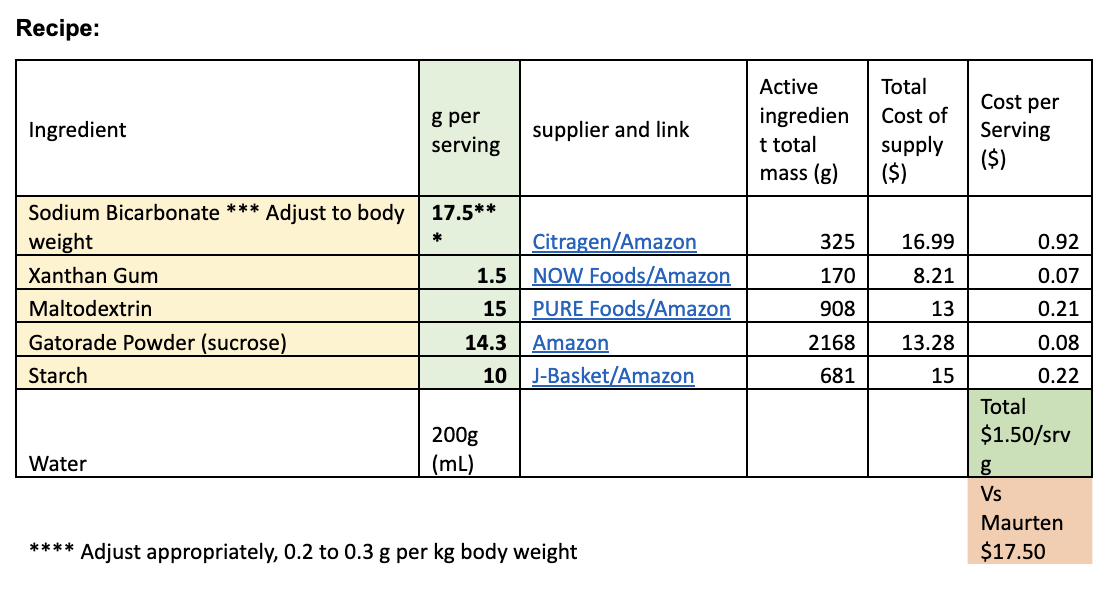
**** Adjust appropriately, 0.2 to 0.3 g per kg body weight
Links:
Instructions and Suggestions:
Prepare and take about 90-120 minutes prior to exercise. A small food scale is needed, but components could be weighed into a small container in advance.
Lightly crush or cut bicarb tablets into small chunks ~1/8 to 1/2 of original size (a butter knife or metal spoon). Unable to find a supplier with smaller tablets but this works and they just need to be small enough to swallow without discomfort. Discard any powder generated by this and weigh the chunks. Use 0.2g to 0.3 per kilogram body weight. For example, if I weigh 70 kilos, and want to take an intermediate dose of 0.25g per kg body weight I use 17.5 grams.
Prepare by mixing all components (besides bicarb and water) into a fine powder mixture. Add 200 mL water (6.76 fl oz), stir (or cap and shake) thoroughly until everything is dissolved. Wait at least 5 minutes to let gel thicken, it should be a “slurry” texture and a bit opaque.
Add bicarb tablet chunks, stirring in briefly just enough to evenly disperse them and you are not trying to dissolve
Consume either by trying to drink, or eating it with a spoon like cereal. DO NOT chew the bicarb tablets, simply swallow with the gel.
Experiment for yourself with when exactly you take it, first trying it while sitting around, then maybe before an easy run, then a lower end dose (0.2g/kg) prior to a workout to learn how it feels and figure out how to make it work best for you. Using for the first time before a race is risky. I’ve seen informal reports of maurten still causing some GI issues for some people and it’s a matter of learning to minimize these vs. benefits.
Experiences so far:
I have used this recipe three times prior to some speed sessions like more intense 400’s or 800’s and feel encouraged enough to try it in an indoor track race this season. It seemed to help in terms of continuing to feel sharp and a bit less like the legs are burning when pushing hard the last few reps. One of the three times I had mild-moderate GI symptoms, with no clear explanation why compared to the other two.
The gel component is a good mix of carbs that is a decent prerace / hard workout fuel in itself and absolutely does it’s job in delivering the bicarb. As a test I once took 25% the usual amount of bicarb when I was just sitting around, and GI issues were worse than the full dose with the gel while running hard. I have also spoken with folks who took bicarb (in baking soda dissolved in water) sans gel prior to racing the 800 or 1500 and they had terrible issues.
Some Additional Reading:
Overall Review on bicarb benefits:
Maurten’s bicarb system greatly reduces GI symptoms and increases blood pH at rest
Maurten Bicarb improved cycling performance with minimal GI symptoms
Detailed Comments about recipe and food chemistry if interested:
I chose the ingredients based on all the information I could get from Maurten and some additional reading. It’s impossible to know exactly what they use but we can make some very good guesses and end with something that works (majorly reduces GI symptoms vs straight bicarb).
Ingredient amounts can be inferred from the nutrition facts (composition of starch (complex carbs including maltodextrin), sugar, and the relative order of list of ingredients - if there’s more it is required to be listed first. The order changes between their products with different, known amounts of bicarb which helped inform the range.
Chose potato starch upon seeing a few things suggesting it may be more acid resistant and forms better hydrogels. Some of the food chemistry reading suggested a ratio of about 1 part Xanthan gum to 80 to 100 parts water, and this recipe reflects that. Starch and xanthan gum are the components that make the hydrogel. This is the part that I’m least certain about – Maurten may be using something even simpler, or maybe something much more sophisticated, but this works.
For a simple sugar, maurten has fructose. I chose Gatorade (sucrose and glucose) simply for flavor. It is rapidly broken down to fructose/glucose in the small intestine. I am inclined to think that the fructose in Maurten’s recipe is for flavor/carbs and is uninvolved in getting the gel texture.
The amount of sodium per se from the sodium bicarb is fairly high and likely no need for other electrolytes leading up to a workout/event.
Won’t go into it but the topical formulations of bicarb that you rub in seem to me to be not well supported or rooted in the realities of absorbable and sufficient doses through the skin.
Episode 111: Multisport vs. Single-Sport Focus, Long-Term Goal Mapping, and Norwegian Training Principles
In this week’s episode, we zoom out to talk long-term goal mapping, sparked by Katie revisiting an athlete questionnaire she filled out in 2017—and how goals like completing an Ironman or qualifying for the Boston Marathon quietly became reality through years of unsexy consistency. From there, we dig into our experiences with multisport training versus single-sport focus, sharing practical ways to use multisport to support durability, aerobic development, and time management while keeping the main goal the main thing during a focused training block or season. We also touch on lessons from the Norwegian Training Method, why consistency beats heroic workouts, how to interpret training data and fitness metrics with better context, and how to think critically about course demands using AI tools (including a deep dive into the Ironman Maine 70.3 bike course). If you’re thinking about long-term progression, balancing multisport with focused training, or building fitness that lasts for years, this episode is for you. Check it out!
Long term goal mapping
Quick thoughts on long term goal mapping – found an athlete info sheet I filled out in December of 2017 (!)
At the time my long term goals were: “Ironman someday! Marathon too, I want to qualify for Boston. Sub 1:30 threshold for swim.”
Lessons: sketch it out and you will achieve it! It could take one year or eight years or longer, but something about vocalizing your intentions seems to matter.
Also interesting: My 10K threshold pace then was around my (peak training / April) marathon pace now. How I got there? Unsexy consistency over time.
Multi-sport vs. single sport
Bit of background – Jim and I both trained as true triathletes for many years and are now more focused on one sport (running for me, cycling for Jim).
Some general thoughts/observations:
Going from multisport to single sport is often easier than the reverse because you don’t need to pick up on new technical skills. Learning good swim technique, cycling technique, or even running technique takes a long time.
Single sport focus is often easier from a time management perspective.
Even if you are a single sport athlete, I fundamentally believe that multisport is helpful for avoiding injury and being a generally more durable and well-rounded athlete. (And a more well-rounded human.)
Case in point: Even for pure runners, my marathon plans are conservative on mileage. I am not a huge fan of junk miles. Minimum effective dose with a ton of cross-training is what I have seen be most effective for avoiding injury.
Q for us both to riff on: how do we incorporate multisport when we are training for an event in a single sport?
Katie: Swim as a recovery day and “economical massage.” 40 mins tops (often shorter), lots of gear, HR in zone 1. X-training like bike, uphill treadmill, or stadiums on non-running days to build volume and durability (often paired with strength).
Jim: First, asking the question, what do I want to get out of cross training? I’m using various sports to advance my cycling goals:
Easy runs: 30’ - 45’ of Z1/Z2 light running, with or without hills, to accumulate easy aerobic time. This offloads some base building to running from the trainer as I find the trainer time to be very mentally taxing. If I can do an easy 30’ run in the morning and an afternoon 90’ bike workout, that’s a perfect combination for the cold winter months.
As a non-runner, super shoes allow me to run 3X per week with almost no biomechanical ill effects. (If I were running hard or doing intervals, this would take the power out of my legs during cycling.)
Strength and mobility: 4X - 5X per week combination of The Sculp Society which is body weight training and mobility usually combined with a couple of weighted exercises for 3 - 4 sets. For example, I’ll do hex bar squats and some shoulder presses after a 20’ body weight exercise or sometimes after a bike trainer session. I also rotate in the back extension machine into every workout - 4X - 5X per week to strengthen my back (my weak link). Body weight strength and mobility are also great for recovery.
Nordic skiing: In the early season, I’m using 45’ - 60’ easy, flattish nordic skiing to accumulate easy aerobic, base building like my easy runs. Again, I want to offload easy aerobic work outside and not on the trainer.
Hiking: Hopefully get in 1X - 2X days per month of multi-hour, easy aerobic winter hiking. These will substitute for a long, low intensity day on the bike.
As the winter progresses and hopefully conditions improve with more skiing terrain, I’ll substitute some of my trainer / interval time with longer, more intense skiing. If I can ski for 2 - 3 hours over rolling terrain, I’ll hit all training zones i.e., all intensities and big aerobic volume.
Broader Multi-Sport to Single-Sport Thoughts
Using the principle of the 10,000-hour rule, you'll progress faster toward sport nuance and mastery with a concentrated block of training, whether that's for one season or more. If you want to get good at something, you have to do that something. Keep the main thing the main thing.
As a single-sport athlete, it's easier to maintain a year-round fitness routine. Conversely, many multi-sport athletes detrain in one or two sports, as it's very difficult and logistically impossible to try to swim, for example, three times per week year-round. As time-crunched athletes, we simply don't have the time to maintain a swim/bike/run schedule year-round.
If you have long-term ambitions to be a competitive multi-sport athlete and you don't come from a cycling background, for example, you may want to spend a season diving into cycling training only and racing a few races to see how people who do this single sport train and race, their culture, etc. If you can become a pseudo-expert in the sport that limits you, you'll come back to multi-sport with better skills—often skills that many multi-sport athletes don't have or aren't aware of.
For example, some triathlons, such as the Boston Triathlon, have many U-turns on course. It's also very flat. For my athletes who have some experience with bike racing, I tell them to treat that course like a criterium or circuit race where you hammer out of corners. This is a very stochastic way of cycling, which is often antithetical to triathlon cycling, where you want to smooth out your power over the entire bike course.
Courses such as the 70.3 World Championships in Marbella or Nice really reward triathletes who know how to ride their bikes and have good climbing skills and are technical descenders. If you want to compete in those types of races, you really need to be very competent on your bike. Consider a season or two where you're racing your bike regularly.
If you're focusing on one sport only, you can more easily build habits and systems around that sport. If you're just running, for example, there's no need to maintain a gym membership to swim or maintain your bike or set up a pain cave. Simplicity rules the day.
If you decide to be "just" a runner or cyclist next season, your fitness gains—your aerobic and metabolic fitness—are transferable across all sports. Biomechanically, there's a lot of crossover between sports, but recognize that if, for example, you wanted to switch to trail/ultra running after a year or so of being a cyclist, you would need to gently ramp into run mileage to build up your biomechanical durability, as the specific biomechanical demands of running are quite different from cycling. However, all of your aerobic and metabolic fitness qualities would transfer over perfectly.
Why Norway Wins: The Real Principles Behind Arild Tveiten’s Revolution
Source: https://inakidelaparra.substack.com/p/why-norway-wins-the-real-principles
This summary captures key ideas from an interview with Arild Tveiten, the architect of Norway’s triathlon boom and one of the most influential endurance coaches in the world.
If you’re curious about the origins of the Norwegian Method—and how Norway went from zero international presence to producing world champions—this article offers valuable insight and practical principles you can apply to your own training.
Key Principles
1. Remove limits and excuses. Build systems.
Assume everything is possible when you eliminate self-imposed constraints.
“You don't rise to the level of your goals. You fall to the level of your systems.” - James Clear
See James Clear’s Atomic Habits to help you build new habits and systems.
2. Everything is possible with consistent work.
Show up on time, prepared, ready to execute—every day.
Consistency, week after week, month after month, is the real magic workout. Think compound interest.
3. Execution begins before the session starts.
Train a lot, mostly easy.
Understand the intention of each workout. Reading your TrainingPeaks plan is part of the execution.
4. Volume builds the base for everything.
Discipline controls intensity.
Volume exposes the body to more stimulus—and stimulus drives mitochondrial development and endurance capacity.
5. Threshold is a skill, not a sensation.
Chase consistency, not hero workouts.
Learn to find the balance point between sustainable and unsustainable effort—critical for long-course triathletes and runners.
Your FTP / run threshold number will vary based on many variables - stress, hydration, fueling, heat, etc - learn what threshold or subthreshold feels and adjust accordingly in your workouts. (see intention of workout #3)
6. Anyone can be a hero for a day. Champions repeat the basics.
A “Basic Week” is unsexy but powerful.
“Begin. Learn. Succeed. Then add complexity” - Seth Godin
7. Easy means easy. Hard means controlled.
Build athletes for 10 years, not 10 months.
8. Avoid early specialization and early selection.
Let kids be kids.
Almost all elite athletes started by playing many sports.
9. Awareness > Technology.
Use data, but trust your eyes.
(Related: #3 intention and #5 threshold is a skill)
10. The body speaks—if you know how to listen.
Create an environment that feels safe, supportive, and enjoyable.
Environment can be anything from a team environment to your internal dialogue and cultivated self-awareness.
Environment is a key component of goal mapping.
11. People thrive in trust, not fear.
Invest time before results appear.
12. Belief creates belief.
Make the process the identity. (Identity as a verb not a noun.)
“People like us do things like this.” — Seth Godin
Check out our Episode 51: Cultivating Self-Belief in Sport and Life
Final Thought
Love the daily work, not the medal.
Ironman Maine 70.3 bike course analysis
I have a number of athletes who do Maine 70.3 every year. As discussed in other podcasts, Maine’s bike course is considered one of the toughest on the Half Ironman circuit. We call these types of courses 70.3+ “plus”. They are out of the normal energy/training range of that race distance.
I wanted to do an analysis of what are the specific demands of this course so I took at GPX file and ran it through some AI to get the following analysis. It took a few iterations to get useful information and then I ran this by one of my athletes who does this course every year and he confirmed this felt about right.
The analysis: 2% grade threshold hill counts, categorized by estimated duration assuming 10 mph climbing speed:
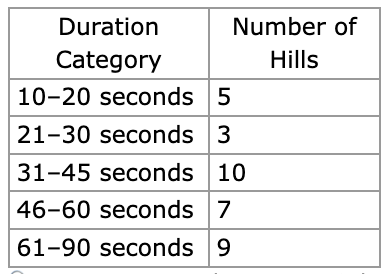
Notes on How These Were Calculated:
Smoothed grade using a 5-point rolling window to reduce GPS noise.
Any segment where grade ≥ 2% is considered “uphill.”
Segments are converted to time using 10 mph = 4.4704 m/s.
Continuous uphill points are grouped into one hill segment.
Interpretation for Training & Coaching
1. You have a LOT of short-to-mid hills on this course
The Maine 70.3 bike course is clearly "rollers-based,"
If the athlete rides faster (e.g., 16–20 mph on flatter rollers), the duration of these hills will shift downward but the pattern (a LOT of short rollers) remains.
2. This course rewards:
Local muscular endurance (LME)
High repeatability at sub-threshold efforts
Strong torque / low cadence strength
Fast recovery between surges
3. Training Implications
You’ll want to integrate:
30–60 second low-cadence climbs (60–70 rpm)
High-repetition Z3 “grinding” efforts
Over-unders that simulate cresting rollers
Neuromuscular torque work to handle repeated micro-bursts
This matches the terrain profile: constant undulation that taxes muscular durability more than VO₂max.
Go-To Swim Workouts
Every swimmer should have 2–3 reliable go-to workouts for days when time is short or when you get to the pool and just don’t feel like doing the prescribed session.
Below are my three favorites—simple, effective, and applicable year-round.
#1 — The Classic 100s Set
Option A: Aerobic Maintenance (Olympic / 70.3 Specific Period)
10 × 100 @ :10 rest
This is essentially a straight, steady 1000.
Use this during the Specific Period when you're dialed into maintaining easy aerobic pacing.
Option B: Two-Speed Repeat Set (Any Time of Year)
10 × 100 alternating: 1 easy / 1 threshold
@ :20 rest
A great two-speed workout you can use year-round.
If you add a warm-up that includes at least 4 × 25 fast, you end up with a three-zone session (easy, strong/threshold, peak). Perfect.
Optional Add-On:
If time allows, finish with 2–4 × 200 using paddles + buoy.
Effort stays easy, focusing on in-sport strength.
#2 — 500-Yard Pyramid (All Three Energy Systems)
This pyramid hits Low, High, and Peak efforts in one tidy package.
4 × 25 fast (Peak effort) :20–:30 rest
2 × 50 threshold to better-than-threshold (“strong”) :20 rest (High effort)
1 × 100 easy (Low effort)
2 × 50 threshold to better-than-threshold (“strong”) :20 rest (High effort)
4 × 25 fast (Peak effort) :20–:30 rest
Total = 500 yards per pyramid
Do 1–4 sets depending on available time.
Take 1–2 minutes rest between sets.
If you complete a short warm-up plus one pyramid, you’ve touched all three energy systems and completed an extremely time-efficient workout. This is a classic maintenance set—you won’t win any swim meets with it, but it keeps fitness sharp and gets you in and out quickly.
#3 — 10 × 50 Progressions
Early Base Period:
Alternate 1 drill / 1 freestyle, or swim 25 drill / 25 freestyle for all 10 × 50s.
Technique-focused.
Complete 2–4 sets.
Later Base or Specific Period:
Alternate 1 easy / 1 above threshold across the 10 × 50s.
Again, complete 2–4 sets depending on fitness and time.
No matter the situation, asking “How (fill in adjective here) can I be?” reminds me that I may not be able to change the situation - but I can always influence my internal dialogue and subsequent response.
I can always ask myself:
How calm can I be?
How kind can I be?
How focused can I be?
How brave can I be?
So this week, turn a hard moment into a testing ground. Maybe you’re running late, stuck in an impossibly slow line, grinding out the last rep of a workout, or sprinting between meetings. Ask yourself in that moment: How can I be?
You might be surprised by the options that open up. And by how much power a tiny bit of curiosity can give you in reclaiming mental control.
Challenge or Resource of the week:
Jim: Simple Practice to Improve Flexibility & Range of Motion | Dr. Kelly Starrett & Dr. Andrew Huberman
Katie: Get outside with a friend or family member during the holidays!
Gear pick of the week:
Katie: Patagonia Down Sweater Hoody
Jim: Men’s Boreal Fleece Tight or W's Aurora Fleece Tight
Episode 110: Building Systems and Habits for Your Basic Training Week
In this week’s episode, Katie and Jim start with some updated reflections on goal mapping and a common athlete question: what to do when no big goals are calling your name. Katie shares guidance on aligning training with purpose, taking unstructured time when needed, and exploring new modalities or distances instead of forcing an event. We then dive into the main topic: how to build a repeatable, low-friction Basic Week using principles from James Clear’s Atomic Habits to make training obvious, attractive, easy, and satisfying. We cover practical strategies for habit formation, systems that support consistency for time-crunched athletes, and why sustainable routines matter more than intensity. We also discuss winter training tools like uphill treadmill, how time off during the holidays can unexpectedly boost fitness, and why fitness metrics on Strava, TrainingPeaks, and Garmin should be interpreted cautiously. If you’re thinking about goal mapping, building habits, or creating a more reliable training structure heading into 2026, this episode offers a clear roadmap. Check it out!
A great listener question to follow up on goal mapping:
Katie - I’ve gotten a variation of this question from a few athletes so far: “I tried to sit down and do goal mapping, but there aren’t any goal races that are really standing out to me or calling my name right now. What should I do?”
(1) My advice is to not force yourself to sign up for something “just because.” Wait until you really feel called to an event, and sometimes that requires just going unstructured for a while with no major events on the calendar and seeing how that feels, or focusing on other goals in the meantime like getting into strength training or yoga. Take your time!
(2) It’s also helpful to think hard about the first question in goal mapping: what is my purpose in training and racing? (rather than immediately trying to pick an event or event(s))
If no goal events are immediately aligning with your purpose, then ask yourself if you can be in alignment with your purpose without a race. **Note: Not ALL years/seasons/etc. of movement have to have an event structuring them.**
Bonus question: what if I can’t decide on an event now and by the time I feel motivated to sign up, registration is closed?
My take: In the vast majority of cases (though admittedly not all cases), if an event is so hard to get into that you would have to sign up >9 months or longer in advance in order to do it, it’s probably something that you would have in the back of your mind for long enough that you wouldn’t be feeling like no races are calling your name (i.e. no one really has a same-day registration attitude for IMLP or the Boston Marathon!). There will always be events you can sign up for on a shorter time horizon!
Bonus approach: this often comes up when athletes have hit big PRs in big events and don’t necessarily want to just race the same thing again. Consider thinking outside of the box to try different modalities (e.g. a trail or ultra event instead of a road run), different distances (e.g. a 10-miler instead of a 10K or half, see e.g., the New England 10 miler series), or a destination race focused more on the travel/fun aspect of the course
And as always, talk to your coach! I’ve had great conversations with athletes where just reflecting back to them what they are saying with my coaching hat on has helped them come up with a plan (either a structured or intentionally unstructured one) for next year
Main content:
Today’s main topic revolves around helping you build a Basic Week and develop systems that keep it low friction, low stress and repeatable. A Basic Week is something you can do throughout the winter that builds a solid aerobic and strength foundation. For some people this is 5 hours, for others this is a 12-15 hour week. Either way, as everyone is a time crunched athlete, you need to make this week feel automatic. It’s what you do week after week with little thought or friction for logistics and planning.
The following four principles are pulled from James Clear’s book Atomic Habits. They are: Make it Obvious, Attractive, Easy and Satisfying.
1. Make it Obvious
Implementation: Commit to specific workout times and locations:
"I will swim at 6:00 AM on Tuesdays and Thursdays at the X pool"
"I will run at 5:30 PM on Mondays and Wednesdays from my front door"
What can make this even more obvious and easier is joining a Masters swim program or a weekly group run. Masters is at a set time and place so it hits Make it Obvious/Easy/Attractive (social)/Satisfying. (This is a take on the best workouts incorporate Joy, Health and Community.)
On Sunday’s I will look at my own schedule in TrainingPeaks - my master calendar - and not only put in workouts but at approximately what time I will do those workouts. I have a time with the name of the workout. For example, Tuesday “11am: 12 x 30’s 120% - 75%” (This is a bike trainer workout I can do inside or outside. Now when Tuesday rolls around I just hit play, no thinking about what to do when. It’s obvious. My thinking/planning was done on Sunday.
Another tactic is habit stacking: Link workouts to existing routines:
"After I drop the kids at school, I will go directly to the gym for my pool session"
"After my morning coffee, I will put on my running shoes and head out the door"
“When I watch TV in the evening, I will do some body weight exercises.”
Katie example in pregnancy: “I will hit my 20 minute hip mobility and diaphragmatic breathing routine as a precursor to every workout.”
Visual Cues: Set up your environment:
Lay out workout clothes the night before
Put bike shoes next to the trainer.
Set swim bag by the front door
Program workout reminders in their phone/watch. I’m constantly setting alarms on my phone to ensure I’m on schedule and accountable.
Example: My bike trainer set up in the pain cave has evolved over time to be a very easy, low friction set up. I use a dedicated indoor bike set up on the trainer. On the trainer I have my older bike computer that is only used indoors as switching bike computers from indoor to outdoor bikes is very timely and inconvenient. I have older shoes next to the bike trainer. I have two overbed medical tables sitting on either side of me that hold my old Ipad which runs TrainingPeaks Virtual and has a small Vornado fan. The other table holds a trainer HR chest strap, TV remote, water bottles, snacks and headbands / small towels. Placed right in front of the bike is a standing fan. I literally just walk up to the bike and everything I need (except my filled water bottles) is sitting right there. For me, I needed a set up that did not have me searching throughout the house for shoes, bike computer, HR monitor, etc. This took some time to build over the years as it does require owning duplicates of a number of items. This provides a great excuse to upgrade some of your gear this year (like a new bike computer) and use the old one for the trainer.
Example: A busy professional who struggles with morning workouts has their bike kit or run kit laid out on the bathroom counter, and set their coffee maker to auto-brew at 5:45 AM. When they wake up, every cue points toward the trainer or run session.
2. Make it Attractive
Temptation Bundling: Pair workouts with something they enjoy:
"I only listen to my favorite podcast or YouTube while on the bike trainer"
"I get to watch that Netflix show while doing an at home strength session"
"I get my favorite coffee drink after completing Saturday's long run"
“I go to my favorite bakery after swimming”
Join a Community: Connect Masters swim and/or local run/bike groups:
Attend weekly swim/bike/run groups
Find a training partner at your level
Reframe the Mindset: Think of workouts as opportunities, not obligations:
Instead of "I have to swim tomorrow," reframe as "I get to work on my weak discipline and see my friends at Masters"
"This trainer workout is making me a stronger cyclist" (See Goal Mapping)
Example: A new athlete who dislikes swimming alone might only allow themselves to listen to their favorite audiobook during swim sessions. Or meeting a friend at the pool, swimming transforms from a dreaded task to social time. In sum, we are social creatures and meant to work hard together. Find opportunities to join a group.
3. Make it Easy
Reduce Friction: Remove barriers to starting:
Keep bike on the trainer year-round (no setup required) or lots of good reviews such as the Zwift bike.
A home treadmill.
A few dumbbells or kettlebells and a pull-up bar or door frame TRX at home along with some resistance bands is enough for a quick, effective at-home strength session.
Have a dedicated gym bag that's always packed
Dedicated bags that have all your outdoor bike gear - shoes, helmet, sunglasses, bike computer, radar, vest, windbreakers, gloves, snacks.
Write out your workouts on an index card (if your memory is terrible like mine!)
The Two-Minute Rule: Make the starting ritual incredibly simple:
"I just need to put on my running shoes" (not "I need to run 5 miles")
"I just need to get in the pool" (not "I need to swim 2000 yards")
"I just need to sit on the bike" (not "I need to complete the full workout")
Positive self talk, “This will be fun! This will be awesome!”
*said ironically* “I’m Alive Alert Awake Enthusiastic!”
Start Small: Rather than jumping into your full training plan:
Week 1: Just 15-30 minutes per session to build the habit
Focus on consistency over volume initially
Gradually increase duration once the routine is established
Prime the Environment: Make bad habits hard:
Limit social media scrolling that eat into workout time
Or to bring it back to habit stacking – give yourself free rein to scroll social media once you sit down on the trainer (especially for WU/CD or recovery intervals)
Set "Do Not Disturb" during scheduled workout windows
Schedule training times with your spouse/partner/friend
Example: A parent struggling to find time could keep a fully-packed gym bag in the car. When they drop kids at practice, they immediately drive to the gym (already in workout clothes from home). The only decision is "do I walk into the gym?" not "do I go home, change, pack, and drive back out?"
4. Make it Satisfying
Immediate Rewards: Create instant gratification:
Check off workouts on a calendar (visual progress) or watch the box go green in TrainingPeaks.
Award yourself a treat after completing the workout (bakery after pool is the best!)
Use a habit tracker where you mark an X for each completed session
Track Progress: Visualize improvement:
Keep a training log / TrainingPeaks showing consistency over weeks
Comment on all your workouts so you can see improvement and insight. Reviewing your training after many weeks/months is super rewarding and you’ll be able to see how much you have progressed and learned.
Note: For both of the above, having a coach makes this even better – you get a comment back in response!
Celebrate PRs in training (fastest 100 in the pool, best trainer intervals, etc.)
Take monthly or every other month fitness tests. A simple test like a 2 x 10’ best effort run test is a low stress way to track your run progress.
Never Miss Twice: Build resilience into the system:
Use “exercise snacks” (15’ - 30’ runs/bikes) for chaotic days
Missing one workout isn't failure—that’s life. Missing several days in a row because of poor scheduling is a red flag to shore up your habits/systems.
Goal Reinforcement: Connect actions to your goal mapping:
"I train early in the morning because I have a personal contract with myself to reach my goals"
Display race number/medal somewhere visible. This sends a message to yourself that “people like us do things like this”.
Enlist the help of your support network. They want to see you succeed.
Example: Create a simple paper calendar on your fridge. Every completed workout gets a big red X. After two weeks of consistency, you can see the visual chain of X's and won't want to break it. You could add: "After 4 weeks of perfect attendance, reward myself with new race/training gear."
Practical Application : Combine all four principles as you start your Basic Week:
Week 1-4 Focus: Habit establishment (not fitness)
Choose exact times and locations (Obvious)
Join the squad or find a training partner (Attractive)
Keep sessions to 20-30 minutes (Easy)
Use a tracking system and celebrate completion (Satisfying)
Key takeaway: During early weeks, prioritize showing up over hitting pace/power targets. Completing an "easy" 20-minute Zone 2 run is more successful than one who attempts a 60-minute tempo run and quits halfway through or doesn’t do it at all. You're building systems that will eventually support bigger training loads.
Katie on consistency – a banger from Steve Magness as a follow-up to our conversation about habits, discussing characteristics of high performers:
“Consistency over short-term intensity: We love the story of the heroic effort. The Strava workout or all-nighter. But the best performers resist the allure unless it’s necessary. They know that shooting for heroic efforts all the time is a recipe for burnout. Instead of swinging for home runs every day, they just put the ball in play. They focus on stacking good work week after week, month after month. They understand that compounding interest applies to performance just as much as it does to finance. A B+ effort repeated for a year beats an A+ effort that lasts a week. This means they accept the non-linear nature of progress. They don’t get addicted to seeing visible results every single day. They are willing to endure the long, boring plateaus where the work is unsexy but essential. They trust that consistency will eventually crack the stone.”
A great goal for 2026 is consistency, and making consistency sustainable involves building a repeatable basic week.
Katie - uphill treadmill
My latest craze! Aka I have done 2x uphill TM sessions on strength days recently. 20-30 minutes, 15% grade, 3 mph hike.
Takeaways:
Back to habits - I like it a lot better than Peloton as it’s more frictionless to just hop on the treadmill before or after strength when I am already at the gym, in the same gear, already sweaty. It feels harder to motivate to get on the peloton later in the day at home, when that involves bike shorts, peloton shoes, change in location, and re-motivating for a second workout.
Quite the burner! Targets glutes, hamstrings, calves, and even core.
Feels cool to do something new – I am less in tune to what it “should” feel like, whereas biking sometimes feels much worse than usual (1) anatomically (diaphragm is kind of squished) and (2) in comparison to pre-pregnancy metrics (power, overall time, HR, etc.)
Given much lower impact forces relative to flat/downhill running, this could be a way to get back into a run-adjacent training modality postpartum sooner than I am ready for true flat/downhill running – especially given possible bone health concerns
Nice choice for the winter when I am generally walking around less in daily life/outside etc.
How to incorporate it:
As a standalone workout/ exercise snack
As an easy, lower-impact double
Scale difficulty by changing speed or incline
For more on uphill TM, check out David Roche: “The Training Theory Of Uphill Treadmill Doubles.” Some useful takeaways from that article:
Less is more: “Treadhills provide a strong aerobic stimulus, but they don’t need to be too long. Past 30 to 40 minutes, there is a possibility that some of the adaptation benefits of doubles are reduced by increased breakdown. There is a razor-thin margin between overtraining and optimal training with these more complex additions to a plan.”
Jim - Holidays
I recently returned from Paris, France, where I took six full days off from aerobic training. I did one bodyweight strength session and spent a lot of time walking and on my feet.
When I looked at TrainingPeaks, it showed a big drop in “fitness,” but the reality was very different. Three days after returning, I did an FTP test and came close to my all-time best. Training + rest/recovery = growth.
I also came back with renewed mental energy, ready for a big training block, and fully recovered from the previous 6–8 weeks of work.
Key takeaway: Holidays often disrupt structured training—and that’s OK. In many cases, that downtime ends up benefiting you in the months ahead.
Katie: And reminder that TrainingPeaks or Strava “fitness” metrics do a very poor job of capturing your actual fitness. Case study of recent-ish fitness numbers over time for me:
Sea to Summit July 2024: Fitness was “92” in Strava
Marathon in April 2025: Fitness was “75” in Strava
Right now, 8 months pregnant: Fitness is “29” in Strava
But none of these are directly comparable because they reflect completely different goals (back to goal mapping!!). Fitness numbers are biased in terms of volume, and for S2S I was training heavy volume on trails + tons of swim/bike. That set me up really well to have a great race there. In April of this year, I pivoted to mainly running with just a few x-train sessions per week (and strength, which we know is not captured accurately at all in fitness numbers). I was WAY faster at marathon running in April 2025 than July 2024 and probably couldn’t have actually raced a road marathon in July 2024 without getting injured. Finally, looking at pregnancy numbers, there is a fraction of the fitness that there was before, but I am somehow still able to hit 25ish miles/week at 8 months pregnant, one long run, one speed workout, etc., while growing an actual human (which I am arguably more proud of than the race results).
So don’t panic if your fitness numbers drop after time off. They are kind of bullshit anyway!
Challenge of the week
Jim: Find your friction points to your Basic Week and build systems to fix them.
Katie: Try out something new like uphill treadmill!
Gear pick of the week:
A few stocking stuffers from past Gear Picks of Week:
Darn Tough Men's Fastpack Micro Crew Lightweight Hiking Sock
Skida - headbands and hats
Bivo - stainless steel water bottles
LL Bean Boat and Tote®, Open-Top - build your systems with gear bags for each sport
Episode 109: Getting Back Into Training, Turkey Trot Takeaways, and Mental Prep for Time Off
In this week’s episode, Elena shares insights from the very beginning of her return to structured training after a true three-month off-season, including what’s helping her rebuild consistency, how she’s thinking about early Boston Marathon goals, and why maintaining joy in her routine matters so much. We then shift to Katie’s turkey trot 5K at eight months pregnant: why she decided to race, how she approached a hilly, unfamiliar course at a “smooth tempo” pace, and what she learned about managing her competitive side, listening to feel over data, and reframing expectations while running in pregnancy. We close with a listener question on mental health, postpartum recovery, and movement during any planned time off, along with Katie’s framework for setting realistic expectations, maintaining identity, and focusing on a healthy long-term return to sport. Check it out!
Links we mentioned:
Episode 36: Finding Balance with Lifelong Athlete and Executive Coach Laura Fay
Challenge of the week
Katie: Set a recurring calendar reminder for something like mobility work at the time of day you’re most likely to do it - have been doing this for the Three Balances in pregnancy
Elena: Add a treat into your morning routine
Gear pick of the week
Katie: Nike ¼ zip running top - good for layering over a short or long sleeved shirt in cold-ish weather
Elena: Cuddl Duds base layer
Episode 108: Goal Mapping for 2026!
Happy Thanksgiving! With the end of the year fast approaching and a new season on the horizon, this week’s episode features a deep dive on goal mapping! We recap what goal mapping is, explain why it’s a great starting point for your next season, go through all of the questions we like to ask our athletes as they map out their goals, and share some thoughts on why the inherent vulnerability in goal mapping can be scary. We then share some thoughts on our own goal maps for 2026, including Jim’s plan to cycle the Haute Route in France in August and Katie’s ideas on returning to sport postpartum. Whether your goals for next year are big, small, or still to be decided, this episode is for you! Check it out.
Main content:
Why do we do goal mapping? Many reasons:
Mapping out goals and the steps needed to get there can help you realize whether your goals are realistic/smart given competing demands on your energy, time, etc.
Mapping out goals can give you a strong “why” that helps when you don’t want to get out of bed at 5am in February to get to the pool
Mapping out goals can help you plan how many and what type of events to incorporate in your season, as most events are ideally in alignment with your goals (or at least not working against them – if you have an Ironman performance goal, don’t race a marathon one week before Ironman!)
Mental prep: from day 1, you can visualize what success looks like
Performance is at least a six months (or often times, years) process. If you have specific performance goals, these should be aligned with yourself and your coach by December / January.
Katie - this is why I don’t plan to have any A races until >9 mos PP, and am open to changing that based on how recovery timeline goes (more on that later)
How we do goal mapping:
Start with post-season evaluation questions (go through below)
Then, goal mapping exercise
Partners in goal mapping: your coach, your village (family + close friends, others who will support your journey; sometimes, colleagues/work)
Disclaimer: goal mapping is vulnerable! It’s scary to put big goals out there because if they are situated at the right level of difficulty, there is always a possibility of not hitting them. Key reminder: “big goals, loosely held”
Your identity can not rest on the achievement of an outcome goal because outcome goals are in some ways out of your control. Process goals are in your control!
POST-SEASON EVALUATION QUESTIONS
These questions can help you determine which races/objectives to target next year!
What are you most proud of about your season?
What did you enjoy most about your season?
Reflecting on your season, what were the biggest challenges you encountered?
What about this season do you want to do differently next season?
What about this season do you want to do the same next season?
GOAL MAPPING EXERCISE
What is your PURPOSE in training and/or racing? What drives you or motivates you to keep getting out there?
What is/are your OUTCOME GOAL(S)? Breaking this down further…
WIG -- Wildly Impressive Goal (“A Goal,” example: qualify for Kona):
WAG -- Wildly Achievable Goal (“B Goal,” example: beat PB in IM):
WOG -- Wildly Obvious Goal (“C Goal,” example: finish IM):
Questions to ask yourself as you brainstorm these outcome goals:
Why this goal now?
What is about this goal that’s important to you? What does this goal mean to you?
Is this goal internally or externally driven?
Note: Be as specific as possible in outlining your outcome goals! And remember: big outcome goals are there, and they can be important to acknowledge, but they should not be the focus. Consider both the process goals and the goal achievement strategies (below) as the most optimal to focus on, with the purpose being the gas that drives that car.
What is/are your PROCESS GOALS? What are the steps you need to follow in order to achieve your outcome goals? (Example: swim 2x per week; foam roll every night; 3 meals and 3 snacks per day in heavy training; meet with a therapist; etc.)
Swim:
Bike:
Run:
Strength:
Recovery:
Fueling/Hydration:
Mindset:
Other:
What BARRIERS do you foresee in following through on your process goals? Consider barriers that held you back this season as well as foreseeable barriers in the next season. (Example: pool hours conflicting with work schedule; commitments with family or kids; fear of cycling alone; struggle to prioritize good fueling on busy days; etc.)
What are your GOAL ACHIEVEMENT STRATEGIES? These should address both enacting process goals and overcoming barriers to following through on these goals. Also consider how often you can commit to following through on each of your goal achievement strategies, and write this out. (Example: >8 hours in bed minimum 5 out of 7 nights per week; breathwork 5 mins per day, 7 days per week; etc.)
Physical:
Mental:
Identify any NEED-TO-HAVES to make achieving your goals possible. (Example: people in your support network and their specific role; get a smart trainer and TT bike; honest and direct communication with coach; etc.)
Jim’s 2026 Goal Mapping & Personal Training Contract
Why did I write this?
As soon as I signed up for the Haute Route—the first major event I’ve committed to in years—my Identity Athlete started to surface, bringing with it shades of Obsessive Passion. My overarching aim is to blend high-level personal performance with exploration, curiosity, support, and sports mastery—anchoring myself in Harmonious Passion.
Short video: Steve Magness Obsessive vs Harmonious Passion
(For more on Obsessive vs Harmonious Passion, check out The Passion Paradox by Steve Magness and Brad Stulberg.)
What specific and general goals do I have for the Haute Route? (Process and Outcome goals)
* Arrive in excellent, personal-best cycling fitness.
* Race my race, not others.
* Enjoy the event and the camaraderie of fellow passionate cyclists.
* To fully express my endurance drive and character through the act and art of cycling.
* Learn the terrain and logistics to support future trips to ride more major European climbs.
* Arrive in Europe knowing I’ve consistently put my best foot forward every day since November 2025.
* Answer the question: Can I reach the same cycling performance and FTP I had ten years ago? What is my 58-year-old body capable of? (Purpose)
* Gain additional cycling-specific knowledge to become a better endurance coach. (Purpose)
What specific performance goals do I want to reach by August 2026 / the Haute Route?
* Achieve an FTP between ‘X-Y’ watts.
* Make riding at ‘A-B’ watts (Lower Threshold Power - LTP) feel sustainable and firmly high-Z2 aerobic.
* Be comfortable riding in large groups.
What key events or workouts do I need to achieve these goals? (GOAL ACHIEVEMENT STRATEGIES)
* Bike camp in March with focus on climbing.
* April Mallorca bike training camp with a focus on extensive climbing and low-cadence work.
* At least two three-day training camps in June and July with 80–100 miles / 10,000 ft of climbing per day.
* Maintain 13–15 hours/week on the bike as a “Basic Week” through winter; increase to 15–20 hours/week in spring and summer.
* Primarily reference and follow an Xert training plan.
Is there additional equipment I need? (Need-to-Haves)
* Probably not. The plan is to ride the R5 (my current bike) with the current wheel set during the Haute Route.
* Check with previous participants for any gear they found helpful or essential.
Is there specific training or knowledge I need to meet these goals?
* Talk with others who have completed the event to learn about the mental and physical demands.
* Watch Haute Route YouTube videos for insights on gear, training, and the overall experience.
* (This is a good checkpoint to evaluate whether hiring a coach would help.)
Are there specific requests I need to make of my family and social network?
* Inform my family of the long-term goal and the time commitment required to achieve it.
* Ask friends to support my training, especially for long-volume days and training camps.
What am I willing to do to achieve my goal? GOAL ACHIEVEMENT STRATEGIES
* Complete monthly FTP tests and periodic power-profiling best efforts.
* Do strength and mobility work 4–5 times per week.
* Wake up early to train on busy days.
* Go out in the cold nearly every day to accumulate bike volume and complete hard workouts.
* Spend meaningful time on the indoor trainer to adapt my legs for high-quality work when outdoor riding isn’t possible.
* Repeat my “Basic Winter Bike Week” week after week from November through April.
* To fully believe that I am capable of achieving my goals. My mental mindset is success and unwavering confidence.
What activities or behaviors do I want to avoid?
* Disrupting or rescheduling family events to accommodate training.
* Becoming so rigid with the training plan that I skip social opportunities. When choosing between a proper workout and a once-a-week (or more) social ride with friends, I will choose the social ride.
* Obsessively relying on data. Instead of validating a workout only through metrics, I will focus on whether I put my best foot forward. Execute and honor the day as you feel, not only as the plan dictates.
* Becoming an identity-driven athlete. I will cultivate a “Love of the Sport” mindset rather than a performance-driven identity.
Katie:
Quick thoughts on goal mapping during pregnancy - bit of a weird year as there is a lot that is unpredictable about birth experience/recovery, baby needs, and what life will generally feel like as a new mom. However, that doesn’t mean that I can’t have goals and goal map! Things I am thinking about now:
Purpose in training/racing - joy! Identity! Having something for me! And not necessarily at the expense of performance, but performance is not the only (or primary) driving factor.
Realistic constraints on my time with a new baby - can’t disappear for 6 hours to ride my bike
Realistic constraints on my environment - I live in a city, and the easiest option is running out the door or doing strength/Zwift at home
Goals - return to sport safely and, eventually, feel like “me” in running (which may or may not mean the same paces/performances!)
Long term goal - marathon next fall, but note I am not committing to any big goals before that so I can honor the recovery process
Challenge or Resource of the week:
Jim: If you are looking to change habits leading into 2026, check out Atomic Habits by James Clear
Katie: Goal map!!! Do it!
Gear pick of the week:
Katie: Jolyn swim top and TYR bottom for my pregnant swim era
Jim: Bob's Red Mill Gluten Free Protein Oats - Don’t sleep on oats! Massive protein and carbs.
Episode 107: Committing to the Off Season, Imposter Syndrome, and Running in Pregnancy
We did a deep dive on a bunch of interesting topics in this episode! Katie and Elena trade insights and questions on: how to make outdoor training bearable now that it's very dark and cold out; Elena's takeaways from committing to a true three-month off season for the first time ever; life lessons from Elena's coaching experience at the Girls on the Run 5K; imposter syndrome at big races and in life; and Katie's extended thoughts thoughts on running in pregnancy now that she is nearly eight months along and still hitting consistent mileage. We also cover some fun challenges of the week related to meditation and gratitude and share our practical (and fashionable?!) gear picks. Check it out!
Challenge of the Week
Katie: Gratitude practice!
Elena: 10 min morning meditation
Gear Pick of the Week
Katie: Reebok Nano X5 - lifting shoes
Elena: Fenix Headlamp
Episode 106: 70.3 World Champs, Off-Season Reminders, and Indoor Trainer Cycling Tips
This week's episode hits a bunch of fun topics including: insights from our athletes and the pros at the Ironman 70.3 World Championships in Marbella, Spain; thoughts on how to get back in multisport training if you have been focusing on a single sport for a while; off-season reminders, including how to balance lack of structure with a smart progression of volume and intensity; indoor trainer tips for cycling; Jim’s new mobility and strength routine; and “chocolate chip cookie” training. We also preview the Triathlon Academy, an entry-level coaching option for members of the Endurance Drive community, and hit some fun fashion-inspired gear picks of the week. Check it out!
Katie:
Insights from 70.3 world champs
Insights from the pros:
Once again, IM/70.3 is a run race – see both men and women winners
LOVE the redemption that Lucy and Taylor brought to race day. Amazing to see them basically race an entire Kona and then execute on this race just a few weeks later.
Rare finish for the men with a sprint, but shows it does matter to be fast at the end!
“Ready is a decision, not a feeling”
Love this! If you wait to feel ready you will probably never feel ready. Repeat to yourself “I am ready” and the performance follows
Two arrows analogy in practice: One of my athletes got a bike mechanical (dropped chain) and recovered it almost immediately / didn’t let it affect the rest of her race. We love this!
And a fun fact: the men’s WINNER who had a sprint finish with KB to win the title crashed early on in the bike, had a mechanical, and recovered it! From his post race interview: “It was my own fault. I just went too fast through that corner. I had no idea we had to go right so I just slid out and went under the barrier. I got stuck a bit and my right TT extension was sort of across this way so I had to ride with it like that. And then the casing on my rear derailleur cage was also bent a bit which meant I couldn’t go into my smallest gearing. So I stopped at the end of the first climb to bend it back and luckily it felt good from there on. But my hip was hurting quite a bit at the start of the run and it took me a little bit to get into it but once I did, I felt really strong actually.”
Another athlete’s insights on bike course:
Practiced all bikes on a course she simulated nearby at home - was super prepared for the climbs and descents, unlike some other riders. For some technical bike courses, it REALLY matters to be a good bike handler. It seems like more and more of these races are becoming quite technical, especially in Europe, so it pays to invest in good bike handling skills.
Amazing negative split on the run —> “Could I have gone faster on the bike?”
My response is almost always “probably, but we never know where the ‘line’ is between nailing it and blowing up. You could be 3 feet away or 3 millimeters away. I prefer to err on the side of slightly easier on the bike, especially long/hard bikes like this one, for your fastest overall time.”
My thoughts on getting back into swimming and biking after abandoning both a couple of months ago in pregnancy
The why: I can still run pretty well! But I know I will likely be able to get back into biking/swimming sooner than I can get back into running, so I want to re-introduce that as part of my routine now.
Also a better fit as the weather gets less nice to run outside
Swim: Start small! 30 minutes, easy technique, no pressure; use gear like fins, paddles and buoy, etc.
Bike: Peloton was quite the adjustment! Picked an easy class, second workout of the day (i.e. very low pressure / doesn’t matter, especially when there’s potential for time wasted troubleshooting), fun music
General: Stop before you’re gassed so you end on a high note; hen in doubt, less data
Mindset: win is getting wet or win is clipping in
Jim:
A Few Off-Season Reminders
When you head out the door this time of year, your primary goal should be simple: keep it light and have fun.
Have a loose plan, but be willing to modify it as you tune into your body’s energy. For example, the other weekend I set out with my mountain bike and a small backpack full of food, hydration, running shoes, and a few warm layers. My plan was to ride for about an hour to a trailhead, run up a mid-sized mountain, and then ride back to the car.
Within the first 20–30 minutes, I realized my ambition level didn’t match my energy level. I ended up adjusting my ride and run plans four different times before finally settling on a version that matched how I felt that day. It was colder than expected, too. By aligning my daily goals with both my energy and the environmental conditions, I turned what could have been a frustrating day into a great one.
In short: have a plan, but feel free to modify the heck out of it!
Layer Up More Than You Think You Need
For longer outings—say anything over two hours—bring more warm layers than you think you’ll need. This can be as simple as an extra wind shell, a dry shirt, and gloves or a hat/headband. The shorter days and lower sun angle this time of year can make temperatures drop quickly. One hour you’re biking or hiking in warm sunshine, and the next you’re chilled in the shadows of the hills.
Keep November (and Maybe December) Relaxed
Use November—and possibly December—as a mentally and physically relaxed phase of training. That might simply mean lowering the pressure and giving yourself permission to go easier.
January 1 will be here soon enough, and with it comes the focused intensity and volume needed to prepare for 2026 races and events.
Practical Guidelines for Triathletes:
Aim for 2–3 easy rides per week, with a few short hard pickups (20–30 seconds).
Run 2–3 times per week for 30–60 minutes. Even a light 20-minute run helps maintain readiness for longer sessions later.
Don’t underestimate the value of frequent, easy 20–30 minute runs — they add up.
If you feel like swimming, great. If not, it can wait until the new year.
For Cyclists:
Focus on plenty of Zone 1 / Zone 2 riding, 3–5 times per week.
Avoid diving into VO₂ max intervals too early but don’t be afraid to put out some effort in Zwift/TPV or hills 1 - 2X per week for short bursts.
Maybe jump into a Zwift race for fun and some organic high-end aerobic work.
Good segway into a listener question: I’m recovering from an injury I got in the off season partially because of inconsistency in volume and intensity; some weeks I would do very little running or biking because I was traveling or doing other active things and then some weeks I would have more time and excitement and do bigger adventure type workouts, and ended up getting injured (largely from running and biking). My recovery has involved structured / planned workout volume and increasing the overtime, so the second part of my off season has actually had a lot of structure. I’ve heard you talk about lack of training plan being good in the off season, leaving flexibility for adventures and different levels (or types of activity). How can an athlete think about balancing both the flexibility and lack of structure and varied types of adventures in the off season with ensuring that variation doesn’t cause issues because the body isn’t used to it?
Winter cycling trainer tips
Now’s a good time to organize your winter training setup. I just went through my annual ritual of reconnecting my trainer, virtual training software, and devices.
Somehow, every year this takes a few hours longer than I expect. This time, nothing connected properly to my older trainer—again—so I ended up syncing TrainingPeaks Virtual to my iPad, which was not on my 2025 bingo card.
My trainer ride progression has been:
1st trainer ride - all kinds of technical problems. Really hard to push any watts.
2nd trainer ride - connected to iPad, power meter broke, low Z1 felt like Z3. Effort feels like two zones higher. Patience with getting your trainer legs.
3rd trainer ride - watts were up 20 - 30, more comfortable getting into my low Z2 zone
4th trainer ride - watts leveled off at 3rd trainer ride level. But feeling a little more comfortable on the trainer
5th trainer ride - Tempo-threshold workout:
Pro tip: Don’t try to set up your trainer and virtual software right before your first workout. It will likely end in screaming, tears, or both! Set aside time to get it all dialed in when you’re not rushing to train. (I ignore this advice every year.)
Why does indoor training feel so much harder than outdoors?
1. Cooling and Heat Dissipation
Indoors, your body can’t shed heat efficiently:
Outside, airflow massively increases convective cooling. 80% of our energy produced is heat. Humans are very inefficient!
Indoors, even with a fan, you’re still steeped in your own heat.
As core temperature rises, your body diverts blood to the skin for cooling — meaning less oxygenated blood for your working muscles.
Result: higher heart rate, perceived effort, and sometimes lower power for the same “feel.”
Fix: Use multiple high-flow fans — one head-on and one angled from the side — and open windows or use a venting setup if possible.
I use an economical floor fan for my front and a smaller table fan for my side. Good fans will fundamentally change your trainer experience.
Fix: Expect about 3–8 % lower sustainable power indoors. You can adjust your Threshold Power in TrainingPeaks (and/or Zwift) at least for the first 2 - 4 weeks then re-evaluate.
2. Lack of Micro-Rest
Outside, your effort naturally varies:
You coast downhill. I coast, on average, 10-15% of my ride time. That is A LOT of rest and recovery.
You soft-pedal into turns or might use the draft of another rider(s).
You stand or shift weight subtly to handle the bike.
Indoors, it’s constant tension and grind — no coasting, no micro-breaks.
That “steady grind” means your neuromuscular fatigue builds faster, especially in the quads and hip flexors.
Fix: Spin light between intervals, stand up 10–15 seconds every few minutes, or slightly vary cadence.
3. Reduced Mechanical Efficiency
Indoors, the bike is fixed — no balance, no forward motion, limited upper-body engagement.
You lose some of the elastic energy return and small stabilizing muscle recruitment that aid efficiency outdoors.
The “locked-in” position can also increase local muscular fatigue, especially in the glutes and lower back. The trainer requires more engagement through the pedal cycle.
Fix: Periodically get out of the saddle or change hand positions to mimic natural movement. I like to move from the tops, to the hoods to the drop bars regularly. I will stand up for a 10”+ every 5’ - 10’. There is no glory in just sitting completely still on your trainer. Find a routine that will make the trainer experience sustainable for the winter.
For longer trainer rides, I get off every 1 hour to use the bathroom, refill a bottle, get another snack. A 5’ break every hour will really help the long rides feel manageable.
4. Psychological Factors
No wind, no beautiful scenery, no terrain = less sensory stimulation.
Your brain interprets that monotony as higher effort for the same output — it’s pure perception of effort (RPE) science.
Fix: Use engaging visuals (e.g., Zwift, TrainingPeaks Virtual, race footage) or structure intervals with clear micro-goals every 2–3 min. Or watch your favorite TV shows. Trainers are great for binge watching.
5. Trainer Calibration
Smart trainers can slightly over- or under-report power depending on setup and calibration.
Fix: Calibrate your trainer and/or power meter before each session.
I use my power meter as the power source when on TPV or Zwift and not the trainer.
If you have ever raced in Zwift, you will find out just how many trainers out there are not calibrated. In other words, you are NOT the worst bike rider in the world but rather over 50% of the field has an uncalibrated trainer which makes them faster than Tadej Pogacar.
Mobility & Bodyweight Strength — My New Routine
Lately, I’ve started a new near-daily routine with Carrie using The Sculpt Society app. The lead instructor, Megan Roup, is a fitness trainer, entrepreneur, and former dancer — and I’ve been surprised by how much I enjoy these light, efficient workouts.
Here’s why they’ve become a regular part of my training:
1. Super Convenient and Efficient
You can do the workouts right at home. The beginner sessions are around 20 minutes, with optional 10–15 minute stretch sessions that fit easily into a busy day.
2. Smart Progression
The beginner program starts easy and gradually builds in difficulty week by week — following the principle of progressive overload.
3. Gentle but Challenging
Don’t be fooled by the simplicity — you’ll definitely feel the burn, especially during the arm/shoulder warm-up and all the hip/glute work.
4. Fantastic Movement Prep or Standalone Session
You finish feeling engaged, primed, and alert. It’s perfect as a standalone mobility and strength session, or as a warm-up before running, cycling, or heavier strength training.
I never thought I’d be doing this kind of workout — but here we are, and I’m loving it.
I talk about mobility and strength all the time with my athletes (especially Masters athletes), but I’ve always struggled to make it a consistent part of my own schedule. This program has changed that.
Mobility truly gives you years of your life back. In endurance sports, we often move in the same planes for decades. These sessions are helping me move outside those planes, building a more balanced, healthy, and mobile body.
No one over 40 has ever said they’re too mobile or too strong — and this is a great reminder why.
Chocolate Chip Cookie Training
I stole this idea from Jessie Diggins when asked if she was able to determine the training magic when she trained with the Norwegians. She said all training is more or less the same.
Training is like making chocolate chip cookies — the main ingredients are always the same. No matter who makes them, you know you’re eating a chocolate chip cookie.
Think about the basic ingredients:
Flour
Butter
Sugar
Chocolate chips
Training works the same way. The key ingredients are:
Consistency – showing up nearly every day
Time – showing up nearly every day for months and years, not just days and weeks
Volume – doing enough training to meet the demands of your event and your goals
Patience – understanding that progress comes from sustained effort over months and years
Sure, some chocolate chip cookies have sea salt, a splash of vanilla, or a secret spice. There are slight variations in how you bake them — but in the end, it’s still a cookie you recognize.
Ad: The Triathlon Academy
What It Is
The Triathlon Academy is designed for athletes who want to train with The Endurance Drive but may not be ready for full one-on-one coaching.
It incorporates our “best of” workouts and proven training practices. You’ll receive structured weekly and monthly plans to help you build triathlon skills and a solid fitness foundation.
Support
I’ll be available through TrainingPeaks and email for guidance and feedback. If we have enough participants, we’ll also host a monthly Zoom call for additional Q&A and community connection.
Who It’s For
The Triathlon Academy is geared primarily toward athletes beginning their endurance journey—especially those training for Sprint and Olympic-distance races. While it’s mostly short-course focused, I do offer a 70.3 (Half Ironman) option. It’s probably not suited for full Ironman-distance training.
How It Differs from One-on-One Coaching
The main difference between one-on-one coaching and The Triathlon Academy is the level of individualization.
One-on-one coaching is highly customized and involves regular, hands-on feedback tailored to your unique goals and lifestyle.
The Triathlon Academy offers a structured, yet generalized plan—still rooted in The Endurance Drive methodology, but designed for independent athletes.
Challenge of the week:
Jim: Keep your activities light and fun in November and December.
Katie: If you’ve been out of the pool… get in for 30 minutes!
Gear pick of the week:
Katie: Lululemon yoga mat for mobility and strength @ home
Jim: Best biking base layer I’ve ever used: Uniqlo Cashmere Turtleneck sweater
Episode 105: Balancing Family, Career, and Sport as a Parent-Athlete
In this week's episode, we asked some of our most inspiring community members to tell us how they make training work alongside busy family and professional lives. We were blown away by the rich insights that came back, including tips on early morning workouts, run commutes, calendar blocks, stroller jogs, home gym setups, and how to effectively tag-team with your partner when both of you want to get some movement in. Our parent-athletes also opened up about how their mindsets have evolved since becoming parents—reframing training as self-care, identity, and connection—and how that shift helps them show up more fully for the people they love, without letting go of big athletic goals. Whether you're a parent-athlete yourself, thinking about starting a family, or just looking for better balance in a busy life, this episode is for you. Check it out!
Favorite gear/resources/etc. for parent-athletes
“A great babysitter!”
Home gym setups:
“2) Home training set-up that you actually enjoy. This both cuts out any travel time to gym, and also lets you workout while kids are napping.”
“For me, the best ‘gear’ is anything that helps save time or make training fit more smoothly around family life. My indoor trainer is probably the most valuable tool I have. It lets me get quality bike sessions done early in the morning without leaving the house.”
“I also rely heavily on my watch and TrainingPeaks to plan efficiently, so I can make quick adjustments when family or work schedules change.”
“Beyond that, I’d say my real ‘resource’ is routine and mindset. Having a clear plan and realistic expectations keeps things sustainable. It’s not about having the perfect setup, it’s about having the right tools to make the most of the time you do have.”
“Treadmill so you can still train while they are sleeping.”
“An eye mask and red lights - one of you will be up during the nights for a while. Using red light really helps me not fully wake up while changing diapers so that I get back to sleep faster. And an eye mask really helps me to stay asleep when my wife is tending to the baby.”
Baby bjorn: “And don't knock the classic Baby Bjorn! I did everything from mow the lawn to vacuum the house to go walking with friends to out for cocktails with baby onboard! (no judgment - both of my children avoided catastrophe in all those scenarios). Babies are mobile - take advantage of that as much as possible! They won't break. ;)”
Our gear picks of the week:
Katie: KT tape for pregnant belly!
Elena:
Notes app– but curious to learn others’ task and planning management systems!
Episode 104: Women's Ironman World Champs Insights, Building Muscular Endurance, and Reflections on Outcomes vs. Process
In this episode we finally got to discuss our reactions to one of the craziest races we have ever seen in Ironman history: the all-women’s 2025 Ironman World Championships in Kailua-Kona, Hawaii. We discuss what it means to win and lose with grace, Taylor Knibb’s incredible post-race interview, the role of heat and humidity in making or breaking an athlete’s day, and what bike brands seem to be most popular at the elite level. We also chat through the role of muscular endurance in super long-distance events like half and full Ironmans, marathons, and ultra runs, and preview some of the innovations we will be bringing to our athletes’ training in the 2026 season to account for this. Next, we deep dive on takeaways from Ironman California, which Katie and Jim agree is one of the best races you can do as a first-time IM athlete. Finally, we expand on a listener question from last week about burnout and drill into three different types of athletes: “event athletes,” “identity-based athletes,” and “for the love of the sport athletes,” considering what lessons we can learn from each athlete type as we try to burnout-proof our season. This episode was so fun to record and we’re excited to share it with you, so check it out!
Links we mentioned:
Taylor Knibb Feisty post-race interview: “All my other measurements were apparently impeccable except for my core body temperature…lots learned, but guess what? It’s one thing I need to fix, so I think it’s fun to have that information because you learn, you grow, and you be better next time, and you can’t do that without acknowledging how you fell short.”
“There’s a Buddhist philosophy of the second arrow and so the first arrow is the bad thing that happens to you, which is out of your control. And then the second arrow is your response to that. And so you get to determine if you’re hit by the second arrow. And so how do you reframe it? What can you learn from it? How do you move on?”
“Perfectionism = rooted in shame. Failure = you didn’t have it on that day. It’s not about you as a person. It’s just whether you had it on the day, and even if you won the race, you wouldn’t be any more or less perfect. Having the privilege to find your limit is pretty cool.”
New Yorker article on Kerri Russel: “Russell was seeking something even more elusive than fame: a sense of self that doesn’t rise and fall with one’s accomplishments.”
Ad: The Triathlon Academy
We’re excited to announce a new coaching option for 2026: The Triathlon Academy.
I soft-launched this program in 2025, and now we’re ready to fully roll it out in 2026. This offer is not on our website yet; I’m launching it for our podcast community only for now.
What It Is
The Triathlon Academy is designed for athletes who want to train with The Endurance Drive but may not be ready for full one-on-one coaching.
It incorporates our “best of” workouts and proven training practices. You’ll receive structured weekly and monthly plans to help you build triathlon skills and a solid fitness foundation.
Support
I’ll be available through TrainingPeaks and email for guidance and feedback. If we have enough participants, we’ll also host a monthly Zoom call for additional Q&A and community connection.
Who It’s For
The Triathlon Academy is geared primarily toward athletes beginning their endurance journey—especially those training for Sprint and Olympic-distance races.
While it’s mostly short-course focused, I do offer a 70.3 (Half Ironman) option.
It’s probably not suited for full Ironman-distance training.
How It Differs from One-on-One Coaching
The main difference between one-on-one coaching and The Triathlon Academy is the level of individualization.
One-on-one coaching is highly customized and involves regular, hands-on feedback tailored to your unique goals and data.
The Triathlon Academy offers a structured, yet generalized plan—still rooted in The Endurance Drive methodology, but designed for independent athletes.
Spots Are Limited
Enrollment is limited for the 2026 season.
If you’re interested, reach out at Jim@TheEnduranceDrive.com to reserve your spot.
Ad: Eli’s Ascutney Vertical Event
Check out the Mt. Ascutney Vertical Backyard race in Brownsville, VT on November 22 (the Saturday before Thanksgiving). A last person standing event, each hour runners have the option of doing a 2.25 mile loop or three .75 miles loops with an e total elevation gain of 1,209 feet up Mt. Ascutney. The person who lasts the longest is the winner.
But this event isn’t just for people who want to go 24 hours or more, and reach the vertical gain of Mt. Everest, it’s an opportunity to see what you’re capable of. How high can you go? Can you do a lap in an hour? How about two laps? Small prizes for those who hit the elevation gain of Mt. Washington (5 hours) and Mt. Whitney (12 hours).
We’ll have hot soup and food, and use of Ascutney Outdoors so there will be indoor space. Runners can set up personal aid stations if they want outside near the start.
Signup is on Ultrasignup and check out Northeast Trail Adventures on Instagram for more info.
We already have runners from the ages of 15 through 71 signed up, and they include casual weekend warriors and some of the most incredible athletes in the region.
Spots are limited to 70 and they’re filling up quickly. Go ahead and earn your Turkey this Thanksgiving.
Check out Eli’s podcast interview here!
Challenge of the week
Katie: Ask yourself what you would do if you weren’t racing next year - in terms of movement, training, etc.? And let that guide your goals!
Jim: Spend some time this week thinking about what will bring you real joy in 2026 from a training, race and event perspective.
Gear/resource pick of the week
Katie: Prenatal strength and mobility content - @goodfortheswole and @pregnant.postpartum.athlete on Instagram
Jim: The Roadman Cycling Podcast: Unlock Hidden Watts: The Science of Breathing for Power with Dr Andrew Sellars and The Sculpt Society mobility workouts
Episode 103: Burnout Prevention, Pros and Cons of AI as an Athlete, and Playing the Long Game in Pregnancy
This week's episode features a deep dive on three big topics: (1) how to plan out a sustainable season in order to avoid burnout, (2) pros, cons, and use cases of AI as an athlete, and (3) playing the long game in pregnancy and postpartum—particularly with respect to new research on bone density in pregnant and postpartum runners. We also riff on hydration and running shoe recommendations and share updates from our training and coaching lives. Check it out!
Challenge of the Week
Katie: Journaling on a burnout prevention plan for your upcoming season! A key question to include – where and when did you start losing joy in your season this year, and what do you think were the main contributing factors?
Elena: Pick anything that you’re trying to improve on in your life right now and try creating a plan for it using LLM help!
Gear Pick of the Week
Katie: Skratch Unsweetened for everyday hydration
Elena: Saucony Triumph shoes
Episode 102: Mental Health in Athletes with Dr. Alejandra Zamora, Psy.D
In this week's episode, we’re joined by a very special guest: clinical psychologist and triathlete extraordinaire Dr. Alejandra Zamora, Psy.D. Ale draws on her experience working with Division I athletes, as well as her own background as an endurance athlete, to answer our questions about common mental health conditions that affect athletes, including anxiety, depression, OCD, and PTSD. We also discuss how personality traits like conscientiousness can act as a double-edged sword in sport, the connections between trauma and endurance training, practical strategies for managing a range of mental health challenges, and how to leverage movement, social connection, and creativity to support mental well-being. Finally, we cover a range of quick-hitter insights on fueling and body composition, using LLMs for season planning and reflection, and setting up your environment to support your goals. Check it out!
Note: This episode is a general discussion of topics related to mental health and does not represent a therapist/client relationship. We encourage listeners to connect with a mental health provider to discuss individual concerns.
Katy Perry VMAs video we mentioned - and Taylor Swift’s reaction :)
Gear pick of the week:
Katie: Maternity FITsplint belly band
Elena: Patagonia Storm Racer Rain Jacket
Ale: Cora menstrual cup; Datefix gels
Episode 101: Getting Your Zone 2 Back, Pre-Race Injuries, Tire Dragging, and Workout Mindfulness
This week's podcast—the first in our next century of episodes—features insights and listener questions on a ton of fun topics including: how to transition back into Zone 2 running after time off, channeling the idea of "smooth" rather than specific paces or other data points in workouts, what to do if you get injured or sick right before a race, why modulating volume and intensity over the course of the year is helpful from a mental health perspective, how you should think about using data to match your goals at different points in your season, the fitness benefits of tire dragging and other forms of resistance training, the science behind building strength while on the bike, an update on TrainingPeaks Virtual, and a discussion of mindfulness in workouts. We also introduce a ~twist~ to our classic gear pick of the week segment that will help us come up with more fun things to share with you in future episodes. Check it out!
Katie:
Transitioning back into training after time off:
Question from an athlete to riff on: “I started to miss running since [A race], so I’m getting back into it - I’m probably on my 5th or 6th run. I took the tactic of ‘just run at a comfortable/comfortably hard pace and completely ignore HR until the rust comes off.’ What this means in practice is that my HR is still very above what I would call zone 2 (160+) in my old zone 2 paces (9:30s). Should I slow down for the HR, or just accept this is part of getting back into it? And in general, what are your tips for transitioning back into running?”
My response:
I would still try to stick to zone 2 feel as best you can (you don’t need to look at HR but I would avoid “comfortably hard” zone) as that will actually get you back to fast running at old zone 2 paces fastest
Don’t glue eyes to the watch if it creates stress but keep things as much of a conversational pace as possible, and consider running for time rather than pace/distance until things settle
Another friendly reminder:
Perceived “regression” in zone 2 after time off is normal. As hard as it is, trust the process and old paces will come back around with consistency and small bricks over time. They will also come back around more quickly than it took to build them up in the first place.
Jim - Focus on smooth. Smooth is…
Being present. It’s recognizing this is the only moment, not past or future.
A feeling not an outcome.
Moving with freedom.
A reduction of cognitive load.
Sustainable like a flywheel.
No agenda, acting by intuition.
Leaving data and allowing yourself to tune into you.
A childlike flow state, not a conscious, adult-like logic state.
What to do if you get injured/sick right before a race:
Inspired by a convo with one of my athletes who is now coaching. One of her athletes training for an IM has been dealing with a meniscus tear that flared back up recently during her run training. While biking and swimming are still manageable, running causes pain to return. With the race just three weeks away, she was debating whether to pull her from running completely, replace it with aqua jogging, and prepare her for a run-walk strategy on race day.
Broader question: How should athletes and coaches approach last-minute injuries like this—balancing recovery, fitness, and realistic race-day goals?
My answer:
This close to race day I would completely shut down running. No more fitness to be gained at this point and main goal is to have a shot at being able to start. In race prep I recommend going through all of the possible run scenarios (no pain, some pain, really bad pain) so she has a physical and mental plan for what she would do in each situation
And also helpful to go through goals with her - is goal to smash this race and in the absence of that it’s not worth it, or to cross the finish line of an IM no matter what happens? Make sure that starting actually makes sense and is in alignment with goals
As a coach: good to lead with questions and then help with coming up with a plan that has answers
A helpful reframe: no more can be done right now physically other than resting and giving your body the best shot at recovery. There is still a ton of work that can still be done on the mental side, so channel energy into that.
Modulating volume/intensity over the course of the year to “change your baseline” of what you need for endorphins, mental health, etc. + what data is useful for this approach:
Came up for me in pregnancy, but relevant outside of pregnancy: healthy to modulate and periodize your training volume and intensity over the course of the year for many reasons. One that stands out is that if you target the same volume and intensity the whole year, you may feel that you *need* that mentally to feel stable (see Episode 48: Adventure, Risk, and Trauma with Catherine Rocchi)
Problem is, you need more and more - can get to a point where you feel like you need 3 hours of movement every day to be able to focus, get work done, feel good mood-wise
For me in pregnancy, the initial transition to a point of much fewer training hours/week, not doing doubles anymore, etc., was hard from a routine + endorphins + mental health standpoint; but now I have normalized to a point where if I just do 20 mins of mobility and breath work and get some good steps in, I feel totally fine with that. This will also help me prepare for going to 0 postpartum (and for non pregnant athletes, can help you prepare for something like injury, medical procedure, major life stress/events, etc. that derail training).
Related to our discussions on data: what data is most in alignment with my goals right now?
Start with your goals: for me, healthy pregnancy, healthy baby, safest return to sport postpartum, mental health/ feeling like “me” (with limitations)
Training that matches my goals: running when I can, safe x-training when running doesn’t feel good, 2-3x prenatal focused strength per week, mobility and breath work every day
What data is useful for that? Not volume (hours), TSS, fitness scores, etc. -- none of it is useful.
Instead, subjective notes on how I am feeling over time (both mentally and physically) as well as occasional metrics such as sleep, stress, etc. and HR/pace just to have a sense of how I am pushing myself
This whole calculation can be done at any point in your season to align with any set of goals. Sometimes training hours/week, TSS, fitness scores, HR, etc., actually can be useful; other times it is not
Ask yourself: is this data serving my goals and/or making me feel better about my performance? If not, drop it.
Jim:
Tire Dragging / Resisted Walking
I created a little stir and feedback last week when I posted to some uphill tire dragging to my Strava. The common question was along the lines of “WTF?!” and “What’s the point?”
So a few items to consider:
Like all training, we need to look at the context: The context for this is my back has been a bit wonky and prevented me from running regularly. I want to get some time on feet and challenge my primary running muscles. I also want to work on hip extension which is really a key to running speed. Dragging a tire is a perfect way to challenge your muscles and promote hip extension.
Also, as we head into off season and thinking about next season, we want to identify and target our limiters. One of my limiters is muscular endurance; I can trail run up to a couple of hours but after that, my muscles really start to tire and my run and vertical speed really diminish. My limiter is local muscle strength, primarily in my glutes, hamstrings and quads.
Like weighted carries, tire dragging is an excellent way to put an extraordinary load on my muscles. Instead of having to run two hours then challenge my muscles, weight carries and tire dragging are immediate muscle challenges and a very time efficient way to build muscle strength and durability.
Key point: The primary point of local muscular training is muscular fatigue is the principal limitation to endurance. If endurance is defined as the ability to do something over and over again, many thousands of times often, it is your muscle fatigue which limits your ability to endure. How many times have you been in a long event and you got to a point where you said something like, “I couldn’t go faster because my quads gave out.”?
1. Low-Speed, High-Resistance Strength Training
Pulling a tire creates constant resistance, forcing the legs, hips, and core to work harder with every step. This constant resistance can mimic what it feels like late in races and adventures.
Lifting weights in a gym is for maximal strength and we highly advocate incorporating this into your endurance training. Tire dragging builds muscular endurance. Muscular endurance may be the most important quality to improve for long distance endurance athletes - runners, triathletes, cyclists, nordic skiers, etc. When you hit the wall at mile 18 of a marathon, the two main causes are low glycogen (fueling) and muscular endurance.
There is a version of this in the pool: swimming with a small parachute or drag bag. It is excellent for developing your catch and muscular endurance.
2. Improved Aerobic Capacity and Strength Endurance
Walking with resistance keeps you in a Zone 1/2–heart rate range if paced correctly. Think low cadence climbing in TPV/Zwift which we do a lot in the winter on the trainer. You can do a lot of Z1/Z2 muscular endurance work without a lot of global fatigue.
It’s a way to combine strength and aerobic training. This is a dream workout; two birds with one stone!
3. Posture, Core, and Gait Benefits
A properly rigged belt or harness keeps the hands free and places load on the torso and hips. You can mimic running form in slow motion while dragging. Think hip extension, rolling up on the big toe and pushing off the back foot.
This challenges the postural muscles (glutes, hamstrings, erectors, abdominals) to stabilize under resistance.
Because you’re still walking, it encourages a natural gait pattern instead of the altered mechanics that sometimes happen with weighted backpacks.
4. Joint-Friendly Alternative
Unlike running or loaded carries with dumbbells, tire dragging is low impact.
The resistance is horizontal rather than vertical, so it doesn’t pound the knees and spine the way weighted running or rucking can. Most endurance athletes - triathletes and runners - should focus on moving their body horizontally and not so much vertically. If you are a mountain runner, vertical movement is an important consideration.
5. Mental Toughness and Specificity
The monotonous grind of dragging a tire develops patience and grit—qualities critical in long endurance events.
For triathletes or ultrarunners, it can feel like practicing the “long grind” late in a race.
6. Versatility
Intensity is easily adjusted:
Heavier tire = strength focus.
Steep hill = strength focus
Lighter tire = endurance and cardio focus.
Flatter terrain = endurance focus.
Can be done on pavement, grass, dirt roads, or even snowy surfaces (similar to sled dragging). If you don’t have a hill, dragging a tire on grass provides a lot of natural resistance.
In short: Dragging a tire while walking builds strength endurance, reinforces posture, adds resistance without pounding the joints, and develops mental and physical resilience needed for long-duration efforts.
Lawrence van Lingen: Resisted Tire Walking
Lawrence van Lingen: How to make a Tyre or treadmill theracord for resisted walking.
Cyclists do not need to incorporate off-bike resistance training to increase strength, muscle-tendon structure, and pedaling performance: Exploring a high-intensity on-bike method: https://pmc.ncbi.nlm.nih.gov/articles/PMC12244400/
This study tested whether cyclists benefit more from gym-based strength training (squats) or high-intensity, all-out pedaling efforts on the bike. Over 10 weeks, both groups did the same training volume and intensity, while a third group just stuck to regular cycling.
Findings:
Both gym and on-bike training boosted aerobic power and strength.
On-bike training gave extra improvements at lower thresholds (ventilatory threshold) and in pedaling-specific strength.
Gym training increased quadriceps size more, but also showed a trend toward more injury symptoms.
The control group lost muscle and strength.
Takeaway: On-bike high-intensity resistance training is just as effective as gym work—and may be safer and more cycling-specific.
Protocol: Resistance Training on bike group: Participants in this group performed seated high-intensity pedaling cycles. Each set consisted of 7 maximal voluntary pedaling cycles (i.e., all-out efforts) from a stationary start on a constant 6% slope (~100 m).
How you can incorporate this into your training:
As you approach a hill, put your bike in the hardest gear (chain on big ring up front and the lowest, or 2nd/3rd) smallest in back. Stay seated and pedal at max effort until you reach around 7 - 10 full pedal strokes.
You can also use stop signs or traffic lights as natural starting points, although you may need to stand up to get the bike moving forward for the first 2 - 3 pedal strokes.
TrainingPeaks Virtual
A quick reminder: all of our athletes with TrainingPeaks Premium (99.9% of you) have access to a great virtual training platform: TrainingPeaks Virtual.
They’ve just added six world-famous routes such as Sa Calobra and Alpe d’Huez, and starting in October you’ll be able to upload your own GPX files to ride any course you like.
In practical terms, this means you could upload an Ironman or Half Ironman course, your favorite local ride, or pre-ride routes for upcoming events. There are plenty of GPX sources, including Strava, and even sites like Cycling Stage, where you can download all current and past stages of the Tour de France, Vuelta a España, and Giro d’Italia.
So, is riding a GPX file of your Ironman or Half Ironman course the best way to train? Not really. It can be fun and give you a sense of the course, but because you can’t truly coast on a trainer, the virtual version will always feel harder. The best preparation remains a mix of structured intervals and race simulations on the course itself (or on similar terrain).
Interesting side note: Computrainer was the original “smart trainer.” But because it never evolved with wireless or modern software controls, Wahoo eventually pushed them out of the market over five years ago. At its peak, though, Computrainer was the trainer—way ahead of its time with course simulations, spin software, and structured training. Here’s a fun read: Computrainer Ceases Production.
Difference Between Doing a Workout and Doing a Workout Mindfully
As we wrap up the season for some athletes, it’s a good time for both coach and athlete to reflect. One recurring theme I’ve noticed is the difference between athletes who approach their workouts with intention—being mindful of both short- and long-term goals—and those who don’t take that extra step.
More often than not, the mindful athletes make greater progress toward their goals compared to those who treat workouts more transactionally.
Key takeaway for next season: Carve out a little mental space before, during, and after each workout. Set the intention, execute mindfully, and reflect afterward. This small habit adds up over time—and by season’s end, you’ll find yourself much further along the path toward your goals.
https://www.researchgate.net/publication/286631650_The_nature_of_mental_toughness_in_sport
This study investigated the components of mental toughness as reported by 131 expert coaches and 160 elite athletes from 31 sport codes. The written statements of coaches and athletes were analysed by means of an inductive content analysis. This resulted in the identification of 12 components of mental toughness. These are: motivation level, coping skills, confidence maintenance, cognitive skill, discipline and goal-directedness, competitiveness, possession of prerequisite physical and mental requirements, team unity, preparation skills, psychological hardiness, religious convictions and ethics. The coaches regarded concentration as the most important characteristic, while the athletes regarded perseverance as most important.
Subthread: Key takeaway from interview with Scott Johnston of Evoke Endurance and coach to the men’s and women’s UTMB champions:
Collecting hard data, such as heart rates and elevation, is important, but understanding the internal load of an athlete is crucial, and currently, there is no great way to collect hard data about internal load, so coaches rely on the athlete's perception of their exertion.
The combination of hard data and soft data, such as an athlete's comments and feelings, allows experienced coaches to make adjustments to the training plan
Challenge of the week
Katie: Related to an insight - as you move throughout your season and off season, ask yourself what your goals are and what data best supports your goals, if any?
Jim: What specific attribute (strength, metabolic, aerobic, skills, etc) are you trying to improve this winter?
Gear pick of the week (or resource)
Katie: Gordo Byrn’s Endurance Essentials substack
Jim: Evoke Endurance podcast - particularly Ep 121 - How we don’t train and Ep 122 - How we do train.
Episode 100: Reflections From 100 Episodes of the Podcast!
Celebration episode inbound! In this episode, Katie, Jim, and Elena reflect on the lessons we’ve learned from 100 (!) episodes of the podcast. We riff on themes including connection, community, endurance principles, gratitude, vulnerability, progress, and creativity, and we share what excites us most about the next 100 episodes. Our biggest takeaway? None of this would be possible without all of our listeners, so thank you to everyone who has come back week after week to signal to us that we have created something worth listening to. We are incredibly grateful, and cheers to the next 100!
Challenge of the week:
Jim: Asking myself when have I been at my best and what was I doing to get there?
Elena: Treat yourself to a nice breakfast (and see if you feel better throughout the day!)
Katie: Season recap journaling and goal mapping for next year. See our sheet here! Key questions to answer:
What are you most proud of about your season?
What did you enjoy most about your season?
Reflecting on your season, what were the biggest challenges you encountered?
What about this season do you want to do differently next season?
What about this season do you want to do the same next season?
Gear pick of the week:
Jim: Kinco 1927KW™ gloves - the best fall / winter bike gloves (and doing any chores / walks outside.
Katie: Craft Hybrid Weather glove - better for running/trail running/hiking, OK for biking too; these are in my pack always, including in summer
Elena: Sprints Car Towel – great for the heat of summer or the wet muddy fall