
Episode 111: Multisport vs. Single-Sport Focus, Long-Term Goal Mapping, and Norwegian Training Principles
In this week’s episode, we zoom out to talk long-term goal mapping, sparked by Katie revisiting an athlete questionnaire she filled out in 2017—and how goals like completing an Ironman or qualifying for the Boston Marathon quietly became reality through years of unsexy consistency. From there, we dig into our experiences with multisport training versus single-sport focus, sharing practical ways to use multisport to support durability, aerobic development, and time management while keeping the main goal the main thing during a focused training block or season. We also touch on lessons from the Norwegian Training Method, why consistency beats heroic workouts, how to interpret training data and fitness metrics with better context, and how to think critically about course demands using AI tools (including a deep dive into the Ironman Maine 70.3 bike course). If you’re thinking about long-term progression, balancing multisport with focused training, or building fitness that lasts for years, this episode is for you. Check it out!
Long term goal mapping
Quick thoughts on long term goal mapping – found an athlete info sheet I filled out in December of 2017 (!)
At the time my long term goals were: “Ironman someday! Marathon too, I want to qualify for Boston. Sub 1:30 threshold for swim.”
Lessons: sketch it out and you will achieve it! It could take one year or eight years or longer, but something about vocalizing your intentions seems to matter.
Also interesting: My 10K threshold pace then was around my (peak training / April) marathon pace now. How I got there? Unsexy consistency over time.
Multi-sport vs. single sport
Bit of background – Jim and I both trained as true triathletes for many years and are now more focused on one sport (running for me, cycling for Jim).
Some general thoughts/observations:
Going from multisport to single sport is often easier than the reverse because you don’t need to pick up on new technical skills. Learning good swim technique, cycling technique, or even running technique takes a long time.
Single sport focus is often easier from a time management perspective.
Even if you are a single sport athlete, I fundamentally believe that multisport is helpful for avoiding injury and being a generally more durable and well-rounded athlete. (And a more well-rounded human.)
Case in point: Even for pure runners, my marathon plans are conservative on mileage. I am not a huge fan of junk miles. Minimum effective dose with a ton of cross-training is what I have seen be most effective for avoiding injury.
Q for us both to riff on: how do we incorporate multisport when we are training for an event in a single sport?
Katie: Swim as a recovery day and “economical massage.” 40 mins tops (often shorter), lots of gear, HR in zone 1. X-training like bike, uphill treadmill, or stadiums on non-running days to build volume and durability (often paired with strength).
Jim: First, asking the question, what do I want to get out of cross training? I’m using various sports to advance my cycling goals:
Easy runs: 30’ - 45’ of Z1/Z2 light running, with or without hills, to accumulate easy aerobic time. This offloads some base building to running from the trainer as I find the trainer time to be very mentally taxing. If I can do an easy 30’ run in the morning and an afternoon 90’ bike workout, that’s a perfect combination for the cold winter months.
As a non-runner, super shoes allow me to run 3X per week with almost no biomechanical ill effects. (If I were running hard or doing intervals, this would take the power out of my legs during cycling.)
Strength and mobility: 4X - 5X per week combination of The Sculp Society which is body weight training and mobility usually combined with a couple of weighted exercises for 3 - 4 sets. For example, I’ll do hex bar squats and some shoulder presses after a 20’ body weight exercise or sometimes after a bike trainer session. I also rotate in the back extension machine into every workout - 4X - 5X per week to strengthen my back (my weak link). Body weight strength and mobility are also great for recovery.
Nordic skiing: In the early season, I’m using 45’ - 60’ easy, flattish nordic skiing to accumulate easy aerobic, base building like my easy runs. Again, I want to offload easy aerobic work outside and not on the trainer.
Hiking: Hopefully get in 1X - 2X days per month of multi-hour, easy aerobic winter hiking. These will substitute for a long, low intensity day on the bike.
As the winter progresses and hopefully conditions improve with more skiing terrain, I’ll substitute some of my trainer / interval time with longer, more intense skiing. If I can ski for 2 - 3 hours over rolling terrain, I’ll hit all training zones i.e., all intensities and big aerobic volume.
Broader Multi-Sport to Single-Sport Thoughts
Using the principle of the 10,000-hour rule, you'll progress faster toward sport nuance and mastery with a concentrated block of training, whether that's for one season or more. If you want to get good at something, you have to do that something. Keep the main thing the main thing.
As a single-sport athlete, it's easier to maintain a year-round fitness routine. Conversely, many multi-sport athletes detrain in one or two sports, as it's very difficult and logistically impossible to try to swim, for example, three times per week year-round. As time-crunched athletes, we simply don't have the time to maintain a swim/bike/run schedule year-round.
If you have long-term ambitions to be a competitive multi-sport athlete and you don't come from a cycling background, for example, you may want to spend a season diving into cycling training only and racing a few races to see how people who do this single sport train and race, their culture, etc. If you can become a pseudo-expert in the sport that limits you, you'll come back to multi-sport with better skills—often skills that many multi-sport athletes don't have or aren't aware of.
For example, some triathlons, such as the Boston Triathlon, have many U-turns on course. It's also very flat. For my athletes who have some experience with bike racing, I tell them to treat that course like a criterium or circuit race where you hammer out of corners. This is a very stochastic way of cycling, which is often antithetical to triathlon cycling, where you want to smooth out your power over the entire bike course.
Courses such as the 70.3 World Championships in Marbella or Nice really reward triathletes who know how to ride their bikes and have good climbing skills and are technical descenders. If you want to compete in those types of races, you really need to be very competent on your bike. Consider a season or two where you're racing your bike regularly.
If you're focusing on one sport only, you can more easily build habits and systems around that sport. If you're just running, for example, there's no need to maintain a gym membership to swim or maintain your bike or set up a pain cave. Simplicity rules the day.
If you decide to be "just" a runner or cyclist next season, your fitness gains—your aerobic and metabolic fitness—are transferable across all sports. Biomechanically, there's a lot of crossover between sports, but recognize that if, for example, you wanted to switch to trail/ultra running after a year or so of being a cyclist, you would need to gently ramp into run mileage to build up your biomechanical durability, as the specific biomechanical demands of running are quite different from cycling. However, all of your aerobic and metabolic fitness qualities would transfer over perfectly.
Why Norway Wins: The Real Principles Behind Arild Tveiten’s Revolution
Source: https://inakidelaparra.substack.com/p/why-norway-wins-the-real-principles
This summary captures key ideas from an interview with Arild Tveiten, the architect of Norway’s triathlon boom and one of the most influential endurance coaches in the world.
If you’re curious about the origins of the Norwegian Method—and how Norway went from zero international presence to producing world champions—this article offers valuable insight and practical principles you can apply to your own training.
Key Principles
1. Remove limits and excuses. Build systems.
Assume everything is possible when you eliminate self-imposed constraints.
“You don't rise to the level of your goals. You fall to the level of your systems.” - James Clear
See James Clear’s Atomic Habits to help you build new habits and systems.
2. Everything is possible with consistent work.
Show up on time, prepared, ready to execute—every day.
Consistency, week after week, month after month, is the real magic workout. Think compound interest.
3. Execution begins before the session starts.
Train a lot, mostly easy.
Understand the intention of each workout. Reading your TrainingPeaks plan is part of the execution.
4. Volume builds the base for everything.
Discipline controls intensity.
Volume exposes the body to more stimulus—and stimulus drives mitochondrial development and endurance capacity.
5. Threshold is a skill, not a sensation.
Chase consistency, not hero workouts.
Learn to find the balance point between sustainable and unsustainable effort—critical for long-course triathletes and runners.
Your FTP / run threshold number will vary based on many variables - stress, hydration, fueling, heat, etc - learn what threshold or subthreshold feels and adjust accordingly in your workouts. (see intention of workout #3)
6. Anyone can be a hero for a day. Champions repeat the basics.
A “Basic Week” is unsexy but powerful.
“Begin. Learn. Succeed. Then add complexity” - Seth Godin
7. Easy means easy. Hard means controlled.
Build athletes for 10 years, not 10 months.
8. Avoid early specialization and early selection.
Let kids be kids.
Almost all elite athletes started by playing many sports.
9. Awareness > Technology.
Use data, but trust your eyes.
(Related: #3 intention and #5 threshold is a skill)
10. The body speaks—if you know how to listen.
Create an environment that feels safe, supportive, and enjoyable.
Environment can be anything from a team environment to your internal dialogue and cultivated self-awareness.
Environment is a key component of goal mapping.
11. People thrive in trust, not fear.
Invest time before results appear.
12. Belief creates belief.
Make the process the identity. (Identity as a verb not a noun.)
“People like us do things like this.” — Seth Godin
Check out our Episode 51: Cultivating Self-Belief in Sport and Life
Final Thought
Love the daily work, not the medal.
Ironman Maine 70.3 bike course analysis
I have a number of athletes who do Maine 70.3 every year. As discussed in other podcasts, Maine’s bike course is considered one of the toughest on the Half Ironman circuit. We call these types of courses 70.3+ “plus”. They are out of the normal energy/training range of that race distance.
I wanted to do an analysis of what are the specific demands of this course so I took at GPX file and ran it through some AI to get the following analysis. It took a few iterations to get useful information and then I ran this by one of my athletes who does this course every year and he confirmed this felt about right.
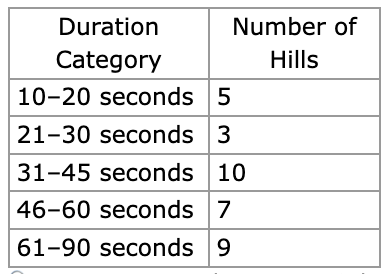
The analysis: 2% grade threshold hill counts, categorized by estimated duration assuming 10 mph climbing speed:
Notes on How These Were Calculated:
Smoothed grade using a 5-point rolling window to reduce GPS noise.
Any segment where grade ≥ 2% is considered “uphill.”
Segments are converted to time using 10 mph = 4.4704 m/s.
Continuous uphill points are grouped into one hill segment.
Interpretation for Training & Coaching
1. You have a LOT of short-to-mid hills on this course
The Maine 70.3 bike course is clearly "rollers-based,"
If the athlete rides faster (e.g., 16–20 mph on flatter rollers), the duration of these hills will shift downward but the pattern (a LOT of short rollers) remains.
2. This course rewards:
Local muscular endurance (LME)
High repeatability at sub-threshold efforts
Strong torque / low cadence strength
Fast recovery between surges
3. Training Implications
You’ll want to integrate:
30–60 second low-cadence climbs (60–70 rpm)
High-repetition Z3 “grinding” efforts
Over-unders that simulate cresting rollers
Neuromuscular torque work to handle repeated micro-bursts
This matches the terrain profile: constant undulation that taxes muscular durability more than VO₂max.
Go-To Swim Workouts
Every swimmer should have 2–3 reliable go-to workouts for days when time is short or when you get to the pool and just don’t feel like doing the prescribed session.
Below are my three favorites—simple, effective, and applicable year-round.
#1 — The Classic 100s Set
Option A: Aerobic Maintenance (Olympic / 70.3 Specific Period)
10 × 100 @ :10 rest
This is essentially a straight, steady 1000.
Use this during the Specific Period when you're dialed into maintaining easy aerobic pacing.
Option B: Two-Speed Repeat Set (Any Time of Year)
10 × 100 alternating: 1 easy / 1 threshold
@ :20 rest
A great two-speed workout you can use year-round.
If you add a warm-up that includes at least 4 × 25 fast, you end up with a three-zone session (easy, strong/threshold, peak). Perfect.
Optional Add-On:
If time allows, finish with 2–4 × 200 using paddles + buoy.
Effort stays easy, focusing on in-sport strength.
#2 — 500-Yard Pyramid (All Three Energy Systems)
This pyramid hits Low, High, and Peak efforts in one tidy package.
4 × 25 fast (Peak effort) :20–:30 rest
2 × 50 threshold to better-than-threshold (“strong”) :20 rest (High effort)
1 × 100 easy (Low effort)
2 × 50 threshold to better-than-threshold (“strong”) :20 rest (High effort)
4 × 25 fast (Peak effort) :20–:30 rest
Total = 500 yards per pyramid
Do 1–4 sets depending on available time.
Take 1–2 minutes rest between sets.
If you complete a short warm-up plus one pyramid, you’ve touched all three energy systems and completed an extremely time-efficient workout. This is a classic maintenance set—you won’t win any swim meets with it, but it keeps fitness sharp and gets you in and out quickly.
#3 — 10 × 50 Progressions
Early Base Period:
Alternate 1 drill / 1 freestyle, or swim 25 drill / 25 freestyle for all 10 × 50s.
Technique-focused.
Complete 2–4 sets.
Later Base or Specific Period:
Alternate 1 easy / 1 above threshold across the 10 × 50s.
Again, complete 2–4 sets depending on fitness and time.
No matter the situation, asking “How (fill in adjective here) can I be?” reminds me that I may not be able to change the situation - but I can always influence my internal dialogue and subsequent response.
I can always ask myself:
How calm can I be?
How kind can I be?
How focused can I be?
How brave can I be?
So this week, turn a hard moment into a testing ground. Maybe you’re running late, stuck in an impossibly slow line, grinding out the last rep of a workout, or sprinting between meetings. Ask yourself in that moment: How can I be?
You might be surprised by the options that open up. And by how much power a tiny bit of curiosity can give you in reclaiming mental control.
Challenge or Resource of the week:
Jim: Simple Practice to Improve Flexibility & Range of Motion | Dr. Kelly Starrett & Dr. Andrew Huberman
Katie: Get outside with a friend or family member during the holidays!
Gear pick of the week:
Katie: Patagonia Down Sweater Hoody
Jim: Men’s Boreal Fleece Tight or W's Aurora Fleece Tight