
In our final episode of the year, we reflect on the biggest lessons from training and coaching in 2025. Katie shares how this year reinforced the importance of trusting feel over data, listening to the body (especially during periods of change or vulnerability), and intentionally building a strong performance bubble to support both physical and mental health. Jim expands on why performance is ultimately a systems game, highlighting the power of basic weeks, consistency, identity grounded in process, smart fueling, muscular endurance, and using data as a tool rather than a driver. Elena rounds out the conversation with insights on becoming a more flexible athlete: checking in with your mental, physical, and emotional state, embracing rest as a performance tool, and intentionally shaping your environment to support joy, sustainability, and long-term growth. If you’re looking to carry meaningful lessons from 2025 into your training, coaching, or life in 2026, this episode is for you! Check it out.
Katie:
Feel over everything
Trusting “feel” instead of relying too heavily on data showed up a ton of times in athletes and coaching this year! Some examples:
Athletes’ power meters or HR straps not working in a race, forcing them to rely on feel, often resulting in faster-than-expected times and really even splits
Why? Data can sometimes limit us by shaping our beliefs about what is possible. We might see a number that seems too good to be true (but is actually possible with a solid taper and excellent training) and doubt it/ artificially hold ourselves back
Data can also put us in a negative headspace – i.e. it’s really frustrating when we are trying to e.g. stay in zone 2 and our watches are yelling at us that we are in the wrong zone.
Finally, data are not always accurate. HR monitors are finicky and sensitive, everyone’s zones are different, etc.
What I have been telling athletes who are frustrated by all of this:
Go by feel and I’ll look at the data after! Can you hold a conversation, can you nose breathe, etc. If they are already bought into the intention of improving zone 2 aerobic base, they can leave the data observation to me as a coach
For me training for my first marathon this year:
I worked with a new run coach and was interesting to do speed workouts that were primarily written by feel (i.e., intervals at “smooth 10K feel” and even marathon pace long runs that had feel cues over numbers. By the end of the season I had a really good idea of what pace ranges those feel cues corresponded to, but I would never have expected to run those paces initially because they shifted over time with training (paces got faster, feel/mindset/intention was the same)
For me in pregnancy:
Data loses a lot of meaning when you are going through major physiological changes. This can be true in terms of return from injury or illness as well (or navigating training in the context of different chronic conditions).
Especially since how I feel has been variable day to day, data hasn’t been helpful and I’ve had to just go in with mindsets/intentions (and flexibility if what my body is allowing me to do isn’t mapping onto that).
***Caveat: I think it’s only possible to truly embrace feel if you have some experience learning and knowing your body with the help of a coach or data. To an extent, I think you have to give Zone 2 training a try with some data guidance (and race initial races with the help of data)
Actionable goal for coaching/training in 2026: Continue the feel focus! Leads me into my next insight…
Importance of trusting your body
Another one of those “really became clear to me in pregnancy but also applies to not pregnant contexts”
Some things I feel like I have learned and really solidified in the past year or so:
The body has a lot of wisdom
It talks to you if you are willing to listen
A lot of high performers have such smart, creative, etc. minds that I think we can override our bodies’ signals; and to an extent, some overriding is necessary to do hard things like push through an interval or finish a race
But listening to your body especially when things are a little quieter (i.e. not mid-interval) is ESSENTIAL for long term health and performance
This year I’ve gotten more in tune with signals like “do I have that buzzy feeling in my chest” or even how I’m sleeping, how my appetite is, how jumpy I feel, etc., and have tried to listen to those better as cues for how safe/stressed my body feels
Tuning into those signals can help us make better choices about things like goal mapping, what races/events we choose, the things we do, the places we go, the people we surround ourselves with, etc.
Actionable goal for 2026: body scan and journal on how you are feeling! This is also something to explore with a mental health professional, especially someone trained in somatic psychotherapy
Building your support network / performance bubble
This year more than ever, having a really solid support network/ performance bubble has been essential for supporting physical and mental health as a pregnant athlete
These networks are ALWAYS important, but I think they are especially important in periods of heightened vulnerability – which come up more than you might think as an athlete
Other examples of heightened vulnerability times where I think you absolutely need to prioritize a support network:
High life stress or big life transitions
Training for something really big (or with really audacious goals)
Returning from injury or long term illness
Getting back into sport after a long time off
Getting into sport for the first time
Reminder from our best friend Brené Brown on what vulnerability is: a state we enter any time something meaningful is at stake. Defined by uncertainty, risk, and emotional exposure.
Uncertainty: you don’t know what’s going to happen and you are acting without guarantees of success (or even safety, acceptance, etc.)
Risk: possibility of loss (which could be mental/emotional, like self esteem, or belonging, acceptance, etc.)
Emotional exposure: allowing yourself to be seen! With all of your fears, hopes, desires, imperfections, etc.
Navigating pregnancy as an athlete – especially when society at large often has skepticism about what pregnant athletes/women can and should do – has been a period of more vulnerability than I expected. Some examples:
Uncertainty - about what abilities would look like, how my health would be, how my baby would do, whether the pregnancy would even progress safely
Risk - no guarantees on any of the above, and doing something for the FFT (so no prior experience to draw on)
Emotional exposure - on the one hand, I couldn’t imagine something worse than something going wrong with the pregnancy or the baby; but at the same time, it felt like exposure to even say “I still want to be an athlete and do big things for me!”
What’s more, that performance bubble needed to know about the pregnancy pretty much right away, which felt really vulnerable too.
My bubble:
Core professionals - coaches (run + strength/prenatal focus), pelvic floor PT, prenatal chiropractor, therapist, and to an extent medical team/doctors
“My people” - Connor, friends/training buddies, family
Ask yourself consistently: is my bubble helping me achieve my goals and creating space for me to be fully authentic and vulnerable in pursuing them?
Actionable goal for 2026: as a coach, fulfill my role as member of performance bubble by holding space for vulnerability, and encourage athletes to fill in additional gaps (could be a PT, dietitian, family/friends, etc.). As an athlete and new mom, continue to rely on that bubble with the recognition that it could change as needs change.
Jim:
2025 Lessons
Main Lesson: Performance is a systems game. The athletes who progress (and stay healthy/happy) aren’t the ones chasing perfect workouts—they’re the ones who build low-friction routines (“Basic Weeks”), execute with intention, and keep their identity grounded in process + love of sport, not outcomes. When you do that, the sexy stuff (FTP, race times, breakthroughs) tends to show up as a byproduct.
1) Systems > motivation (Basic Week, low friction, repeatable habits)
Build a “Basic Week” you can repeat all winter (whether it’s 5 hours or 15 hours).
Reduce cognitive load: plan on Sunday, make workouts “hit play.”
Atomic Habits framework: Obvious / Attractive / Easy / Satisfying.
“Never miss twice,” exercise snacks, environmental design (trainer setup, gear laid out, packed bags).
2) Consistency, volume, and patience (the “unsexy” fundamentals)
Norwegian principles: “train a lot, mostly easy,” “basic weeks,” “10 years not 10 months.”
Chocolate chip cookie training: the ingredients don’t change—consistency, time, volume, patience—just small variations.
Consistency is the magic workout that compounds like interest.
3) Identity and mindset: outcome vs process, “focus on smooth,” internal control
Obsessive vs harmonious passion.
“Race my race, not others,” control the controllables, reduce decision-making on race day.
Focus on Smooth as a guiding philosophy: present, low cognitive load, intuition, freedom, not data-chasing.
“Going all in” as full intent, not reckless intensity; excellence = respond, don’t react.
4) Fueling + hydration as a performance unlock (and safety tool)
The biggest “2025 upgrades”:
High-carb fueling + gut training accelerating athlete development (“leveling up quicker”). A rising tide lifts all boats.
Race-day fueling rehearsals as the #1 Ironman lesson (Every IM athlete stresses this.).
In the heat: underfueling can impair thermoregulation → fueling becomes risk management, not just speed.
Sweat sodium / sweat rate tools (hDrop) to make hydration more precise.
5) Muscular endurance as the limiter (LME, torque, durability)
Maine 70.3 “rollers-based” demands → repeatability, Z3 grinding, over-unders, low cadence torque.
Kona reflections: Ironman as a massive muscular endurance ask.
Tire dragging / weighted vest / resisted walking as time-efficient LME builders (especially when impact needs to be low).
Strength + mobility as the long-term health multiplier (especially Masters athletes).
6) Specificity and skill: “work on your limiter,” single-sport blocks, technical competence
To get good at something, do the thing (10,000-hour / mastery framing).
Single-sport seasons as a shortcut to nuance (bike racing to become a better triathlete; technical descending/climbing for Nice/Marbella-type courses).
Skill-based: bike handling, open water safety, course knowledge.
“Fitness is fitness” (aerobic transfer), but biomechanical durability still needs respect.
7) Data is useful—but awareness leads (hard + soft data, intention, RPE)
We are not anti-data—we are anti-data-as-identity:
Threshold is a skill, not a sensation; numbers vary with life stress, heat, hydration, fueling.
Coaches need hard data + athlete perception; internal load matters.
Mindful training: intention before/during/after; reflection drives progress.
8) Community and environment (joy, health, community) This shows up as both training adherence and life meaning:
Masters swim / group runs as “Obvious + Attractive + Easy.”
Ironman Lake Placid: weekly Zoom builds connection; “come for the plan, stay for the community.”
Elena:
Becoming a flexible athlete!
Modifying training often based on feel and known warning signs
Make the ideal plan, but calibrate expectations accordingly
Always be checking in on your why– is this serving the right purpose?
The 3 check system:
Mental check: was this fun? Am I excited about it?
gut check: is this serving its purpose?
physical check: how does my body feel? What is it telling me?
Practicing radical acceptance
Letting feelings and frustrations sit rather than immediately trying to problem solve them– they’re likely telling you something
Often times problem solving can add more stress to the bucket
Rest as a performance tool!
Nothing really new here, but really embracing periods of intentional rest– not pushing anything that doesn’t feel comfortable. Different for every person, but necessary and the sky won’t fall down.
Know thyself
Write down what you’ve learned about yourself through life and training– what are your warning signs for being over the edge? What are the signs that you’re thriving?
When x happens, what y helps you out of it→ know your toolkit
It’s still data, just perhaps noticed and tracked differently. Build a system around you.
My most consistent truth for life→ you cannot help being shaped by your environment, so craft the environment that supports who you want to be. Doesn’t mean over-optimizing, but it does mean intentionality.
Content you consume
Friends you spend time with
Values of your community
For me, does my environment support→ joy over performance? Lots of time outdoors? Optimism over pessimism? Excitement over “shoulds”? Authenticity over conformity?
Challenge of the week:
Jim: Use your 2025 main lessons to set your 2026 intentions.
Elena: Try to write out your own personal operating manual as if you’re explaining how you work to a trusted friend.
Katie: Journal on your own lessons from 2025!
Gear or resource pick of the week:
Elena: Patagonia R1 Fleece hoody
Katie: Technogym ball for home gym setup
Jim: Elena’s homemade bicarb recipe (see below)
Why Bicarb:
Accumulation of acid in working muscles and blood is highly related to fatigue, especially in distances ~~400-5k. Bicarbonate is one of the simplest bases that if delivered properly, can at least partially neutralize acid and keep pH in a normal range.
Why gels
Bicarb entering the GI Tract will immediately react with stomach acid to produce carbon dioxide gas. With pure bicarb (e.g. baking soda or tablets alone), this will very likely cause a full suite of GI issues. Embedding the bicarb in a gel can mostly protect the bicarb from stomach acid until it can reach the intestines where it is far less acidic and it can be absorbed into the blood as intended. The Maurten system is expensive.
Recipe:
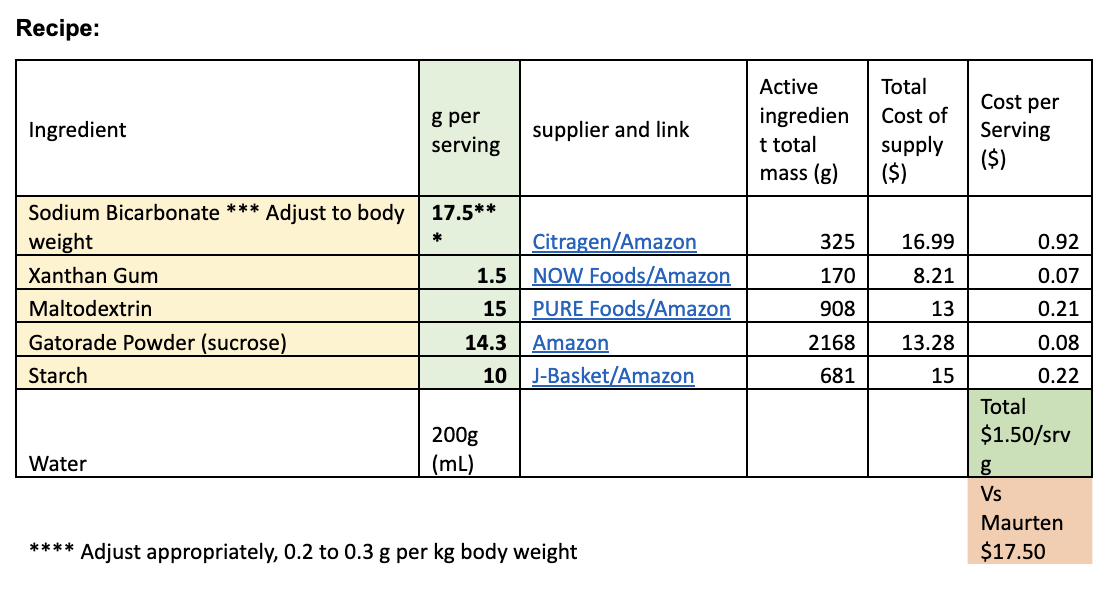
**** Adjust appropriately, 0.2 to 0.3 g per kg body weight
Links:
Instructions and Suggestions:
Prepare and take about 90-120 minutes prior to exercise. A small food scale is needed, but components could be weighed into a small container in advance.
Lightly crush or cut bicarb tablets into small chunks ~1/8 to 1/2 of original size (a butter knife or metal spoon). Unable to find a supplier with smaller tablets but this works and they just need to be small enough to swallow without discomfort. Discard any powder generated by this and weigh the chunks. Use 0.2g to 0.3 per kilogram body weight. For example, if I weigh 70 kilos, and want to take an intermediate dose of 0.25g per kg body weight I use 17.5 grams.
Prepare by mixing all components (besides bicarb and water) into a fine powder mixture. Add 200 mL water (6.76 fl oz), stir (or cap and shake) thoroughly until everything is dissolved. Wait at least 5 minutes to let gel thicken, it should be a “slurry” texture and a bit opaque.
Add bicarb tablet chunks, stirring in briefly just enough to evenly disperse them and you are not trying to dissolve
Consume either by trying to drink, or eating it with a spoon like cereal. DO NOT chew the bicarb tablets, simply swallow with the gel.
Experiment for yourself with when exactly you take it, first trying it while sitting around, then maybe before an easy run, then a lower end dose (0.2g/kg) prior to a workout to learn how it feels and figure out how to make it work best for you. Using for the first time before a race is risky. I’ve seen informal reports of maurten still causing some GI issues for some people and it’s a matter of learning to minimize these vs. benefits.
Experiences so far:
I have used this recipe three times prior to some speed sessions like more intense 400’s or 800’s and feel encouraged enough to try it in an indoor track race this season. It seemed to help in terms of continuing to feel sharp and a bit less like the legs are burning when pushing hard the last few reps. One of the three times I had mild-moderate GI symptoms, with no clear explanation why compared to the other two.
The gel component is a good mix of carbs that is a decent prerace / hard workout fuel in itself and absolutely does it’s job in delivering the bicarb. As a test I once took 25% the usual amount of bicarb when I was just sitting around, and GI issues were worse than the full dose with the gel while running hard. I have also spoken with folks who took bicarb (in baking soda dissolved in water) sans gel prior to racing the 800 or 1500 and they had terrible issues.
Some Additional Reading:
Overall Review on bicarb benefits:
Maurten’s bicarb system greatly reduces GI symptoms and increases blood pH at rest
Maurten Bicarb improved cycling performance with minimal GI symptoms
Detailed Comments about recipe and food chemistry if interested:
I chose the ingredients based on all the information I could get from Maurten and some additional reading. It’s impossible to know exactly what they use but we can make some very good guesses and end with something that works (majorly reduces GI symptoms vs straight bicarb).
Ingredient amounts can be inferred from the nutrition facts (composition of starch (complex carbs including maltodextrin), sugar, and the relative order of list of ingredients - if there’s more it is required to be listed first. The order changes between their products with different, known amounts of bicarb which helped inform the range.
Chose potato starch upon seeing a few things suggesting it may be more acid resistant and forms better hydrogels. Some of the food chemistry reading suggested a ratio of about 1 part Xanthan gum to 80 to 100 parts water, and this recipe reflects that. Starch and xanthan gum are the components that make the hydrogel. This is the part that I’m least certain about – Maurten may be using something even simpler, or maybe something much more sophisticated, but this works.
For a simple sugar, maurten has fructose. I chose Gatorade (sucrose and glucose) simply for flavor. It is rapidly broken down to fructose/glucose in the small intestine. I am inclined to think that the fructose in Maurten’s recipe is for flavor/carbs and is uninvolved in getting the gel texture.
The amount of sodium per se from the sodium bicarb is fairly high and likely no need for other electrolytes leading up to a workout/event.
Won’t go into it but the topical formulations of bicarb that you rub in seem to me to be not well supported or rooted in the realities of absorbable and sufficient doses through the skin.