
ATHLETE RACE AND TRAINING BLOG
A place to report, share and learn from fellow athletes

2023 IRONMAN 70.3 North Carolina Race Report -- John Witmer
About Me
To provide some context for those looking to consume some content for reference. I'm 35 and work as a software consultant and Jim (coach) was able to tailor the training around my travel schedule which was a huge help. NC 70.3 was my 5th 70.3 but my first using a dedicated tri-coach. I had completed a 70.3 each year the past 5 years minus the COVID year. In my previous races, I always ended up bonking out and needing to walk in during the run at some point which was really frustrating since I felt that I was training so hard (which with the knowledge I have now after coaching, was the reason I wasn't performing to my capabilities). During those races I was able to drop my times from 6:35 to 5:33 but still didn't feel great at the end of the 5:33 race at Indian Wells and had to take multiple walking breaks to keep my HR under 190bpm.
I was under The Endurance Drive directive for 6 months prior to the race and felt that I was quite consistent with two 1 week breaks during that span. One week to move to Boston from San Diego and the other week to indulge in Oktoberfest in Germany. The training wasn't overwhelming and at times I felt like it was almost too easy since I wasn't used to ever training in Z2. My HR loves to stay around 160-180 and higher and trying to keep it around 145 (Z2) was really tough at the beginning and I had to run around a 12:00 min pace to keep it there. By the time I reached the race, I was doing my Z2 runs around 10:00. I provide my final thoughts at the end!
Pre-race
I like to wake around 3 hours before the start of the race. On this day, I woke around 4:30 and my dad and I left the hotel around 5:10. During this time I showered and did some thoracic spine stretches and had a fair amount of coffee with a bagel and a banana.
My dad and I drove over to the T1 transition zone so that I could put air in my tires, mix my nutrition and use the restroom. I like to give myself plenty of time where I can relax and listen to some music. The lines for the restrooms weren't terrible at T1 and my dad waited for me so I could put a lot of my gear I didn't need back in his car. Once he left, I walked over to the buses that would take us to the swim start. On the bus ride over at 6:20am, I sat beside a guy doing his 19 70.3 and we chatted about his favorites and it kept my mind off the morning.
Swim
For the swim, the 35 - 37 minute swimmers were in the 2nd parking lot awaiting. The faster groups were awaiting in the first parking lot. During this time I listened to some relaxing music, did some stretches and just tried to keep my heart rate low. I was obviously stressed since my watched beeped at me stating to do some breathing exercises since my stress levels seemed high. Just standing there my HR was around 110bpm and it was cold as hell with everyone else standing around shivering. I took a SIS gel at 7:10 thinking this would be 15 minutes but the start but it was really about 35 minutes before I started. Once our group moved over to the other lot around 7:35am I was able to put my morning clothes bag into the group of large totes in the first parking lot. The atmosphere was great and we crossed the road to where we walked down to the start.
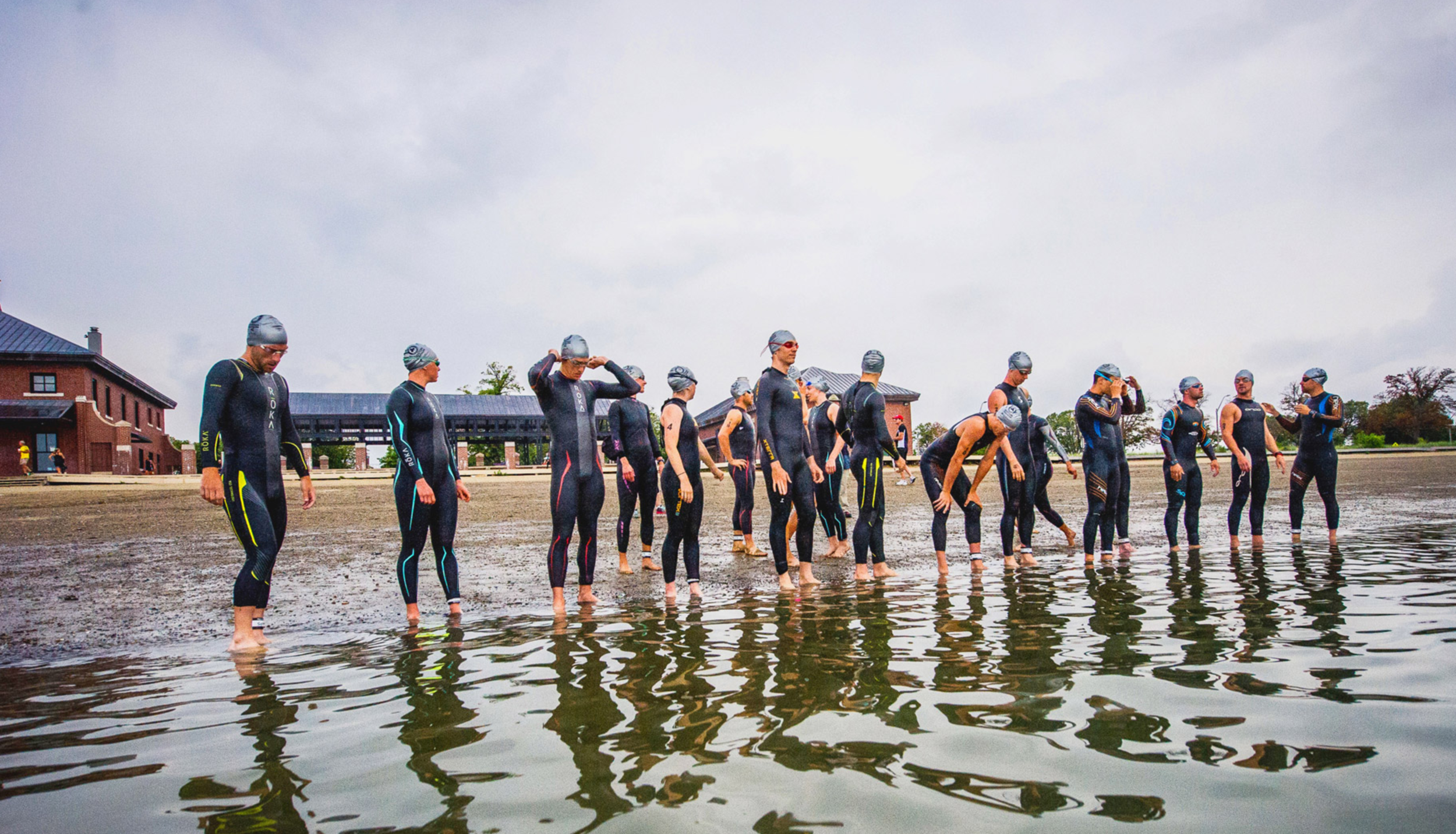
At 7:42 I got into the water and immediately noticed how much warmer the water was than the air. Water was around 69 degrees and it was about 53 outside. This race didn't have nearly as many people climbing over each other and there was a lot more room to spread out since they were releasing 5 people every 5 seconds. I got into a rhythm and felt great from the start. I was surprised on how many people were grabbing onto the life raft/platforms within the first 100 meters. I think for some, it’s the first time in open water and especially very salty water and it can be overwhelming. I was able to sight really well since the sun was on my right eastern side. I felt that I swam the route well and didn't meander too much. The parts that were the most cluttered were the 3 main turns but even this wasn't terrible. The current was pushing us along and people were getting pushed slightly off course so people were trying to swim back around the turn buoys. My heavier than usual load of swim training put me in a great spot and I could tell when I needed to back off my pace some but never once felt tired or overexerting. Once I saw the ladders where the race was finished about 200 yards out, I thought to myself that I could have easily have done that distance again. I typically swim around a 1:50 pace in the pool and swam around a 1:27 pace. The ladders were easy to get up and I didn't have to wait at all.
Swim Time: 32:09
T1
Once I got up the ladders, I ran about 30 yards to the wetsuit strippers and they pulled it off quickly. From there it was about .4 miles of running barefoot on concrete and grass to the first transition. I was lucky to have a great spot that was easy to find near the entrance. I got my swim gear tucked into the T1 bag, got my bike gear put on quickly and was headed off. I dropped my bike after about 10 yards since I wasn't used to pushing the new bike (aero bars were heavier) but luckily it was in soft mud and didn't cause any issue.
T1 Time: 5:22
Bike
I hopped on the bike and within 4 minutes took another SIS gel. It was really slow going the first 5 miles due to how narrow the one lane was and going over the bridges where we couldn't pass. It was within the first 5 miles where I noticed we would be having the solid forecasted headwind. I wasn't really able to get comfortable In aero until mile 6 but then things started to spread out. Initially I felt great on the bike and was able to get the HR stabilized and get into my push/pull rhythm. Around mile 6 we got onto the highways and here I was able to get aero and get a real feel for the bike since my only other long ride on the new QR X-PR was when I was sick. It felt incredibly smooth and handled very well in aero and I could tell I was hitting the quads more with the geometry of the bike. For about 20 miles this one guy kept drafting off me and this lady and she got pissed and called him out on it but he didn't care and continued. He was being reckless and it scared several people we passed. It was really hard not to draft or be near others due to so many bikers but this guy was obviously trying to reduce his headwinds. Unfortunately the course marshal didn't penalize him the 3 times they passed. The headwinds for the first 32 miles were anywhere from 10-15 mph but luckily the highway asphalt was smooth. I recommend not riding on the highway shoulders cause saw several people were getting popped tires from the debris on the shoulders. I was able to keep about 19.5 - 20 mph with all the headwinds and my legs were tired and I was able to keep my HR around 165 - 168 the entire way.
Once we got to mile 32 -35 and start turning around, it was go time. Headwinds turn to tailwinds on out-and-backs. I did have to stop quickly since my front thru axel seemed to be slowly unscrewing for some reason (perhaps knocked loose when I dropped the bike?) but I found an aid station, tightened it, grabbed a water and was able to be get going only losing about 45 seconds. I felt amazing on the way back and I mentally kept telling myself everyone feels great till around mile 35-40 when the wheels fall off and one starts having leg cramps like I usually do, but this time I felt really strong and could tell I was nailing the nutrition. I was able to pick up the speed consistently around 22-24 mph while maintaining the same HR and RPE. The difference between a road bike and a tri-bike were becoming more and more apparent. My support team was even able to drive their car beside me a few times and chat while I was on the highway and they were in the lane beside me which was really encouraging. I did have one guy in front of me starting peeing and looking like a water sprinkler in front of me and that was amusing. Around mile 50 I still felt really good and kept pushing up a notch until we crossed over the big bridge back into the town center. Once we got to the top of the bridge and started hammering down it, I was really excited to get to the run. I came into Wilmington and down some of the smaller streets with crowds cheering along the side and saw the dismount line. My HR was only around 170 at this point which was the best out of any race and I was ready. One thing to note, I was really impressed with how many aid stations there were on the bike course and the volunteers did great.
Bike Time: 2:42 (20.99mph)
T2
I got to the dismount line and expected my quads and hamstring to tense up once clipping me out and I was pumped when I didn't have any fatigued feelings. Even the first steps off the bike felt solid. It was a really short downhill run and again had a great spot where I put up the bike, took another SIS gel, got my shoes and bib on quickly and ran to the exit at the bottom of the hill.
T2 Time: 2:41
Run
The first .5 miles felt really easy at a 8:15 pace and my HR at this point was about 171 once I get into my step. Running through the city at first was really cool since the crowds were huge. The first 1-2 miles had a lot of rolling hills but I noticed my 8:20 pace felt really smooth. I kept telling myself that I needed to stay at the goal of 8:30 pace but with my HR so low at the beginning I figured I could keep up the pace for a little to see how my body would react. Mentally, I kept telling myself to pace easy to be able to have a strong finish but the knees, HR, hips, quads and all told me I had more in me early on. Even on the uphill's I was able to maintain my HR to not fluctuate too much. Around mile 3 I got to the lake area and it was a well shaded section and then the run became a mind game. "Let's get to mile 6 and then and see how I feel". At mile 6 my HR was around 174 and I felt great. It was around here I saw the support crew and it gave me a boost. Mile 6.5 I was at the out-and-back turn-around past the Red Bull blow up and that was even more motivation. "Lets get to mile 8". HR was still around 175 with a pace around 8:10, so it was around 9 where I told myself that I could up my effort and just rip it and hold on from there. I got to a sub 8:00 pace comfortably and knew I had the hilly downtown area coming up but I wanted to see if I could mentally push myself and embrace the suck.
I was really impressed with how my body was continuing to pull from energy stores I hadn't experienced in previous races and I knew then that this training method was paying off. It was around mile 9 I looked at my overall race timer and my first thought was that the watch was off or it wasn't including my transition times cause it was far ahead of my goal. For a moment I thought, "Could I really make it in the sub 5:20 time?!". I found this lady around mile 8 and ended up chasing her to maintain the sub 8 pace. I had my fastest mile as my last mile and not one time in the race did I have to take a walking break for the first time. Coming down the chute was such a great feeling and it was at that point I allowed myself to know that I executed that race as well as I could. I looked up and saw my name and then saw the finish time and couldn't believe it. I finished the run with an 8:08 pace (only 3-4 minutes slower than my fastest ever half marathon) and a final time of 5:08. This was 25 minutes better than my PR and 20 minutes faster than my goal. Train slower to race faster works.
"Don't stop when you're tired, stop when you're finished".
Run Time: 1:45 (8:08 pace)
Nutrition
This made a HUGE difference. Some few small tweaks but I feel like I hit this spot on. I didn't have any stomach issues the issues the entire race and the Maurten's are perfect for my body. I walked each water station and would have 1-2 cups of water and then pour one over my head. Also, this was my first race not consuming solid foods.

John’s nutrition plan for IM 70.3 North Carolina.
Needed Tweaks
Pre-Race
Try to get around 1.5 bagels with a banana closer to race time
Get to 1L of water w/ electrolytes
Swim:
Take a gel around 15 minutes before and not 40 minutes before
I felt hungry coming out the water
Bike
Get to 1L per hour on the bike.
Get to 100g of carbs per hour
Salt tabs worked perfect
Run
I can do a Maurten 100 around every 2 miles
I got noticeably hungry around mile 5 so the extra carbs on the bike are needed
Final Thoughts
Admittedly, I was hesitant the week leading up to the race. It was my first time using a tri-coach (Jim!) and the first time with 80/20 method of training. I knew I was quite consistent with the workouts and was executing them well but I didn't feel like I was pushing myself hard enough. This is probably because with my previous 4 70.3s, I pushed myself around Zone 4 for every workout for months which looking back was just bad training and not allowing my body to recover. When people asked how I felt before the race, I didn't have much to compare to since this was my first time with the method and the 2 warm up tri's were Olympic distances where you push yourself hard the entire race. Once I got to mile 30 of the bike, I noticed that my quads and hamstrings weren't showing fatigue and it was starting to feeling promising. On the run, I couldn't believe I was able to maintain that fast pace and still regulate my HR. I felt like I was really pulling energy from sources I hadn't had before. I kept thinking the wheels would fall off at some point and they never did. Even coming across the line, I didn't feel that I had to kill myself to get to it. It was one of the first times I fully enjoyed the race and didn't have to completely suffer the entire final 2 hours. The training works.
I'm looking forward to training for my first full distance Ironman with the Endurance Drive for August 2024 in Copenhagen!

2023 IRONMAN 70.3 Florida Race Report -- Izzy Wilson
Congratulations to U25 athlete Izzy on a 2nd-place AG finish and 70.3 World Champs qualification at IM 70.3 Florida! We’re so proud of you, Izzy!!
I think the biggest lesson from this race was how to navigate the uncontrollables. I consider myself a bit of a control freak and it makes me really anxious when things don't go as planned. The night before every race I often ruminate over everything that could go wrong that's completely outside of my control. Until this race, I was lucky enough to avoid those circumstances but the Florida 70.3 was a new challenge.
Going into the race, I had been feeling under the weather all week with a headache and congestion. Nothing serious but I was so worried that my body wasn't ready for what I was going to put it through. I was nervous about that to begin with and then the moment I jumped into the water the left side of my goggles filled with water. I quickly suctioned it and no more water leaked but it resulted in a half-blind swim with my left eye shut the entire time while I navigated the complex M-shaped course with my right eye. A minute later, someone clocked me in the head and I started seeing stars. I had a momentary panic attack that I wasn't going to be able to complete the swim at all and the whole race would be a failure. I talked myself out of it though and was able to recover into a rhythmic stroke. However, these three misfortunes just added to my initial anxiety and made the start of my race extremely stressful.
From the swim to the bike I was feeling really strong. My bike felt so speedy compared to the last race and I was gaining confidence watching my pace climb steadily. I got to 20 mph and felt like I could sustain it forever. It was also such a beautiful course and I found myself smiling the whole time as I whizzed past beautiful orange trees and beaches. 20 miles in I got a notification on my watch that it had 10% battery remaining and started freaking out again. How did it not charge all night?? I was so mad at myself for such a careless mistake and worried that my entire race strategy would be thrown off as a result. I wasn't going to know how often to fuel or what my pace and heart rate were. So I decided that this was an opportunity to make friends with everyone I encountered on the course and rely on their Garmins to gauge how I was doing. It ended up kind of being a blessing in disguise because I got to talk to so many people on the course and learn about their backgrounds. I was amazed by how fast the bike went by because instead of fixating on my pace and miles I was just chatting with people and enjoying the ride.
At mile 50 we hit a rough pavement section and it knocked my water bottle cage off and I dropped a chain. I had to pull over to the side of the road and frantically fix my chain praying that it was only a chain and nothing more serious. Luckily it was fixed in a matter of minutes and I spent those last 6 miles praying that I would just make it to the end without any more issues.
Moving into the run, I could immediately feel how unsustainably high my heart rate was. Since I didn’t have a watch, I had nothing to gauge my pace or HR off but I knew it was probably way too high (turned out I was at 185 which makes sense...) Again, I decided this was my chance to pick a new friend to pace off of and I found a friendly triathlete from Florida who ran by my side the entire way. I was aiming for a 7'15'' to 7'30'' pace but once we hit the first hill at mile 2 and the temperature climbed to 85 degrees I knew this was not going to happen. It was SO HOT I felt like I was going to pass out every time I picked up the pace. So I gave up on pace entirely and just put my head down trying to survive one minute at a time. I had to stop at every single aid station to put ice in my jersey and dump water on my head. This was the hardest mental battle I've experienced in any race. The entire time by mind was telling me to stop as my HR and body temp kept climbing. Usually the run hurts physically but I've never struggled this much with my internal dialogue before. Having my new friend by my side was a saving grace because I kept telling myself that as long as he kept running I would stick with him. We were in it together. Every 3 miles we would fist bump and force a gel down our throats with a gag but it really helped having someone to get me out of my head and hold me accountable with my fueling strategy.
By the second half of the run, everyone was suffering. Most people were walking or slowing down a ton but it was pretty amazing seeing how high the energy on that course stayed throughout the physical pain. Everyone was cheering each other on and it was the most positive community of racers I've seen. It felt like trauma bonding in a way as we all laughed about our long lost PR goals and just put one foot in front of the other to get to the finish line. The last mile I emptied the tank and got my pace down to 6'10'' as I sprinted through the finish with my mom waiting for me in the distance. The whole run I had been picturing that moment of crossing the finish line and collapsing into a ball and I have to say it really did feel amazing. I fell to the ground right at the finish line and didn't get back up for a while as I tried to slow down my breathing.
I honestly still had no idea how the race went because I wasn't tracking my pace or overall time at all but the second I saw my mom she cheered "YOU GOT SECOND MY GIRL!" and gave me a huge hug. This was the best surprise ever and finding out that I beat my goal was the best reward that any athlete could ask for. I went into this race aiming for 5.5 hrs and 5th place and beat that goal by quite a bit. I stuck around for the awards ceremony and slot roll downs and was given the only spot in my age group to compete at the Ironman World Championships in New Zealand in 2024! Despite everything that happened along the way, I am really happy with how the race turned out and SO EXCITED to compete in New Zealand.
Putting this race into perspective, I think it was really good for me that it didn't go exactly as I hoped. I learned how to work around obstacles and not stress out when there are bumps in my ultra precise strategy. I am confident that I will go into my next race so much less anxious because this race proved to me that I CAN handle anything that comes my way. And I firmly believe that there are truly no bad things, just good content and good plot. All my (relatively minor) misfortunes weren't bad things, they were good content that gave me some laughs afterwards, new friends, and a good story to tell. I will carry this lesson into my life outside of triathlon and tackle life challenges or seemingly bad luck with the same perspective.
2023 IRONMAN California Race Report -- Liselle Pires
Race report by athlete Liselle Pires — congrats on an amazing race Liselle!!!
TLDR;
The race went really well! I had a comfortable swim of 56 min (woo, current!), and had to push past people casually walking around. I felt great, though, and excited knowing I would see Carl, my partner, soon. I fumbled through transition, dealing with a toe issue, but once I was on the bike I was happy. I had a great first 56 miles, with mild winds and lots of energy. My fueling plan went perfectly on the bike. Unfortunately, it poured about 65% in for me, which did affect my mental and physical state a lot. I powered through an hour of heavy rain, and raced back to transition. My legs were feeling awesome, and despite another slow transition, I started running, saw my friends cheering for me, and had a solid run. The run started to get slower and harder halfway through when the downpour started again and it got really dark. Those miles were the real test of the day. Ultimately, thanks to a deep desire to go home and my amazing crew spotting me so many times - I finished!
Before Race Day
I signed up for the Victoria 70.3 in 2019 on a bizarre whim with a friend who, like me, didn’t swim or bike, but foolishly thought “well, I’ve run marathons”. When COVID hit, we deferred our 2020 race to 2021, and I personally forgot all about it. In May of 2021, I remembered my plan and bought a bike, started riding, and learned how to swim (poorly) shortly after. I comfortably finished the WA 70.3 that fall and loved how I felt. It was just a fun experiment, but as an infinitely unsatisfied and antsy creature, I always feel compelled to explore my limits. A full ironman seemed as ridiculous as it gets. Knowing I was moving to SF, I signed up for IMCA 2022, but unfortunately, I struggled that summer with several months of heart issues after getting covid, and with a lot of frustration, deferred to 2023.
2023 came. My goal was to simply finish what I’d mentally begun.
While I’m lucky to have an athletic partner who joined me on a majority of the rides, and a handful of close cycling friends, I didn’t have a triathlon community to workout with, whine to, or learn from, so the training block got immensely lonely and mundane quickly. Training to ride in zone 2 made me feel out of place at my favorite group rides, where everyone showed up to work much harder than zone 2. It made me feel out of place with my own friends, who were often too chill or too fast for my goals. My simple goal felt detached from my daily chosen experiences. I became addicted to self comparison: metrics were often the thief of any joy in a workout and I found myself crippled with negative self-talk. So, when I did discover the vibrant local tri club, I unfortunately hesitated to join for almost 3 months - months lost to imposter syndrome and a fear of being inadequate among a group of super triathletes.
8 weeks before the race I joined and went on one of the group’s rides where a woman who had recently qualified for Kona (world champs) was riding up a hill beside me and asked if I was trying to qualify. I laughed incredulously and said something brutally self deprecating - and meant it. 4 weeks before the race, I had a great race simulation, and wondered why I was so hesitant to dream big and why her question had seemed so ludicrous to me 4 weeks prior.
Training for an ironman was never physically exhausting for me - it was, however, endlessly mentally taxing and lonely. I had a mental breakthrough that 17th week, realizing I tended to set ‘safe’ goals because of a fear of personal and social failure, and decided that I would rather fail dreaming big. I knew that realistically, I hadn’t trained for a ‘dream big’ race, but instead for a ‘safe race’, but whatever shape I was in or skill I had didn’t stop me from feeling more inspired again, and more like my wildly audacious self for the first time in a long time. I didn’t have to have any checkboxes checked to feel capable of striving for greatness.
Over those next 4 weeks, I struggled with a hip impingement flare up that wouldn’t go away with rest, a wonky bike fit, endless back and forth about last minute buying an aerodynamic tri bike so I’d have a chance at a faster bike time, and the next thing I knew it was race weekend in Sacramento.
Race Day
I woke up at 4:15am. They say it’s really about the rest two nights before, and I had spent the past week on a regimented sleep schedule, correctly predicting a horrible night of sleep before the race.
I swallowed ~550 cals of the breakfast I had consumed before every long ride for the last 20 weeks - oatmeal, protein powder, chia seeds, banana, and coffee - and waited for my driver (my boyfriend) to wake up.
I peed on the side of the road before he dropped me off so I could avoid porta potty lines - this would become a shameful, but authentic ironman theme of the day. I probably walked more than a mile to drop all the various bags that needed to be dropped off (to reclaim between sports and on the course), opened all my energy bars and broke them into pieces in my bento box (snack box on my bike top tube) for easier consumption, and got on the shuttle to the swim start. At the swim start, I made my first big mistake. I knew the river had a strong current and my practice swim a few weeks ago on the course had been 52 minutes, but, the race director was asking people to seed themselves at their predicted time without a current to avoid incorrect seeding. Not only did a lot of people likely not follow this direction, but I seeded myself so far back that I entered the water a full hour after the first group. There probably would have been some swim-bumper-cars in earlier groups given my slower pace, but it also would have been fine, and I would have avoided dealing with the weather that came later on the bike…
The swim was largely uneventful, (besides a woman grabbing me around the waist when she panicked) and I stayed calm knowing it was just an hour in a very long day ahead. It’s wild to think that in 2021, the swim was the biggest, most stressful unknown for me.
As I got out of the water, I was pushing past people casually walking the ramp chatting with each other, and I was the only one running into transition. My second mistake of the day was not having much of a plan for the transitions, which by default results in having very slow transitions. I fumbled with soggy athletic tape for the blister on my toe, couldn’t find a glove, and felt chaotic as I ran out with my bike. Before mounting, I saw Carl and got an instant boost of calming energy.
Miles 1-5 were packed with nervous energy as I found the groove of pace and space for myself among hundreds of cyclists. Miles 6-30 I felt smooth and great - my legs were light, fluid and fast, though I was already looking around at expansive farmland thinking “wow, this is going to be extremely boring”. I entertained myself by making up stories about passersby, taking in the dudes on $30k setups, and refocusing my mental energy on enjoying what I knew was a fleeting experience. I started repeating the mantra I would take through the day that I stole-borrowed from Coach Katie - “I’m Liselle Pires. I can do anything. All I have to do is show up”.
I noticed around this time that my heart rate was pretty low, and that my body was feeling exceptionally good. I made a plan to increase my speed on each of the 4 laps, which I executed smoothly on the second lap. Going into lap 3, I was ready to level up again and my feet still felt ‘light on the pedals’, which was a cue I had ingrained from Katie. I peed on the bike for the first time ever, which immediately led to an uncomfortable rash-like feeling, but also a strange sense of accomplishment that I didn’t need to waste 5 minutes with a bathroom stop. I also found myself getting small boosts whenever I interacted with other women - women hollered for other women and complimented each other often. Beautiful. Not the dudes!
I got ready to tackle the headwind on lap 3, and then…the downpour came. The sky cracked and the light mist, which had been delightful to ride in, turned to pounding rain. Everyone slowed down, myself included. I reminded myself that I’d ridden in the rain before (at my half ironman because duh) and that nothing bad was going to happen; but, the intensity of the rain mentally and physically slowed me down a lot on lap 3. I started counting the miles to the turnaround for lap 4 where I’d get a tailwind, as having mini milestones during an endurance event (and in life) is the only way through for me. All of my energy bars, which were pre-opened and portioned, sitting in my open bento box on my top tube, got soaked – mmm…soggy Skratch rice krispies.
Once I got to the turnaround, something inside me broke free and wild as I became desperate to get off the bike - I got out of my aero position and onto my hoods, because I was increasingly worried about agitating my hip, and started riding hard, passing everyone I could over the last 28 miles. I felt great when I saw Carl, Fred, and Cate 10 miles out, and even better as I rolled into transition. My nutrition on the bike was perfect - a bottle with Skratch every hour, and a high carb bar every hour, alternating between Maurten bars and Skratch rice krispies. I’d inherited this from Katie’s own nutrition plan, very intentionally trained this way, and prioritized bars despite the effort to chew, knowing the run would rely on gels and that my body would absolutely reject 10+ hours of gels. I also had Katie’s description locked in - “an ironman is a marathon with a bike and swim beforehand to distract you”. So, I was glad to feel so good at that stage, but also knew the real work was about to come.
I popped 1000 mg of Advil (insert grimacing emoji), a spring energy gel, applied biofreeze to my hip flexor, and then wasted a lot of time in transition by over prioritizing blister care. I ran to the medical tent, where they very nonchalantly offered me a chair as I frantically exclaimed “no no no I just need a bandaid!!!” Those poor volunteers.
I was nervous for the run. When I did my 70.3, I told everyone that if I made it to the run, I would do great. I had been right. For the full, I felt the opposite. I hadn’t run a marathon in 5 years, and was incredibly nervous that the hip pain from last week would suddenly show up in full force while running. So, I took it easy. I saw my friends again, and kept a comfortable pace. I had my first Maurten gel ever at mile 4 and laughed at myself for trying new nutrition at a race. Fortunately, my intuition that Maurten would be easy on the stomach was right and I had a couple more (4 total, probably not enough) during the race.
About 10 miles in, I went to a mentally chaotic place. This run course is incredibly redundant and I was doing laps of random out and backs, which was great for seeing your support crew, but Sacramento is not a spectator heavy race or a scenic race. And, by not scenic, I mean I may as well have been on a treadmill. The miles were getting dark and boring. I noticed my heart rate was somehow in low Z1, meaning my heart had more to give, but I couldn’t muster up the mental fortitude to push that much harder. It started pouring again, and my shoes were totally waterlogged, squishing and sloshing on every step as I approached mile 14. I jogged the entire course, following the best tip I got from Katie, to shuffle through every single aid station, where I sipped 1 cup of water and poured a second all over myself to stay cool. I never got hot on race day.
At mile 18, I wanted to be in a hot bath tub at home so badly. I was frustrated at the incorrect course markers (everyone seemed to have .4-1 mile extra on their watches by halfway through the run), antsy, bored, and my quads were seizing with lactic acid. I knew I had to turn on tunnel vision if I was going to finish this. I was so lucky to see my friends so many times during the marathon, a unique possibility with a repetitive course. It made such a difference to know my loving people were waiting for me to finish, including Cate, who has an early bedtime, so I better not walk!
I sprinted the last ½ mile. A spectating man leaned into the path and high fived me, yelling out Allez Allez! I couldn’t believe the random Frenchman I had spoken broken French to before the swim recognized me, now covered in my own urine and rain a sea of darkness. I believe I said “Oui!” back.
After
While my race nutrition was literally perfect - zero gastric issues and no moments of lost energy - I spent the 14 hours after the race with horrible gastric issues. I was lucky my body held out til I finished, but those 14 hours were traumatic. All I could consume was a half cup of broth and water. I also chafed horribly for the first time ever, probably in part because of the downpour. The area where my sports bra and heart rate monitor were on my torso was dark pink and raw all over, making a shower unbearable.
I slept for 3 or 4 uncomfortable hours, and woke up with my stomach in agony and my head spinning from fatigue. I couldn’t believe I had to start work in an hour.
I spent the day after struggling through the work day and eating as much as I could, finally getting my appetite back. I also spent the day feeling…gloomy. Why did I start the swim so late? Why were my transitions so unintentional? Why didn’t I run harder - I knew I could have. Why didn’t I get a tri bike, knowing I could have ridden faster? It took me 48 hours to transition from feelings of regret and what could have been, disappointed in my performance, to reality - I had done something that seemed out of human reach to me just 2 years ago, something I barely understood, and I had done so pretty comfortably. Within the niche of 1% of people who do things like this, I could question myself, but to the rest of the world I had done something amazing. I may as well absorb the latter attitude. I feel so grateful to have had a great first race, a supportive coach, a partner who truly made it possible for 20 weeks, and friends and family supporting me from near and far the entire time. Now, I am totally over the whys and on to the now what?


2023 IRONMAN World Championship Race Report
Woohoo!! Happy to report that I crossed that magic finish line on Ali’i Drive once again! After a very long Ironman season and a “train a bit but mostly have fun” approach to the twelve weeks between Ironman Lake Placid and the world championships in Kona, I wasn’t sure what to expect from my body and mind on race day. Coming off an amazing day at Placid (which you can read about here), I was as low-stress as I have ever been going into an Ironman, and I think that the relaxed energy and have-fun mentality set me up well for a great race. Here’s the recap!
Pre-race: Travel to Kona was overall smooth. I broke up the journey from Boston to Hawaii with a 2-day stop at Stanford for some research meetings, and that helped me adjust to the time change and minimize the impact of long-haul travel on my body. I arrived in Kona on the Wednesday before the race and got a few solid pre-race swims, runs, and rides in. I also made sure to get any and all bike mechanical issues out of my system before race day with a full tire-and-tube overhaul at the “Canyon House of Champions,” where the Canyon staff were doing bike maintenance on all Canyon bikes for free. Betty finally begins to pay for herself!
My dad arrived on Thursday and Connor flew in on Friday, and Team Katie was ready and in position for the Saturday morning start. My age group (25-29) was in the second-to-last wave at 7:15, so we actually started after the first pro women (led by the unstoppable Lucy Charles-Barclay) had finished the swim. I hadn’t done a mass deep-water swim start since my last time in Kona, and I had forgotten how chaotic that format can be. The entire age group (plus the 18-24 year olds, who were grouped with us) had to swim out 100-200 yards to the starting line and then tread water there for a few minutes, jockeying for a good starting position while trying to stay afloat and not kick anyone. Wetsuits are not allowed at Kona because the water is so warm, but the added buoyancy of the salt water almost made up for it as we floated there waiting for the gun to go off. I stayed as far to the right as I could so I had a direct line to the first buoy, and at 7:15 exactly, the race began.
Swim: Historically I’ve felt that male athletes have been the most aggressive during triathlon swims, but the women of Kona proved me wrong! The long rectangular swim was chaotic and crowded for almost the entire time. I reminded myself that I had survived plenty of tough swims before, but that didn’t mean I enjoyed it when multiple people grabbed onto my shoulder or hip and pushed me down under the water as they fought for a good position. That said, I was probably guilty of doing the same, especially when I caught up with slower swimmers in the waves ahead of me, and the sheer number of people on the swim course made many of the collisions inevitable. My mild frustration at the chaos mostly melted away when one woman accidentally hit me on the arm as she took her stroke and actually took the time to shout “Sorry!” as my ear broke the surface. Apology accepted.
Despite the challenging conditions, a quick glance at my watch every time it beeped for 500 yards revealed that I was having a really strong (for me) swim. I had done almost no open water swimming since Ironman Lake Placid and had avoided long endurance sets in the pool because I don’t really enjoy them, but I was somehow going faster with each passing 500 and feeling really smooth despite the ocean swells and mild chop. Excitement about the strong effort propelled me forward to the end, and I was out of the water in 1:10, which was about six minutes faster than my first time in Kona and not far off my time from Placid. Surprisingly pleased with the result, I jogged through transition (with comfort-driven stops including a quick rinse with the hoses, chamois cream applied, sunscreen, and a snack), and then I was onto the bike.
Bike: The Kona bike includes a short out-and-back in town and then a very long out-and-back on the Queen Ka'ahumanu Highway (Queen K for short) all the way to a town called Hawi. It is notoriously known for sizzlingly hot pavement, relentless sun, high winds, humidity, and a surprising amount of elevation gain. Although it’s an intimidating course, I felt pretty confident about how to manage the conditions because I had done it before. For me, that meant prioritizing staying cool (with icy cold water bottles dumped all over me as I rolled through aid stations), fueling and hydrating as much as possible in line with my race plan, and staying in aero for most of the ride.
For Placid and most of my training, I had used power to guide my Ironman bike effort, but my power meter had been broken for a few weeks leading up to the race, and I had actually been enjoying using heart rate and perceived effort as a guide instead. After consulting with Jim, I decided to not try to get the power meter fixed in time for the race and instead would focus on three key stats: average speed, average heart rate, and current heart rate. We wanted to maximize average speed (which meant being as aero as possible, especially on flats and downhills) while keeping average heart rate at a sustainable level (in zone 2) and not letting current heart rate spike too high, especially on any climbs or very windy sections.
This strategy worked well for most of the ride, and after initially spiking in the first 20-30 minutes of the ride, my heart rate settled into a very sustainable zone. The beginning of the Queen K had a nice tailwind too, so my speed was looking great and I felt pretty comfortable as I headed out to Hawi. I did well with nutrition and hydration for the first 1.5-2 hours, and although it was already a scorcher out there, I was staying on top of the cooling pretty well by grabbing cold water bottles at the aid stations and dumping them down my back and on my head, then returning to the aero position.
After about two hours, I started to feel a bit nauseous and crampy, which was likely driven by the extreme heat and the salt water I had accidentally swallowed during the swim. It was really hard to take in any of the solid food I had in my bento box (something about a soggy, congealed bar stuffed into a hot plastic box was not really calling my name), but I had about 50 grams of carbs / 200 cal in each bottle with a mixture of Skratch Superfuel and LMNT, so I knew I would be okay (if not optimal) from a fueling perspective if I could finish the bottles. I stopped at an aid station for about a minute to pee right before the long climb to Hawi, and that very quick break did help me refocus for the climb, which had a stiff headwind the whole time and was relentlessly hot and sunny. (I still have not mastered the art of peeing while on the bike.) Watching the pro women on their return trip to Kona offered a nice distraction—I could see Lucy up front, followed by Taylor Knibb, and then a huge gap to the rest of the pack. One of the tough parts about racing is that you can’t really watch the pro women’s race unfold, so it was great to get a glimpse of what was going on as I rode.
When I got to Hawi, I stopped again briefly at bike personal needs to switch out the three bottles I had finished for three new ones I had sent ahead. Unfortunately, I had déjà vu to the World Champs in St. George when I grabbed the bottles and realized that they were, once again, hot from having sat out in the sun for most of the morning. In my nauseated and sweaty state it was very hard to motivate myself to drink down the tea-like fuel, and I started to get concerned that my nutrition strategy was going to fall apart. Luckily, the long downhill from Hawi gave me some time to let my heart rate settle and digest the liquid without expending as much effort, and I was able to finish one of the bottles and get back on top of my nutrition strategy.
The toughest part of the bike for me was from about miles 75-105, where we had a headwind, everything felt like it was uphill, and I was frankly just done being on the bike. I focused on just making it to the next aid station, and the next one, and the next one, and I got a few power-ups by grabbing the cold sport-top coke bottles they had stocked at the later aid stations (this was the only type of nutrition/hydration that felt appetizing at this point). In between, I worked together with a small group of women that were all about the same pace, staying the legal five-bike-lengths apart but keeping an eye on each other as a pacing strategy. I found that relative to other riders, I generally did well and would pass people on the climbs without much effort (a testament to my Upper Valley training), but was not as fast on the flatter or downhill sections since I don’t have access to a lot of that type of terrain.
In the last seven or so miles of the bike, I passed the pro women on the run course and cheered loudly for Lucy, who was still well on her way to the overall title. I was thrilled to be done and glad to have a pro race update, and as I descended back into town I began to prepare myself for the run. I finished the bike in 5:55:00, about a minute faster than my time at Lake Placid and a result I was really happy with given the challenging conditions.
Run: I again took a little bit of time to eat something quickly in transition and put on dry socks, and my legs felt pretty good as I jogged out onto the course. It was nearly the hottest time of the day—around 2pm—but I felt confident in my cooling strategy (ice down the kit and water on my head at every aid station) and knew that I could propel myself forward as long as I kept my heart rate in check and stayed on top of fueling and hydration. I saw my Dad and Connor in the first mile on Ali’i Drive and appreciated the familiar faces cheering me on.
The Kona run course starts with about 7 miles in town on Ali’i Drive with plenty of spectators to keep you energized, then features the infamously steep climb up Palani Drive to the Queen K, a long out-and-back with a turnaround in the notoriously hot and hilly Energy Labs section, and then a return trip on the Queen K and down Palani to the finish line on Ali’i Drive. I felt good on Ali’i Drive and made it through the first 12 or so miles without any walk breaks except a strategic power hike up the steepest section of Palani, and I did a good job of taking in the SIS gels every few miles and coke, ice, and water at most of the aid stations. It was fun to see my Dad and Connor at mile 8ish, and my Dad literally sprinted down the road so he could get a better video of me passing by—go Dad!
Past the top of Palani, my heart rate was steadily in the low-to-mid 150s at roughly 8:30-9:00 mins/mile, which was exactly in line with my race plan. Even so, morale was up and down—similarly to the early and middle miles of Ironman Lake Placid, it was a bit demoralizing to do the math of how many miles (and hours) I still had left to go when all that I wanted to do was lay down in front of an air conditioner. After the halfway point, I made a deal with myself and said I could take a short walking break at every aid station (just enough time to grab adequate hydration and fuel) as long as I ran everything else.
I soon found myself next to another woman around my age who seemed to be running at the same pace as me with the exact same aid station strategy, and we ended up sticking together for over ten miles and keeping each other on pace. It turned out that she had qualified at Lake Placid as well, and I was super grateful to have her by my side for those tough final miles. We were moving more efficiently than a lot of people around us at this point; the carnage was starting to set in and I was just glad to not be falling apart.
The sun started to set around mile 22 back on the Queen K, and at that point I knew that all I had to do was run home. I took my final aid station walk break at around mile 24, and then put my head down to pick up the pace for the final descent of Palani and turnaround on Ali’i Drive. That section felt longer than it had the first time, but I saw Connor at the bottom of Palani and again on Ali’i Drive, and I knew my Dad was at the finish line, so it was easy to break out a smile even though my body was beyond ready to be done. The crowds got louder and the lights got bright as I approached the famous Banyan Tree that stands behind the finish line, and I crossed the finish line once again to those magic words—this time announced by two amazing female announcers—Katie Clayton, you are an Ironman. Marathon time 3:57:46, total time 11:16:57.
General thoughts: Kona was a well-executed race for me. I hit my goals of swimming, biking, and running faster than my first time at Kona, and my overall time was my second-fastest Ironman (behind Placid earlier this year, which I’m glad remains my perfect golden race). I exceeded my expectations given my more relaxed approach to training since Placid, and feeling the fitness I had built early in the season shine through months later in a completely different environment was affirming. I’m also really proud of how low-stress I was going into and during the race, and I was glad to see that putting less pressure on the result didn’t really change my ability to perform and motivate on course. And it was amazing and inspiring to race with all women—more races should be like that!!
More broadly, I’m super happy with how the season came together and grateful to Jim for building a plan that helped me achieve all of my goals for the year (and maybe for several years!) in Ironman racing. I actually feel a lot of closure with the Ironman distance, and I’m proud of everything I have learned from over five years of looooong endurance events. I’m excited to focus more on unstructured adventures, trail running, and gravel riding next year, and I may try some shorter distance races and/or adventure races that don’t require 22-hour training weeks and as much time running and riding on pavement. Before that, though, I plan to fully embrace the off season and enjoy moving and adventuring for fun only. It’s been a long time coming!
Thank you to everyone for following along and for supporting my race and life journey! You all make this fun. :)
2023 IRONMAN Lake Placid Race Report
I saw my parents and Connor screaming for me—Connor was the loudest, screaming “YOU ARE KATIE CLAYTON” and I ran faster. The crowd seemed pretty surprised to see anyone moving at faster than a slog at this point in the race and I got some extra cheers and “She looks so strong!”s that pushed me along. I hit the turnaround, got a quick glimpse of my competitor a ways back, and pushed even harder as I finished out the last three-quarters of a mile toward the finish. My parents were gone (I assumed they had headed to the finish line), but I spotted Connor in the same spot he had been in before. He wasn’t yelling anymore. This time, he just locked eyes with me and mouthed one word over the roar of the crowd: “Maintain.” I knew I had it.
Friday, July 21st.
In 48 hours, Ironman Lake Placid 2023—my fourth Ironman and second time at Lake Placid—should be just about wrapped up. This year, I decided to write the first part of my race report before the race. I’ve been thinking a lot about process goals rather than outcome goals and big takeaways from this Ironman build. In that reflection process, I realized that no matter what happens on Sunday, I’m proud of everything that went into getting me to the starting line, and I want to reflect on that before all of the post-race feels (good, bad, or a mix of both) take over.
Training for Placid this year went almost perfectly from January to June. Jim designed an elite Ironman plan for Kevin and me that brought us through a variety of different training blocks that were all guided by a lactate threshold and VO2 max testing session in January. We did short bursts of high intensity work, VO2 max sessions, tempo sessions with varied recovery, race pace work, and then lots of zone 2 base work to balance everything out. We got stronger, and faster, and fitter, we stayed healthy, and we executed big race simulations almost perfectly at 12 weeks and 8 weeks out from race day. After that week 8 race simulation, Jim asked me if there were any gaps in our training that I thought we should start incorporating, and I honestly couldn’t think of any. The only concern I could think of was that I might be peaking too early.
I don’t actually know if I was peaking too early, but things changed soon after that, when life stressors started threatening to chip away at the huge foundation of aerobic fitness and mental toughness I had built in the months leading up to the race. In short: in just a matter of weeks, I got really sick with food poisoning, found out about a terminal cancer diagnosis for a loved one, struggled to find answers to a couple of different non-training-related health issues of my own, and dealt with multiple rounds of exciting career developments that were immediately followed by unexpected and crushing disappointments. At the same time, I repeatedly hit what seemed to be more than my fair share of life’s minor inconveniences, and while none of them were catastrophic on their own, the combined effect of them all was overwhelming. I was rapidly burning through my finite supply of Katie Clayton matches.
I’m not saying this to complain (everyone has shit to deal with), but I learned once again that it’s difficult, if not impossible, to sustain an elite Ironman training load when your LSS (life stress score) is through the roof. My sleep tanked, my energy levels were low, and my training became sporadic and disorganized as I leap-frogged from trying and failing to execute my planned workouts to shuffling along on trails to try to make myself feel better to trying the failed workouts again because I felt guilty and stressed for skipping them. Even when I came close to completing a planned workout, I was going through the motions, distracted and apathetic. Eventually, I wasn’t going at all.
My mental health ultimately reached an ATL (as Bo Burnham says, “an all time low—not Atlanta”). I avoided biking by myself because I would start to zone out and forget what I was doing while in aero at 25 mph. I canceled a trip to Lake Placid for our annual training camp at the last minute and skipped my week 4 race simulation (historically the most important session leading into race day) in favor of a joyless and aimless wander on trails listening to “New Song” by Maggie Rogers and Del Water Gap and “No Complaints” by Noah Kahan on loop for three hours in the pouring rain. Two weeks out from race day, I spent the day on the couch after bailing on a 16-mile run less than ninety seconds in. I seriously considered not racing at all.
Because I’m now writing this race report, it should be clear that I changed my mind and decided I would race. Coming out of the dark place I was in for much of the last chapter of the Placid build involved removing as many stressors from my life and my headspace as possible, pulling out and using every single tool in my self-care toolbox. With the help of many, many incredible people in my corner, I forced myself to prioritize time in places I love, mini adventures with my crew, unstructured movement for joy, therapy, acupuncture, good food, and daily mood boosters like an iced maple latte on a hot day, 20 minutes just sitting in the sun, or a puppy snuggle. And it worked, at least to get me to a place where I actually felt a little bit excited for race day. I still have a lot of processing and self-care to do in the post-race period, but for now, I’m cautiously optimistic that I can get across the finish line.
So, before I go and do this huge endurance thing, I’m writing down a few things I’m proud of:
I’m here, and I’m healthy. These are two things you can never take for granted.
I’m getting better at self-care and de-stressing; digging myself out of a deep and dark hole just in time for the race is a victory in and of itself.
I’m getting better at being compassionate with myself, and I’m hoping that will help me walk away with my head held high no matter what happens on Sunday.
Even though my training wasn’t perfect, it was still very good. I believe that I am about as fit as I have ever been for Ironman, and that reflects months of hard work.
I have learned so much about life, myself, and my needs in the last few months. For that, I am forever grateful.
My race day mantra is a mash-up of something Connor told me in our wedding vows and a recent gem from Coach Jim. “You are loved. You deserve respect. You are Katie Clayton, and you can do anything you put your mind to. // You just have to be you on race day.”
It’s almost show time. See you on the other side!
Sunday, July 23rd.
Good news: Katie Clayton showed up to race Ironman Lake Placid. I had an A race on an A day. Here’s what happened…
Pre-race: I miraculously slept pretty well for the night before an Ironman (9:15 pm - 3:45 am straight) and got up with plenty of time to do my usual pre-race breakfast routine (coffee, oatmeal, banana, peanut butter, Skratch), get dressed, braid my hair, and roll out. Connor and I were lucky enough to be staying at an Airbnb that was less than a 5-minute walk from transition, and we quickly and efficiently made it through bike personal needs drop off (a bag with three bottles I would switch out at the halfway point), transition setup (adding more bottles to my pre-racked bike and snacks to my bento box), and run personal needs drop off (a bag with a bunch of SIS gels).
We then made our way over to the swim start and ran into my parents, Jim, Colleen, and almost the entire Endurance Drive crew of 11 athletes. Jim told me to get to the swim early so I could line up at the front instead of getting stuck behind nearly 2000 other racers, so I got my wetsuit on and did some last-minute hugs before heading to the front with Kevin. I ultimately lined up a couple of rows back from the very front, but I seeded myself slightly faster than I expected to swim because I knew that everyone usually overestimates their swim time. At 6:25am, the pro men started, followed by the women at 6:27am, and the age-groupers at 6:30. I was in the water by 6:31 and onto the course.
Swim: The Ironman Lake Placid swim is one of the best Ironman swims out there. It’s in the calm and clear Mirror Lake and features two long rectangular loops, but the best thing about the course is that it is marked by an underwater cable that follows the route exactly. This means that if you swim on top of or next to the cable, you don’t really need to pick your head up and sight for the turn buoys, and you can instead stare at the cable like it’s a lane line at the bottom of a pool. It’s an awesome feature, but it never fails to amaze me how many people swim dozens of yards off the cable and end up swimming extra. Their loss!
The first 1000 or so of the swim was awesome; I felt strong and in control, the water was moving fast and the draft on the cable felt like a jet stream, and I wasn’t getting kicked or pushed around too much. Unfortunately, the chaos set in as soon as we hit the first turn buoy, and I immediately started getting jostled around by what felt like a lot of Large, Confident Men (LCMs hereafter) who had no problem literally swimming on top of me or kicking me in the face. This level of chaos lasted for the remainder of the swim and got worse on the second loop, when I ran into the age groupers who had started the swim up to 30 minutes after me and were swimming much slower than those of us that were already on our second loop.
At that point I knew my pace was slowing because it was hard to find a rhythm, but I just tried to stay relaxed and keep moving forward. I knew that working 50% harder would probably only save me two or three minutes for my total swim time, and it would be better to make up that time on the bike, run, or in transition than to totally gas myself. Reminder: no one wins an Ironman on the swim, but you can certainly lose one. I made it out of the water in just under 1:09, which was a little bit faster than my 2019 swim time at Ironman Lake Placid but a few minutes off the pace I know I can sustain when I’m not getting trampled by LCMs. Still, my swim was smart, and my heart rate was in control as I exited the water, got some help from the wetsuit peelers, and jogged down the carpet into T1.
T1: There were a handful of fast-looking women in the change tent when I got in from the swim, so I tried to get my helmet, socks, shoes, and glasses on as quickly as possible while eating a half a bar. I skipped the chamois cream (a questionable decision that I paid for on the bike but still stand by) but did make a brief bathroom detour because I did not achieve my usual goal of peeing on the swim and didn’t want to have to stop while biking. (Only goal un-achieved.) After that, I was off on the bike course and zooming out of town.
Bike: My heart rate was higher than I wanted it to be for the first 20-30 minutes of the bike, so I kept the effort easy and resisted the urge to push up the initial climbs out of town so I could get it back into the 145-155 bpm range that Jim and I had planned on. Luckily, the wind was minimal and the weather was coolish (mid-60s) so the elements weren’t driving my heart rate up further, and it began to settle as soon as I hit the Keene descent—a notoriously steep, fast, and fun section with an elevation loss of over 1000 feet. I got a head start on nutrition and hydration, taking in most of my first bottle and the other half of my macro bar before I descended. The descent is so long and fast that it provides a great opportunity to barely pedal and still hit over 45 mph while allowing your heart rate to drop considerably and your stomach to digest. And it was beautiful! Going from Lake Placid to Keene is probably one of the most iconic sections of the course.
After Keene, I took the left turn towards Jay and entered another fast and fun section that trends slightly downhill and often features a slight tailwind. I tucked down in aero and churned out another 10 fast miles, nailing my Ironman watts and feeling really strong. There weren’t very many women around me, so it was hard to tell where I stood relative to the rest of the field, but I did get passed by some LCMs on very expensive tri bikes. I whispered “See you on the run” to each one that went by me.
The next section is a series of steep climbs from Jay to Wilmington, and then there’s a flattish but rolling out-and-back on Haselton Road that allows you to see who is up to 20 minutes ahead of you on the course. I felt strong on the climbs and passed plenty of people who seemed to think it was a good idea to stay in aero while they were climbing at less than 10 mph, but I was surprised on the Haselton out-and-back to see that there were a lot of women slightly ahead of me who looked super strong. It was hard to tell if they were age groupers or pros and exactly how old they were, but it was clear to me that my competition was going to be stiffer than it had been in 2019. Still, there was a lot of racing ahead, so I just put my head down and continued to focus on eating, drinking, and efficiently moving through the course.
The hardest section of the bike course is from the end of the Haselton Road out-and-back all the way back into Lake Placid. This 20-mile stretch gains almost 1000 feet of elevation and seems to always have a headwind. It’s also the first section where you really see people start to struggle, but I was glad to still feel mentally locked in and energized from the consistent carbs, and I passed more and more people on every climb. After making it up the last of the three bears (final kickers before entering Lake Placid), I was glad to see the crowds once again and got a boost with loud cheers from Jim, Colleen, my parents, and my friend Brandt’s parents, who were volunteering at the race. I rolled into the bike personal needs station just before mile 56 and switched out my three bottles with fresh ones, and in less than a minute, I was off on the second loop.
An Ironman Lake Placid adage is that “First loop heroes are second loop zeroes.” Loop 2 was much quieter than Loop 1. The field had stretched out quite a bit, and it seemed that many people who I had dropped on the first loop had lost further stamina on the climb out of Lake Placid. I could definitely feel that I had been working, but my heart rate and power were both consistent and exactly in line with my race plan, so I just kept doing what I had been doing, eating and drinking as much as possible, and being strategic about being down in the aero bars vs. sitting up depending on my speed and the grade of the hills. I was passing even more people on the climbs than in the first loop, and while I was definitely not feeling fresh and was sore from being on the saddle for so long, I was motivated to keep up my power and pace. I knew that I was on target for a sub-6 hour bike if I could replicate my first loop, and that kept me going all the way through the 2nd grind up from Wilmington.
I hit mile 100 at around 5 hours and 15 minutes and realized that I had just biked my fastest century ever, which was shocking because my previous fastest century ever (just under 5:20) had been on a training ride with Jim and my friend Matthew “MattyBOOM” Goff, who is one of the strongest riders I know and pulled me for almost the entire way. Seeing that I had biked that fast by myself, in a race, after swimming 4200 yards and before running a marathon, gave me a huge mental boost (I think I actually said “F*ck yes, Katie” to myself out loud). I was even in good spirits and started laughing when the skies opened up with a classic and unforecasted Placid downpour from miles 104-110. The rain stopped just in time for me to roll into town, and the bike was over in a strong time of 5:55.
T2: I handed off my bike to Brandt’s parents who were helping to re-rack athletes’ bikes and tried to jog over to the tent, but I quickly realized that my legs felt like sticks and couldn’t really move. Luckily, they loosened up in the four minutes it took me to put on my shoes, a visor, and my race belt. I stuffed some gels in my pockets, grabbed some vaseline to help with some bike-related chafing, and was out the door and onto the run course.
Run: The Lake Placid run course is a double-out-and-back with two big hills and a bunch of smaller rollers. It’s a beast of a run course, and the hills come late in the day, so it’s common to see people start out hot and fade hard. Luckily, I was glad to see that my heart rate was very much in control for the first few miles of the day, and I knocked off two miles at or above goal pace with little effort. As I did on the bike, I focused on trying to eat and drink early and often because I knew it would be harder as the day wore on. I saw my parents and Connor right at the beginning, Kevin’s family by Lisa G’s and Sentinel Road, and Jim and Colleen at Jim’s classic spot near the Lake Placid Recycle Center. It was great to have so many friendly faces to look forward to at different spots.
When I saw Jim and Colleen a little before mile 2, Jim told me that I was in fourth place with two women in my age group 5-10 minutes up the road and a few other women in my age group close behind. It was déjà vu from 2019, when he told me at the exact same spot that there was another woman in my age group 26 minutes ahead of me, but that she was running 12 minute miles and that I could catch her hours later if both of our paces stayed the same. The difference, however, was that the women ahead of me and behind me were all really strong runners. I wasn’t going to be able to overtake them without blowing up if I tried to catch them now, so my best bet was to run as steadily as possible and hope that some or all of them fell off the pace.
Mentally, this situation was less motivating than my 2019 race. I knew I needed to stay steady, but that might not be enough to beat anyone in front of me or stay in front of the people behind me. 24 more miles was a long time to just keep methodically chipping away at a consistent pace, and I was tired. While I was doing well aerobically (my heart rate was in a sustainable zone) and I wasn’t bonking, I was starting to feel like I just didn’t want to be out there anymore. Starting the 7-mile out-and-back section on River Road from miles 2-9 made things worse; there were almost no spectators out there and I knew I had so much longer to go. I could feel myself checking out mentally, but I kept pushing the carbs, dumping water on my head, and throwing ice in my sports bra. This strategy kept me cool, gave me something to look forward to every mile, and provided me with little jolts of energy that propelled me forward. My heart rate and my pace stayed steady.
When I saw Jim and Colleen again at mile 9, morale was lower than it had been the last time I had seen them. Jim informed me that the situation was essentially unchanged; one competitor was nearby up the road, and a few others were close behind. I could tell that he thought I had it in me to run down the woman ahead of me, but I didn’t believe that just yet and I choked out (or maybe snarled) that “I only have one pace right now,” to which he replied, “Hey, it’s okay. I know. That’s your superpower!” Colleen tried to pump me up with some additional words of affirmation and I kept on moving back into town, where I saw my parents (who asked how I was feeling and I said “eh”) and Connor. They told me I looked stronger than I felt. I decided not to stop at run personal needs because I didn’t really want more gels at this point and I didn’t want to waste any time there, and before I knew it I was back out on the second loop. (I paid for this later when I tried a Maurten gel for the first time at the mile 14 aid station and had to spit it out because it was so gross.)
Despite having 13 miles in my legs, the second loop felt better than the first because at least I knew I was more than halfway done, and my heart rate and pace continued to be miraculously consistent. I started to do the math of what my overall finish time might look like if I kept up the pace, and I found a new source of motivation in thinking about how dramatically I might be able to beat my old Placid PR (which I had sort of considered to be an unbeatable performance). I was still in 4th place, and I started to become fully at peace with that result because I was so excited about the huge PR prospects. Regardless of whether I stood relative to others, my own performance was exceeding all of my expectations.
After the mile 14 gel debacle I largely switched from gels to aid station coke, and the small doses of caffeine and straight high fructose corn syrup at every mile were enough to keep me moving. When I hit the River Rd turnaround, I knew that all I had to do was run home, but I got a better view of the competition behind me. There were several women within a few minutes of me that looked tired but were still hanging on, and I knew that I had to keep up the pace in case any of them were in my age group. While I was fine with 4th place, I didn’t want it to turn into 5th at the last minute. My physical energy was waning, but my mental energy was building as I ran back to the main road.
When I hit the first of the two big hills for the second time (at mile 22), I spotted a woman ahead of me who had cruised by me in the first mile of the run at what looked like a sub-7 minute/mile pace. I had a feeling that she might be in my age group, but when she had passed me in the beginning I didn’t even consider chasing her because I assumed that she was an uber-runner who I had no chance of beating. But here she was, walking up the hill and looking totally spent. Interesting.
I jogged behind her, speed-walking the steepest section to keep my heart rate in control. She started running again at the top and I did too, and she briefly went out of sight when I grabbed coke and ice at the mile 23 aid station and she didn’t stop. Then I saw Jim and Colleen at mile 24, and they said I had a competitor 30 seconds ahead of me, and she was fading. I knew it was the same woman. Jim and Colleen blasted my 2019 pump up song “Atlantic City” from their speaker as they biked past me to get back into town for the finish, and I kept on moving forward.
I hit the final Lisa G’s hill a little after mile 24—an absolute kicker. No one was running, and before I knew it, I was just yards behind my direct competition. The hill takes a sharp left after the steepest section and continues to grind uphill for a while before turning right onto Mirror Lake Drive, and then there’s a final out-and-back section of about 1.5 miles total before the finish line. I made my move after the sharp left; she was walking, and I was running. When I passed her, I knew it was time to leave it all on the course. I unleashed the threshold heart rate I had successfully avoided for the whole race, and I surged down Mirror Lake Drive.
I saw my parents and Connor screaming for me—Connor was the loudest, screaming “YOU ARE KATIE CLAYTON” and I ran faster. The crowd seemed pretty surprised to see anyone moving at faster than a slog at this point in the race and I got some extra cheers and “She looks so strong!”s that pushed me along. I hit the turnaround, got a quick glimpse of my competitor a ways back, and pushed even harder as I finished out the last three-quarters of a mile toward the finish. My parents were gone (I assumed they had headed to the finish line), but I spotted Connor in the same spot he had been in before. He wasn’t yelling anymore. This time, he just locked eyes with me and mouthed one word over the roar of the crowd: “Maintain.” I knew I had it.
I rounded the corner, hit the Oval, and ran hard down the finishing chute and across the finish line, looking up at the clock as I finished. I don’t remember hearing the magic “Katie Clayton, you are an Ironman” announcement, but I know it happened from the video my Dad took. I do remember seeing my time on the screen: 11:03:45—a nearly 20-minute PR, and good for the 3rd place podium spot in my age group, a Kona qualification ticket (to the first-ever all women’s Ironman World Championships), and a race I couldn’t be prouder of. Ironman Lake Placid, done and dusted in an exciting fashion for the second time.
After: This is one of the longest race reports I have ever written, so to those of you who stuck around until now, thank you! I will keep my post-race reflections brief so you can get back to your lives. First, life has ups and downs. Sometimes you need to have a lot of downs in order to have an up, and that’s okay. I’m learning a lot from riding the waves. Second, I have so much love and gratitude for my enormous network of family and friends who have supported me through every step of this journey. I’m glad I could put on an exciting show, but it means the world to me to know that my crew would have loved me just as much if I hadn’t even started the race. I love you all.
--KK

2023 IRONMAN 70.3 Oceanside Race Report -- Audrey Herrald
Ironman Oceanside 70.3 race report.
IRONMAN 70.3 Oceanside: Race Report & Reflection - Audrey Herrald
My thoughts about this race span two timelines. First, more broadly, is the extended (and ongoing) process of building fitness. Second is the relatively short, yet remarkably full, six hours and 17 minutes of racing. As for the former: I realized while training for this race that I want to view triathlon as a perpetual element of my life. It brings too much joy for this race to have been a one-time thing. And far from just Ironman brand races, or exclusively long-course events, I can’t wait to get more familiar with the sport of triathlon in all of its forms: small, local races; sprints and olympic-distance courses; crazy, mountain-scaling adventures; and (in general) swimming, biking, and running endeavors of all shapes and sizes. I cannot wait to keep setting big goals and making plans to achieve them with a community of like-minded, hard-working, endlessly dedicated training buddies and friends. I have much more to share on these notes (likely in greater detail than belongs here). For now, I’ll stick to a race-experience reflection. Interestingly, the race itself was characterized by precisely the same themes that accompanied the preparation: happy realizations about (1) the power of genuine enjoyment and (2) the value of consistency.
Pre-Race
Race week started out wonderfully. The timing was perfect; our first week of tapering lined up with the team’s spring training trip, which created an excellent atmosphere for quality training sessions under coaches’ direct supervision, proper fueling, good sleep, and (most significantly) a fabulous group of friends to pass time with. The “taper blues” that I’d gotten barely a taste of in the few days before our trip rapidly evaporated. As it turns out, there’s nothing like pulling the team trailer from New Hampshire to North Carolina to make two days of complete inactivity feel productive and (oddly enough) remarkably fun. Major shout-out to my trailer crew buddies. :)
By the time we arrived home from North Carolina (trailer intact) on a Sunday night, it was practically time to turn around and pack for Oceanside. Robin and I started classes for the spring term on Monday, squeezed in a couple of runs, a ride, and a swim, cleaned bikes, and then we were off! I focused on sleeping and fueling in those few days leading up to the race, and it seemed to pay off—at least in its effects on mindset, if nothing else. I arrived in California feeling giddily excited and grateful, with barely-discernible nerves. (This, despite losing my whole wallet—license, credit card, school ID, etc.—mere minutes before we needed to check our bikes at the Boston airport! Enormous shoutout to Coach Katie for speed-searching the car, Robin for keeping me sane while I frantically turned every bag I brought inside-out, and Noah for knowing what to say on the phone.)
By some miracle, TSA let me board the plane without any form of identification. We arrived—bikes in hand—in Oceanside. Both of us had been warned that the pre-race expo would be full of “shiny things” and that wandering the sea of vendors could very easily sap energy the day before the race. Nonetheless, it turned out that a fair amount of wandering was a necessary precursor to picking up packets. Due to some tricky accommodation logistics, we had just a couple of hours to build bikes, ensure that they functioned, and get them into transition on the Friday before the race.
Until this point (say, 3 pm on Friday) nearly every detail of the travel process—and, honestly, even the training process—had gone largely according to plan. I felt in-control and comfortable. But Robin and I were staying with her boyfriend’s (incredibly kind and shockingly generous!) family, who insisted that we join them at their Airbnb near the finish line. I’d made an embarrassingly detailed itinerary for our pre-race plans, complete with a 30-minute ride, a shakeout run to follow, and a couple hundred yards of ocean swimming to get used to the water—all on the Friday before the race. None of these things happened. But Robin was positively glowing getting to see the people who she loved, and I was infinitely more grateful than I was frustrated about any logistical difficulties. The bikes got built, briefly ridden, and my sweet mother made a last-minute bike shop run to pick up a stand pump. (A note to self: the race packet says that they will have pumps available, but these are few and far between—and shared! Having my own stand pump from the get-go will be a must, moving forward.)
Once the bikes were safely stowed in transition (a gravel-looking road bike with 32mm tires looking a bit comical amidst the TT bikes and disc wheels—but we love you, Doms!), Robin and I walked the mile or so back to our Airbnb along the run course. I’d grabbed a windbreaker for the ride up to transition, and I wished I had something heavier. A strong wind whipping off the ocean was far from warm. Sunset was fast approaching; our time for a nice ocean dip had come and gone. Determined to feel the water before race day, I ran down to the ocean, still in my bike shorts from the ride to transition, and felt my chest seize up. It wasn’t just chilly. The water was frigid. Even the mist of spray that accompanied the waves stung sharply.
For most of our travel time (save the frantic wallet search) I’d been calm and eager. Honestly, nerves had been one of the farthest things from my mind. But standing in my bike shorts in the overcast dusk, my fingers numbing and the waves eerily loud, pre-race jitters hit with full force. Tomorrow was going to be filled with things that I couldn’t begin to anticipate. Intense things, perhaps—but incredible things, too! And I wouldn’t be alone. Nor was I alone in the ocean; Robin’s boyfriend and his best friend were throwing themselves into the waves further down the shoreline. Robin was a few feet away. She looked over at me, both of us shivering and beaming. Suddenly, the absurdity of the scene and the avalanche of nerves had the two of us laughing hysterically as we crawled back up the steep-ish shore of stones. Whatever happened the next morning, I decided, I was lucky beyond words to be in such a beautiful place, doing what I loved with people who I cared about. That was for certain, and that was all I needed to know.
Race Day
The Swim
To my surprise, I slept wonderfully the night before the race. Our morning was a blur of headlamps in chilly air, frenzied goo-rubbing (and ingesting), wetsuit wrangling, and the occasional excited Robin-nudge: “ohmygosh look look that’s [pro triathlete] RIGHT THERE!” By the time we padded our way to the swim start, the sky had begun to lighten. The race directors decided on a last-minute shift of the swim course, and our crew of racers—each of us with swim caps atop neoprene hoods and earplugs beneath those—tried to piece together their garbled loudspeaker announcement of the change. I’d pay for a video of us five attempting to communicate that morning. Instead of starting in the ocean, it seemed, the swim had been shifted to the harbor. We’d swim a near out-and-back, moderately protected from the high surf and allegedly colder waters of the open ocean. To me, this sounded fantastic! We wouldn’t be allowed a warm up due to space constraints in the harbor, but I thought nothing of it. “It is what it is, I guess!” I half-yelled to Robin. She laughed. (Edit: she had no idea what I said. None of us could hear a thing.) I ran through my swim plan as we filtered into pace groups and shuffled towards the start line. First: the water would be cold. I’d give myself five strokes with my head above water to feel the temperature, breathe deeply, and take a good look around. After five, head would go in. And from there? Muscle memory. The second piece of my plan was to sight excellently. I would not be pushing the pace, nor panicking if I was getting passed—I would stay calm, swim efficiently, and cut the cleanest path I could between buoys.
In theory, that is.
Our four-tone buzzer sounded, and I jogged my way into the ocean. It did not feel like Post Pond in the summertime. Then again, my limbs and lungs were functioning! After five calm-down strokes, I felt excellent. Acclimated. My head went under. Immediately, salt water was everywhere; the goggles were almost painfully tight against my head, but for some reason, they weren’t sealed around my eyes. My next move was to gasp and swallow half the harbor. I felt my legs stall. In those few seconds of panic, the next group of athletes had caught up—and none were thrilled about my stagnant presence. One hand grasped at my ankle, and an elbow jabbed my ribs. I kicked a few times for some separation, and suddenly my head was back underwater. A neoprene-clad man was swimming over my body. I couldn’t see, let alone kick my legs or turn my head for air. But the emotion wasn’t panic. I was, rather unusually, enraged. The man splashed his way over me and I shoved the dysfunctional goggles against my face with one hand, paddling hard with the other. One more try in the water: no dice. For the third time, salt water was inside the goggles and well beneath my contacts. I dumped the excess water, set sights on the train of orange buoys, and committed myself to the strongest and calmest goggles-less swim that I was capable of.
Now, I can say with certainty that there were countless moments of the bike and run that felt euphoric, dream-like, too-good-to-be-true—and by far more of these moments than times that felt tough. But in the water? I’ll admit that “euphoric” was far from the dominant emotion. Every stroke was a touch panicked. All of the swimming mantras that I’d practiced with: wrist as your fulcrum, pull with the back, peek at your hands, core tight legs loose, surface tension fingers, slow-to-fast arms, water back not down, power in the twist… they all lacked meaning with my head cocked awkwardly up out of the ocean and flailing limbs on all sides. Every few strokes I’d get fed up and stick my face in, only to instinctively shove my fingers against the searing eyeballs and inevitably swallow some water, all while lost time left me a sitting duck for other swimmers to pass—elbows, feet, hands on my ankles, and water (or bodies) over my head. I couldn’t keep slowing down. At what I imagine was about 700 yards in, I decided I would stop trying with the goggles; when the water got beneath my contacts, not only was it shockingly painful, but the lenses started to come unstuck. Losing one of those would cause serious issues for my legally-blind nearsighted self—both in the swim and the rest of the race. The last couple hundred yards to the turnaround were far from calm or fast, but they were perhaps the least frantic yards of the swim. For a moment, it stopped feeling like everyone around me was caught in some rapidly flowing riptide that did not apply to me. The effects of the cold were also becoming less pronounced; I felt my breathing, which I realized had been shallow and gaspy, begin to normalize.
Just as I calmed down enough for thoughts about pace to enter my mind (as opposed to the mere “survive!”), we hit the turnaround buoy. Naturally, swimmers who’d been cutting a rather wide arc adjusted their course to slide just past the buoy, and the sudden influx of bodies left me literally smashed up against the rubber. (I expected the inflatable thing to be soft. In case anyone wondered, the buoys are not soft.) I was fully vertical in the water, treading and shoving just to get myself some space. We turned the corner, and I set sights on the next buoy back to harbor. Weirdly, though, nobody else seemed to be swimming the line that I was taking. A large group of bodies took off nearly at a right angle from my path. I paused and looked again. Genuinely, I had no idea what they were looking at. It hit me that one advantage of head-above-water swimming was that I’d be able to perpetually sight! This realization made the back half of the swim measurably calmer than the first. I was still slow (and frustrated) in my awkward posture, trying not to think about what I knew was an open chafing sore on the back of my oddly positioned neck. But I was able to hold onto some shred of dignity as the swimmers who flew past me did so at odd angles—shooting out to my right in small packs, then zagging back across to my left. I was slow, I repeated to myself, but I would be slow and efficient!
The Ride
Perhaps the best part of the ride was being out of the water. I don’t hate to swim—quite the opposite! But I loved that I’d be able to execute my plan on the bike in a way that I’d not been able to do on the swim. “Resist the urge to put on a show,” had been Coach Jim’s advice about T1. More due to my own elation about having survived the swim than any desire to entertain onlookers, I found myself flying past a long trail of walk-jogging swimmers on my way back to transition. My bento box was packed with solid fuel (fig, cliff, and nutrigrain-like bars, all cut into bite-size pieces). I had just enough fuel in the box to successfully complete my nutrition plan—but there wasn’t room for extra. Uncertain whether I’d be able to stomach the solid fuel all race, I stuffed some gels and chews into the pockets of my kit in transition.
The first few miles of the bike were winding and pothole-ridden. Barely two miles in, we bumped over a bridge that dislodged about half of the nutrition I’d put into my kit. I tried to stuff the remaining gels a bit further down, realizing then that the pockets of the kit I was wearing weren’t nearly deep enough to keep them secure. A minute later, we hit another bridge, and the rest of the gels went flying. I apologized profusely to the guy behind me for the surprise debris, and he laughed. “I just feel bad for you! Maurten at the first aid station, you can get there!” It was kind. And correct!
We all slowed to a near-crawl just before the aid station, where we’d been warned of “some water” on the course. I hadn’t pictured the steadily flowing stream of 3-5 inch-deep water at the bottom of a descent that we’d all splash through—but my bike was optimally suited for the adventure. The TT bike behind me was not so lucky; I heard swearing and a frantic unclipping. A few other members of our race crew reported fishtailing in a scary way. Potholes and water aside, though, the bike course was absolutely stunning! In what Robin described as uncharacteristic for this time of year, the rolling hills that we rode through were intensely green. It felt other-worldly. Because the course wound almost entirely through Camp Pendleton, we saw few spectators; I was content to push my watts, snack in the no-passing zones and speed-capped descents, and exchange joking expressions of pain with the crew of athletes who I’d been leapfrogging with when we bunched up at the base of steep climbs.
The first half of the ride was powered by adrenaline and novelty. Everything was exciting. My heart rate, though, was in a good place; it averaged 152, much lower on the flats. It wasn’t until mile 38 that I first glanced down at my headset with the intent of checking mileage. Before that point, I’d been enjoying the views, hammering a bit above my target wattage, and trying to see if I could get aero enough in my decidedly less-than-aero setup to pass TT riders (while keeping watts in check). The solid food in my bento box was going down just fine. In fact, at mile 40, I felt like I could’ve sprinted it home. Which made me nervous. I saw myself cooking it and leaving my poor legs out to dry for the 13 miles that would follow. Trusting our plan, I upped cadence and stuck right at my target wattage for the rest of the ride. After the last aid station, riders started to fly past me. So many riders. But none of them were females who appeared to be in my age group. I was here to race; I had my eye out for 18-24 y/o women. If I thought I saw one, I’d make an effort to bump the wattage just a tad and see if I could hang. There was one whose name I wish I knew. We passed each other back and forth too many times to count, and she laughed with me when I grabbed an aid-station Maurten gel, attempted to swallow it, and visibly recoiled in shock. (The oyster texture! It was just so new to me! I could not handle it and returned gratefully to my fig bars.)
The last half mile of the ride was a slow and winding soft-pedal over the carpeted chute that ran from one end of transition to the other. I remember running on that carpet post-swim and looking around for the bike-in, absolutely certain that they couldn’t have us ride the hairpin bends and little roundabout turns that we’d run. Apparently, they could! I remember a fleeting thought about how my comfort on those twists was an encouraging finding ahead of some potential spring term crit racing. I also remember feeling guilty for my far-off cycling excitement when I should’ve been mentally preparing for T2. The bike shoes came off, running shoes on, and it was go-time.
The Run
The run was the biggest unknown of the race. I felt certain that I’d enjoy the ride, and I knew I’d at least survive the swim. But my running legs are still fairly new to me—which feels funny to say! I was captain of our cross country and track teams in high school. Running was my thing! But in truth, I was injured on and off for almost the entirety of high school. My best workouts back then were probably our weekly races; I’d stay off my knee (or feet, or calves, or whatever the issue was) all week, minus the occasional required soccer practice/game, and then race all-out every Friday on nothing but dregs of base fitness from the summertime. It was an odd way to train. The result as I entered college was a love for running and familiarity with the sport, but next to nothing in the endurance department. Finally healing my legs and getting to train running in a dedicated fashion with an excellent coach was hands down the best part of the HIM build.
This is all just to say that I had little idea what to expect when I headed out of T2. I was beaming on post-ride endorphins, a sea of friendly faces outside transition, and relief about relying just on my own two legs. The first mile felt floaty—bizarrely effortless. Adrenaline! It does wonderful things. I have less to say about the run than I do about the bike and the swim, because I truly believe that fewer thoughts crossed my mind. That floating, bouncy feeling didn’t disappear until the start of mile 11. Until that point, I’d been trying to negative split the back half of the run (and was having some success)! But a sharp uphill and lack of shade suddenly made me very conscious of my searing quads and vague nausea. I pulled back a bit for that second-to-last mile, baby jogged the final aid station, and vowed to make the last mile my fastest by a long shot. (It was!)
The intervening miles (2-10) flew by. There was an aid station each mile, and I took a couple of seconds at all of them to dump water on my head and take a quick sip of coke/redbull/gatorade. (Favorite? Redbull, hands down. To my great surprise.) The course was two loops of a 5k out-and-back, which meant that we ran the same stretch of beachfront miles four times. So, four times, I cheered for the guy dressed as a dinosaur, waved at the angels spraying us with their garden hose, high-fived a little kid in a wagon, and yelled “banana man!” everytime I passed the athlete who was racing in a banana suit. Robin and I saw each other twice (!!) running opposite directions, and I can mark both instances with an excited little jump in my pace. For the first 7 miles, I stuck as close as I could to our planned 8:20-8:30 minute miles. To my surprise, the pace—and consistency at that pace—came easily. In training, I’d find myself exerting significant effort trying to keep my “race pace” runs at a consistent speed. The number would fall and I’d overcorrect, bouncing wildly from 6:50s to 10:30s (probably failing to account for the lack of flat roads at this College on the Hill). My paces would average out, usually, to a mediocre approximation of the goal, but I remember feeling frustrated that I couldn’t ever pace myself “by feel.” On race day, though, I was shocked by the consistency of my pacing. So shocked, in fact, that I did a watch-face double-take (at least three times) to see if the time was still running, completely certain that I’d accidentally paused. I add this as a note to my future self. Training works, and hard work comes through (even when attempts might feel futile)!
The run wrapped up in a sea of spectators and undeniable bliss. A wild physiological finding: one minute I was running down the finish chute at a sub-7’ pace, and literally thirty seconds later (post-finish line) I could not bend my legs. Or my back. I’d felt my back tighten sharply after the first 400 yards or so of swimming with my head up out of the water, and I definitely recalled standing up and trying to stretch it out on the bike while we coasted down a speed-capped descent. As soon as I stopped running, though, I could not twist side to side nor even begin to bend down and pick up the bottle I’d dropped. Mildly alarmed but wildly excited, I hobbled towards a beaming Robin.
Post-Race
Without question, one of the coolest parts of this race was that I was excited to go home. A race like this one is fun; it’s bound to be. The views are stunning, the energy is unmatched, and there are professional triathletes everywhere you look. I can’t say exactly the same about every training ride, run, or swim (of course). But I had so much fun building up to the race—running on healthy legs, slowly learning the ropes in the pool, and working harder than I ever have on the bike. Doing all of these little things everyday, with excellent coaches and my very best friends, was nothing short of wonderful. So when it was time to pack up and head home, I was grateful for the experience and excited to fall back into a training rhythm (after some rest, of course). When I say that I’m ready for more triathlon, I’m not sure yet what that means. Perhaps another 70.3 (definitely at some point; the question is when!). But in the immediate future, I can’t wait to prep with the team for our spring sprint race. (Yay, Polar Bear!) It feels like every day I get a bit more excited about the prospect of SBRing with this top-notch crew of athletes and coaches in Hanover for another few years.
As a final note: I debated adding the following section, and I’m still not positive that it belongs. But in the hope that it’s a helpful thing for someone to read—or even just mildly interesting—I’ve left it in! I also have so many more thoughts on the topic, if anyone feels like chatting. I’ve learned a ton and am always looking to learn more!
I’ve struggled with chronic bone bruises, cartilage erosion, and amenorrhea for about as long as I’ve been running. Even after I received treatment for a severe eating disorder in my last two years of high school, chronic underfueling in the name of looking “like a runner” was preventing me from running at all. Last summer, after seven months of rest and no indication that the bone bruises in my femur and patella were healing, I was forced to face the fact that my ED recovery was far from complete. On some level, I think that I was well aware of this. The difference was that now, I had concrete athletic goals to pursue, a community to pursue them with, little-sibling athletes to influence, and a self-made ultimatum: it was time to solve this fueling thing. For good.
Physiologically, the doctors explained, energy deficiency and a lack of sufficient estrogen (due to prolonged amenorrhea) was one of the few explanations for my persistently weak bones. The diligent work that I was doing—physical therapy, cross training, stretching, rolling—would be unlikely to yield results if I didn’t fix my fueling. So, in the summer of 2022, I dug in. I resumed appointments with my long-lost nutritionist and promised to be honest with myself. The plan was to fuel for athletic performance. It took an uncomfortable several months of genuine (and rather invisible) mental effort, but I went from walk-running on perpetually swollen knees to beginning a full—and painless—HIM build in December of that year. While I’m sure a number of factors were at play, the only variable that shifted significantly was my decision to work with a licensed nutritionist, gain weight (!!), and fix my amenorrhea to help my bones heal. The complete disappearance of knee pain that had been around for nearly as long as I can remember is still a bit shocking to me; grateful doesn’t begin to express what I feel. This first 70.3 marked a number of mental transitions, but one of the more significant of these was a final nail in the coffin for the concept that lighter would inevitably mean faster.
Now, a final (final) note: To Robin and all of the training buddies/best friends who I’m so lucky to have in my life: THANK YOU for the adventures! More to come! And to my family, who only sometimes questioned the absurdly long winter-break trainer rides / pool trips, you guys rock. So much. I’m also ridiculously grateful to Coach Jim for the daily words of advice and encouragement (let alone the stellar training plan), to Coach Katie for the above-and-beyond support (even when I wasn’t “her” athlete!), and to Coach Jeff for helping me believe that I could be a triathlete before I could even swim 50 straight yards. I hope they all know that it means so much. :)
Contraception Choices for Female Athletes
For anyone, choosing the right method of birth control presents a challenge. This challenge becomes even greater for female endurance athletes, as different methods have different pros and cons related to health and athletic performance. I’ve spent the last couple of months learning about the pros and cons of various contraceptive methods as I’ve debated whether to switch up my routine, and this post summarizes what I’ve learned about contraception and its effects on athletic performance. I should caveat this post with the disclaimers that (1) I’m not a doctor, (2) I have received no formal medical training (although this post has been checked and edited by multiple nearly-doctors and female badasses in my corner—you know who you are and thank you!), and (3) contraception choices are very individual-specific and have no “right” answers. You should absolutely do your own research and make an informed decision about what is best for you!
Combined oral contraceptive pills (OCPs): OCPs deliver estrogen and progesterone systemically (i.e., throughout the body). A big pro is that it is easy to stop taking them for any reason without going through a medical procedure (such as IUD removal). However, some important cons for female athletes are that OCPs have been linked to worse athletic performance outcomes, including decreased VO2 max, higher oxidative stress, and/or decreased ability to adapt to intense training. This is largely because estrogen changes the body’s ability to hit intensities and recover from stress. Since OCPs pump a large amount of estrogen and progesterone through the body throughout the month (approximately 6-8 times the amount we produce naturally), women are effectively in a continuous high-hormone state and miss out on the natural fluctuations in hormones that generally allow them to hit higher intensities in the first half of their cycle (the follicular or low-hormone phase). When female athletes use OCPs, experts estimate that around 11% of their performance potential is left on the table.
Moreover, an important misconception about OCPs is that they give you a natural period. There is a “withdrawal bleed” associated with the fourth week of the cycle (a placebo pill), but this bleed is not a normal period and does not indicate that a woman is cycling naturally on her own. This is why using OCPs for female athletes experiencing hypothalamic amenorrhea (stopped periods) is generally a bad idea (unless it is being used to treat other underlying health conditions such as endometriosis, PCOS, chronic pelvic pain, menstrual migraines, premenstrual dysphoric disorder, ovarian cysts, acne, or hyperandrogenism), because it masks the underlying problem of energy deficiency and may not fix the associated declines in bone density and other negative health outcomes.
Note: Other options that include systemic hormones are the patch, the DePo-Provera injection, and the implant. There is less research on how these methods impact female athletes and endurance training given their often less-desired side effect profile, but there is reason to believe that they have similar systemic effects on performance.
Hormonal IUDs (in a class known as long acting reversible contraceptives (LARCs); brands include Mirena, Kyleena, Liletta, Skyla, etc.): Hormonal IUDs (intrauterine devices) are small, T-shaped devices that are inserted vaginally and placed directly inside the uterus by a medical provider. Hormonal IUDs release small amounts of the hormone progestin (levonorgestrel) into your body, which prevents pregnancy by stopping sperm from reaching and fertilizing eggs via changes to cervical fluid that inhibit sperm transport and changes to the endometrium that inhibit implantation, among other mechanisms. Pros are that they are highly effective, can be used for 5-7 years, and do not release estrogen into the body, so they are not associated with the same negative effects on athletic performance as combined OCPs. By contrast, research suggests that they mimic a natural cycle and might even be beneficial at reducing PMS-related performance declines in the late luteal phase. Fertility also usually resumes immediately after IUD removal, while it can take longer to resume when coming off of combined OCPs and other systemic methods.
However, important cons for female endurance athletes who are training at a high level and/or are worried about potential energy deficiency are that they can lead to stopped periods, which eliminates a key indicator that an athlete is handling fueling, training, and stress appropriately. (Note: This can also be a pro for those who are not worried about energy deficiency and prefer the logistical benefits of not dealing with a period.) The differences between hormonal IUD brands are the size (for example, Mirena and Liletta are slightly larger than Kyleena and Sykla) and the amount of hormones that are released into the body. For the Mirena, for example, which has 52 mg of levonorgestrel, about 20% of women will stop getting their period after a year, and for the Kyleena, which has 19.5 mg of levonorgestrel, about 12% will stop their period. There is currently no way to predict how a woman’s cycle will react to a hormonal IUD, but it’s important to keep in mind that IUDs can be removed. It also takes people a few months to adjust to the influx of hormones that come from the IUD, so cycles can be irregular and many people experience spotting as they adjust. People usually have their new normal cycle by 3-6 months.
Finally, IUD insertion can also be painful. That said, there are a variety of things you can do to mitigate this, including asking for lidocaine-prilocaine cream, taking misoprostol prior to insertion (though the data are mixed on whether this helps), using ibuprofen for cramping, and scheduling your training around the insertion procedure to give your body a chance to rest and do its thing. Many women agree that a small amount of discomfort is worth it for the peace of mind that they will not get pregnant.
Progestin-only mini pill: For women who do not want the systemic effects of estrogen and progesterone but also do not want an IUD, there are progestin-only oral contraceptives. These pills are thought to have similar non-effects on athletic performance as an IUD and are easier to stop taking for any reason, although they are not localized.
Copper IUDs (also a LARC; most common brand is Paragard): The copper IUD (Paragard) is a hormone-free IUD that works by creating a toxic environment in the uterus for sperm. It is one of the only hormone-free birth control options for women (other than medical sterilization and FAM) and is highly effective. It can also be inserted as an emergency contraceptive method, and is effective for up to 10 years. A big pro is that you will still get a period while using a copper IUD (allowing you to use your period as a guide for health and performance), but a con is that periods can generally be heavier or more painful for several months after insertion. Like with hormonal IUDs, the insertion procedure can also be painful, and the copper IUDs are the largest in terms of size (although they are still objectively small and do not interfere with athletic performance or sex).
Fertility awareness method (e.g., Natural Cycles): Some people prefer to avoid hormones and devices altogether and will use the “fertility awareness method” to track their cycles and prevent pregnancy. By tracking indicators like basal body temperature, cervical fluid consistency, and cervical shape, you can identify with some certainty what phase of the menstrual cycle you are in and avoid unprotected sex during your fertility window, which can be about 7-10 days for most people. Apps like the Natural Cycles app have made tracking easier, and many women enjoy learning more about their own physiology throughout the process. However, this method does take a lot of effort and tracking behaviors, and it rules out unprotected sex for several days in a given month, which many people dislike.
My experience
My main considerations related to choosing a birth control option were the following: (1) I probably want to get pregnant eventually, but not anytime soon, and I want to have high confidence that I won’t get pregnant now; (2) I do not want birth control to negatively impact my athletic performance; and (3) I like to use a natural menstrual cycle as a regular indicator that my body is handling stressors, training load (energy output), and fueling (energy input) appropriately. As someone who experienced RED-S (relative energy deficiency in sport) in college (you can read more about that here), point #3 was particularly important to me.
For all of these reasons, not being on birth control and tracking my cycle naturally was the right choice for me for a while—that is, until I confronted the reality that condoms aren’t perfect and had to take plan B (an emergency contraceptive). While that was ultimately the right decision, it was an objectively bad experience for me for multiple reasons (happy to elaborate for anyone in a similar position who is curious), and I was confident that I didn’t want to have to take plan B again unless absolutely necessary. So that meant that I needed to find a new birth control solution that would give me greater certainty that I could avoid an unwanted pregnancy.
I was fairly certain that all methods that featured systemic (non-localized) doses of estrogen and progesterone (including OCPs, patches, injections, implants, etc.) were off the table for me because of their potentially negative consequences on athletic performance. That left me with hormonal IUDs, a copper IUD, or the fertility awareness method. FAM seemed like a lot of work to do correctly, and I was worried that I would not feel as confident about the effectiveness of the method as I would with an IUD.
The copper IUD was attractive to me because it contains no hormones, but I was concerned about the performance effects (and logistical nuisance) of potentially heavier, longer, and more painful periods—especially when I’m well on my way into a big IRONMAN build. I actually sent Colleen Quigley—an Olympic steeplechaser-turned-triathlete and social media influencer who has been amazingly vocal about her copper IUD experience—an Instagram DM asking for her thoughts, and she reiterated that she loves the copper IUD now but would recommend getting it placed during an off season rather than during peak training, which wouldn’t have been an option for me until the fall.
For the hormonal IUDs, my main hesitation was the idea that I could end up not getting my period, which would make it harder to have an objective indicator of overall health and balanced energy input and output. Ultimately, I decided to go with the Kyleena, one of the two lower-dose hormonal option (my OB-GYN told me that the Skyla, which is technically the smallest and lowest hormone dose, is being phased out of use because it’s not very different from the Kyleena and only lasts for three years before it has to be removed or exchanged). I then learned more about ways to keep tabs on your cycle even without having your period as an indicator, including:
Keeping track of other menstrual cycle-related symptoms, including patterns in resting heart rate or heart rate variability, breast tenderness, feeling more bloated (a result of fluid retention), mood swings, sex drive, cervical fluid, etc.
Keeping track of symptoms related to energy balance, including weight loss, mood swings (especially anxiety/depression), persistent illness, injuries, sleep quality, performance declines, always feeling cold, etc.
Optionally, getting bloodwork done to measure estrogen, progesterone, and testosterone to let you know whether you are in the follicular or mid-follicular phase.
The insertion procedure itself was not fun at all, which is another important potential con for people considering getting an IUD. I had heard that the Kyleena insertion might be the least painful (compared to the Mirena or the Paragard) because it is the smallest in size, but holy hell it was an experience. I took misoprostol the night before the procedure, which is theoretically supposed to make insertion less painful by dilating the cervix. I also took ibuprofen about 30 minutes before the procedure and throughout the day afterwards, and I had planned a very easy training day. Even so, my OB-GYN had to do the insertion twice because according to her I have “the strongest pelvic floor she has ever seen” (humble brag, I know) and it hurt a lot both during and afterwards. But I woke up the next day feeling a lot better and have only experienced mild cramping and other PMS-like symptoms in the days following, and have mostly resumed normal training.
I’ll have to do a follow-up post in a few months to definitively weigh in on how the IUD did or did not affect my experience as a female athlete, but for now, I stand by the decision that I made. I know that my odds of getting pregnant are extremely unlikely, I am confident that the IUD is unlikely to negatively impact my performance, and I have a plan for how to stay on top of health indicators even if I end up in the minority of people with an IUD that do not get a period. I also feel empowered for making an informed decision. Special thanks to the many amazing friends, doctors, and other important women in my corner who shared their experience, expertise, and insight to help me figure this out—girl power!
Some resources if you want to learn more about contraceptive methods and pros/cons:
The Effects of Contraception on Female Athletes’ Performance
The Fifth Vital Sign: Master Your Cycles & Optimize Your Fertility
A few favorite social media follows on topics related to contraception/ the menstrual cycle and female athletes:


2022 Ironman World Championship Race Report
Race: Kona Ironman World Championships 140.6
Date: October 8th, 2022
Location: Kailua-Kona, Hawaii
Finish time: 10:13:25
Goals
1) Beat my IMLP Time which was (11:32)
2) Enjoy the most iconic triathlon in the world
Brief Overview
Pre-Race
The logistics for this race were a little more challenging than my first two triathlons. Traveling halfway across the world for a race wasn’t easy, but thankfully no major hiccups along the way. Besides a flat tire, nothing was damaged or missing from the bike bag that endured an 18+ hour travel day…
My mind and body were in the right place all week. Never once did I doubt my preparation, taper, or the position I had put myself in going into the race. I knew I would be going against the best triathletes in the world, but I didn't focus on that. This race was ME vs. ME, not about anybody else. It was time to execute my personal best and have fun.
I used some of my vacation days from work, so I had more time to get in my tune-up sessions, recover (stretch + mobility), and get everything settled. The race nerves were minimal, it was a waiting game, and I was just eager and ready to get out there. I had been visualizing the race day all week, which I believe is so important for any type of success. Picture yourself on that day, have a plan, know things can come up and the unexpected can occur and decide how you are going to react when they do.
I had my breakfast and coffee, my dad and Hanna dropped me down by transition at 6:00 AM, and it was time to get ready.
Swim (01:10:12) – Avg Pace 1:39 per 100yd
Everything was organized by age group for the swim start. Starting with pros at 6:30 AM and my age group (18-24) starting last at 7:40 AM. They had us lined up on Ali’i Drive waiting for our turn. The
jitters were starting to go away and my focus was dialed in. Right before hitting the water, I saw Hanna and my parents for some last-minute support.
I knew this swim was going to be a challenge and just wanted to be out in under an hour and fifteen minutes. We swam out to the start line and treaded water for about five minutes. We stayed in front of the surfer volunteers that were lined up to keep us behind the start line. Almost go time, the surfers moved us to the start and BOOM the cannon went off.
I felt surprisingly very strong for the first 2100 yards. People were veering all over and swimming off course. I kept my eye on the yellow buoys to hold the line and kept going until we hit the big boat to turn around. This is where I started to feel it a little. I swallowed some salt water, veered off slightly, and felt my pace begin to slow. All I kept thinking was “20 more minutes, just get to your feet!” I kept my eyes on the buoys, accidentally grabbed someone's feet in front of me (he yelled some not-nice words in his French accent back to me lol…) I saw the big yellow Gatorade blow-up and kept pushing until we hit the end. Just like that, my first and hardest ocean swim was done.
T1 (5:45)
I took off my swim-skin, stopped at the water station to hose down and drink some water after the salty salty swim… Grabbed my transition bag and was quickly into the changing tent. I ate a bar quickly, and was off to the bike!
Bike (05:11:15) – Avg Power 193 (NP: 210) / Avg Speed 21.68
All I can say is wow, this course did not disappoint. Easily my strongest & favorite part of the day. One very memorable part was a few minutes into the bike heading out of town, a bee gets in my helmet and stings me right on my head. I knew we could only go up from there…..
Once we hit the Queen K Highway, I knew it was time to rock. We would be on this road for the majority of the ride. The way out was pretty tough with steady uphill climbs, rough headwinds, and a super crowded road. I was able to find a groove and rode around the same five competitors by chance for a good duration. We began passing the older age groups as we headed out since they all started before us in the swim. You only get around 30 seconds to pass somebody, so it was a lot of back and forth with the crowds ahead of us.
My nutrition was second nature at this point. I was aiming to finish a bottle every 45 minutes and then eat a Nutrigrain bar every 45 mins. I slowed down at every single aid station, grabbed an ice cold water to pour it all over my back and neck, and then a Gatorade and water to drink until the next one. There was one point at mile 70ish I felt a dehydrated headache coming on, so I started to push more fluids and used an LMNT packet in the next bottle and it worked. Felt hydrated, and my pee was crystal clear.
There was a 500ft climb up Hawi halfway into the bike. This would be the hardest part, but on the turnaround it was all downhill and I was flying. Once we got back on the Queen K, we had a really nice tailwind helping us back into town. The legs felt good—I was passing on the left and pushing some strong watts. At mile 90, I was able to kick it into another gear and sent it home into Kona. Into town, we were able to see all the pros finishing up their runs which was a pretty cool experience.
T2 (5:49)
This one was not terrible despite how far I had to run to drop my bike, and then around again to grab my “run bag.” Headed into the changing tent, I took off my bike shoes and my feet were blistered EVERYWHERE. I felt it on the bike but had no idea it was this bad. Put on new socks, tied my shoes, my headband, Oakleys, and headed out.
Run (3:40:25) – Avg Pace 8:20
Two words for this run, PAIN CAVE. I didn’t expect anything else, but it was a very tough 26.22 miles. Right from the first step, my right foot bottom blister was screaming but it was bearable. The first seven miles I felt really good, all mid to high 7-minute splits for pace. After this, we headed onto mile 8 which brought us out of town onto the Queen K again. This was when the real race started.
Mile 8 was directly uphill on the “Hoka Hill” (Palani Road). Still felt strong all the way out until mile 12. Had been on the Queen K for three miles at this point, with no shade, uphill, trying my best to push fluids with my run bottle. I had started to feel myself lose some steam. I walked at every aid station, taking in fluids, and throwing ice in my tri-suit and my headband. I kept chugging along.
Things started to slow as we headed into the “Energy Labs.” I had heard about this part of the course but never got to run it in practice. It takes you on an out-and-back from miles 14-18.5. Downhill on the way there, all uphill on the way back. I was thinking just please get me back to Queen K.
Home stretch, I told myself I can do anything for eight miles. You are not out of the fight. Miles 22-25 I felt like I was running in quicksand relative to the beginning of the race. Self-doubt hits you at times, and you start to think “Can I finish? Are you slowing that much?” But I ignored it all. I knew I had this, and I knew I could get to the finish line soon enough. I just couldn’t get my feet moving the way I was in the beginning. I stayed in the low to mid 9’s and set my focus to getting to Ali’i Drive.
I hit Mile 25 at the top of Palani Road and was ready to soak this next mile up. Approaching the most iconic finish line in triathlon history, I was smiling the whole way down. Once I hit Ali’i Drive, the red carpet, the flags of 100+ countries, and the thousands of fans, it was the coolest finish line I’ve experienced to date.
I saw my parents and Hanna again right at the finish line and smiled the whole way down the carpet. Mike Reilly's famous “You are an Ironman” rang and that was it. Race over. Ten hours and 13 minutes out there. I left everything I had in Kona and shaved off one hour and nineteen minutes off my IMLP time.
Post Race Thoughts
My race goals were to beat my IMLP time & put together a complete race on one of the toughest courses/conditions in the world. I was happy with all three disciplines and knew I left it all out there. Are there things I would do differently next time? Mistakes made? Of course. That's life. Learning from mistakes and improving. It was only my 2nd full Ironman distance and 3rd triathlon. Plenty of room to grow, but plenty to keep in the book.
Most of all, the experience was unlike any other. The atmosphere of Kona and being surrounded by 5,000 other triathletes who all qualified for this special race. Seeing and racing with the professionals. The pre-race expo, the local volunteers sharing the special “Aloha.” I will never forget this weekend.
Again, my support crew, I will never take for granted. I could never thank Hanna, my parents, and my family/friends enough for the support I always get. Also a huge shoutout to Katie and Jim for all the help along the way. I decided to self-coach myself for this Kona Prep but utilized their help plenty of times.
Another special thank you to my sponsors along the way.
First Columbia LLC
VENT Fitness
Lia Auto Group
Promix Nutrition


2022 IRONMAN 70.3 Musselman Race Report
Race Information
Race: Musselman 70.3
Date: July 10th, 2022
Location: Geneva, NY
Finish time: 4:27:04
Goals
1) Sub 5-Hour
2) Podium Finish for AG
Brief Overview
Pre-Race
3:30 AM wakeup, I had some coffee, an oatmeal bowl, bagel & a banana. I packed everything the night before so we could just hit the road and go. We got to the parking lot and had to walk 20 minutes to the Ironman Village to the bike and transition area.
The usual jitters set in, but seeing some familiar faces helped to distract me. I was able to see five of my athletes, and then Hanna was on the bike rack right next to me. I slurped down a Mocha Super Coffee, had another banana, and checked my bike one more time. Put on my wetsuit, and walked to the start line.
Swim (31:57) – Avg Pace 1:31 per 100yd
I seeded myself in the 30-minute (total swim time) wave. The line began to move as we became closer and closer to the sand beach. The race had a time-trial start, so they give you a few countdown beeps, and then the volunteer gives you the clear to go. Boom, I sprinted out into the water and took the dive to start it up.
One thing that was concerning to me about this swim course was sighting. If you don't sight correctly, you can end up swimming way more than you have to. Training in Lake Placid every weekend, I get lucky that the swim course has a sighting rope underneath. I kept my eyes on the yellow and orange buoys as best as I could and kept chugging forwards.
I felt myself start to get into a rhythm as the swim was underway, dialing in my two-beat kick strategy. People were everywhere, kicking and grabbing feet but I just kept my eye on the buoys and kept going. Finally, I saw the red buoy signaling the end and hopped on my feet with about 10 yards to go.
T1 (5:54)
Way too slow in this transition. Ripped the wetsuit off but had to run to the bathroom, and struggled to get my bike shoes on after that. My back tire felt off so I stopped at the mechanic tent quickly and he gave me the ok. Off to the bike start.
Bike (2:20:58) – Avg Watts 240 / Avg Speed 23.8
Surprisingly, this was my favorite and strongest leg of the day. I was in great spirits the entire time. Smiling, talking to volunteers & police support, making jokes, laughing with some of the racers (some weren't having it…lol). I took in the countryside of Geneva, NY, and felt really strong.
In the first segment, it was time to fuel. I took down two (2) Nutri-Grain Bars (easy carbs) and then one bottle every 45 mins. I missed my first Gatorade hand-off at the aid station but I knew I couldn't stop to go back—there would be others ahead.
I held consistent watts (anywhere from 230 - 290 depending on hills) which translated to some increased speed. I was able to break free and ride by myself for a while. There was one guy who was passing me and slowing down right after. I would pass him as he slowed down, and boom he would feel the need to pass again… This continued for about eight miles before I finally hit a big downhill and said see ya lata!
Once the 40 mile marker hit I knew I could sustain these watts and push my pace some more with big climbs in the rear view. I opened it up and averaged 26 MPH for the last 12 miles.
T2 (4:11)
Again, too much time in transition… I didn’t undo my bike shoes prior to getting off the bike which was a mistake. Took me probably about 30+ seconds to get to my transition area because of running on the bike shoes…. live and learn. Shoes, glasses, and hat on, and then it was time to run.
Run (1:24:06) – Avg Pace 6:28
Overall, I was happy with the run, but deep down I know I could have pushed the pace a little more. I was shooting for around 6:15 pace but felt myself on the border of bonking because of low fuel. My plan was to drink my run bottle with 44g of carbs and 500mg of sodium, but I couldn’t stomach it. Every sip I took I felt a small barf with how much liquid I had in my stomach. I threw my bottle to my parents the next time I saw them and just pushed through. Two Huma gels at miles five and nine helped me sustain some energy.
Not much wavered throughout the run. I stayed between 6:20 and 6:40 pace and felt like I was on cruise control. My heart rate was stable at around 155pm-163bpm. There was a big hill around mile three & mile ten but I stayed consistent. After mile eight, I definitely felt my energy decrease with little fluids, but I just kept chugging.
At mile eleven I told myself I would turn it up because if I bonked, it'd only be two miles of suffering which I knew I could do. I hit mile twelve at 6:24 pace and mile thirteen at 5:50 pace. The last mile I just told myself to empty the tank, one foot after the other. The volunteers directed us to the sharp left and we hit the red Ironman carpet straight to the finish line. Race Completed.
Post Race Thoughts
My race goals were to finish under five hours and to be on the podium for my age group, so overall Sunday was a great day for the team. Each race I am reminded of how lucky I am to have as strong of a support squad as I do. I received unconditional support from family, friends, and athletes who were able to attend, and from those who weren't.
I love racing because of the adrenaline and joy it brings. There are times that you feel dominant, and times you'll feel weak, but it's that ebb and flow of race day that makes the finish line that much more gratifying.
Considering that this was only my second triathlon race, there is massive room for improvement. I love the competitive nature of races—not only to determine how I stack up against competitors, but the internal competition with myself to face and overcome adversity on race day. I can learn from my mistakes for the next race and appreciate the achievements that I have earned. Coach Katie and Jim continue to give me the foundation for the utmost success in training and competition. From the sweet-spot Zwifts Katie programmed, to the training camp weekend practice rim simulations, everything comes together.
Time to get the body right and enjoy the small wins, because that fuels the big ones. TIME FOR KONA PREP!


2021 IRONMAN World Championships in St. George Race Report
It’s hard to believe, but the IRONMAN World Championships in St. George—and a six-month training block that featured the highest training volume I have ever done—is over. The epic journey to race day was full of plenty of ups and downs, and the stress of it all peaked about a week out from the race with last-minute bike mechanical issues and COVID close contact scares. Luckily, everything mostly worked itself out by midweek, and I arrived in St. George on the Wednesday before the race with my co-pilot husband Connor and a functional bike. We checked into our condo with Jim and Ben and then proceeded to get the final race prep logistics underway.
Pre-race jitters
The pre-race “training plan” called for extremely light movement that was designed to “activate, not overload” the body. This meant that on Thursday morning, we drove out to Sand Hollow Reservoir to do a practice swim. Unlike at Lake Placid or Kona where you can go swimming in the open water whenever you want to, the practice swim at St. George was highly regulated. You lined up in your wetsuit with all of the other racers during a specific time window, put on a timing chip, and swam a designated 900-yard course with turn buoys before exiting the water. It felt like a super chill open water swim ‘race,’ and the experience of having to line up and wait to swim, enter the water when it was your turn, and then follow the course exactly was a really nice way to simulate how race morning would feel.
At 59.4 degrees F, the water itself was freezing. It was the kind of breathtaking cold that numbs your hands and feet and gives you a headache. Jim and I wore silicone ear plugs and wetsuit booties, but it was still the coldest water that I have tried to open water swim in. We completed the loop, but I exited the water with a sinking feeling that even the swim during this race—which was supposed to be nothing more than a warm up for the bike and run—was going to present many of its own challenges.
On Friday morning, we continued our pre-race activation sessions with a short run and a short ride. I ran early in the morning, but it was already hot out and my heart rate was higher than it should have been—probably a combination of conditions and nerves. I then headed out for an easy spin with Ella and Jim. The bike had been one of the bigger challenges for me leading up to the race. Fitness-wise, I was prepared, but mentally I was struggling to overcome a lot of anxiety on the bike that had started happening during our race simulation weekend in St. George a month before (you can read about our experience here). I was so nervous that I ended up in panic attack mode once again during shakeout spin and had to get off the bike and calm down for 10 or 15 minutes before soft pedaling back to the house. This was not an ideal way to close out the pre-race workouts, and it definitely shook my confidence. The rest of the day was spent getting organized and trying—unsuccessfully—to stay relaxed. My parents Bruce and Julie, and Jim’s son Soren, all arrived that afternoon and evening to complete our support squad.
Race morning
Race morning was a bit of a logistical nightmare. Unlike at most races, where T1 and T2 are in the same location, the St. George T1 is located a 35-minute drive away from town at the reservoir, while T2 is located in the center of town near the finish line. This meant that all athletes had to show up in town with our special needs bike and run bags (bags that we have access to during the bike and run), drop those off, then board school buses and drive out to the swim start. Jim and Ben were scheduled to start earlier than I was, so they left the house with my dad at 3:45 am, and Connor and I got a ride over to the town square at 4:30. I ended up waking up before 3 am (for less than four hours total of sleep), and saw Jim and Ben off before heading out in the later shift.
I was able to get on a bus fairly quickly, but Connor was not allowed on the athlete buses and had to wait on a separate line to board a bus for spectators. I put in headphones for the ride over and tried to stay relaxed, sipping on electrolytes and snacking when I could. There was a lot of nervous energy on the bus, and zoning out was the best way to avoid absorbing even more nerves.
When the bus arrived, I headed over to T1 to put my snacks and bottles on my bike (which I had dropped off the day before), topped off my tires with air, and then found Jim and Ben. Our pro move was to bring inflatable sleeping pads with us so we could lay down on a comfortable spot while waiting for *over 2.5 hours* to start the swim; most athletes were just laying or sitting on the ground. Although it was a long wait, time went by quickly, and before we knew it it was time to get wetsuits on and get ready to go. Jim started around 7:15 am, Ben was close to 7:30, and I was scheduled to start at 8. Just as they were getting ready to line up for the swim start, I found Connor, so I had someone to wait with after they left. My parents and Ella and Colleen all arrived soon after that. Then it was time for good luck hugs, a few photos, and the dreaded walk to the holding pen where I would line up with everyone else in my age group. They shuffled us along faster than expected, and all of the age 18-29 women entered the water three at a time in our green swim caps a little before 8 am.
The swim
The first good thing that happened during the race was that the water was not as cold as it had been on Thursday. A few days of 90-degree temps on Thursday and Friday and mild evenings had warmed the water up to about 64 degrees, so it was definitely less shocking than it had been during the practice. I settled into a rhythm quickly and focused on keeping my stroke long and smooth and my effort easy. It was very bright in the water and I had chosen clear goggles that fit me better than my mirrored ones, so it was a little hard to see the turn buoys, but I think I sighted fairly well and was able to stay consistent with pacing. After about 1000 yards, I made the first turn, and realized that there were a few other women in green caps around me. I figured that if we had swam the same pace up until this point, they were probably trustworthy to draft off, so I settled behind someone with a strong kick and cruised there for another 1000 or so. I could tell that there was someone right behind me too, so we had a pretty nice pace line going on.
One of the problems we kept running into was that there were a lot of slower swimmers ahead of us. Unlike at Placid, where swimmers seed themselves based on expected finish time, the World Championship races feature age group starts. The women were last (classic), so we had to fight to pass every slow swimmer in the previous waves. The water got pretty congested, especially around the turn buoys. I did my best to just stay near my drafting buddy who was pretty good at crowd control, and after about 3000 yards we had passed most of the slowest swimmers.
With 1000 to go, I decided that my pace felt relaxed enough that I still had plenty left in the tank, so I moved to the front of the pace line and increased my turnover. I ended up dropping my pace line crew and cruised into the finish in a time of 1:10, which was about the same as Placid and considerably faster than Kona. Considering that I had only done one open water swim in the 8 months prior to the race (the 900-yard practice on Thursday), I was happy with my time and effort and left the water feeling ready to take on the bike.
T1
The wetsuit strippers helped me get the wetsuit off in three seconds flat, and then I headed over to T1. As I jogged over to the change tent, I realized that my left shoulder was really hurting near my rotator cuff. I’ve never had an injury there before, but I think I just wasn’t used to swimming with the added pressure and weight of the wetsuit and had thrown something off. At least the major rotator cuff work for the day was done, so I put it out of my head and tried to get mentally ready for the bike. I threw on my helmet, glasses, socks, shoes, and fingerless bike gloves (useful for sweaty hands in the heat), made sure to put sunscreen on, and jogged out to grab my bike while eating a fig bar. I made it out of T1 in a few minutes, saw my family and friends cheering, and headed out on the bike.
The bike
My strategy on the bike was to hold back as much as possible. I had learned during the race simulation weekend that it was extremely easy to overcook it by riding “normal” IM watts since the heat, altitude, and wind are so challenging. That meant that I had to focus on impulse control above all else and prioritize keeping my HR in check, eating, drinking, and staying cool.
As it usually is after the swim, my heart rate was skyrocketing in the beginning of the bike, and my rotator cuff was bothering me, but I was able to get things under control by taking the first out-and-back section nice and easy. There were people passing me that seemed to be attacking the initial rolling hills pretty hard. I fought the urge to keep up because I knew that I would probably see them later in the day. Within 30-45 minutes, my HR settled to a high zone 2 sustainable effort, and I actually felt a lot less anxious than I had felt previously. The course was closed to cars, the wind had not yet picked up, and it was warm but not yet HOT. I tried to smile for the on-course photographers and kept reminding myself to chill out and have fun any time my HR started to creep up, because I still had a long day ahead.
At around mile 25-30, we rounded a corner and started the grind west towards St. George. This 20+ mile section had a bunch of relentless and annoying hills, and a really strong headwind was picking up. Temps were also creeping towards the high of the day (94 degrees F). I made a point of rolling through every aid station and grabbing a cold water bottle to dump on me, which always gave me a little boost before it all evaporated and left me completely dry and hot again in a matter of minutes. I find that encountering challenging conditions in the first half of the swim, bike, or run can sometimes be mentally harder than during the second half because of the sinking feeling that you still have so far to go. Grinding against that headwind and trying to stay fueled and cool, I hit a bit of a low morale point. I eventually hit a downhill cruise into town, where I could get to bike special needs and pick up my Skratch bottles that I had sent ahead.
Unfortunately, my bike bottles (and everyone else’s) had been sitting in plastic bags under desert sun for hours, and the Skratch was actually hot when I first took a sip. The thought of getting all of that down in the already scorching temps made my stomach turn, and I spent the next few minutes puzzling through what to do so I could get enough hydration and electrolytes in. When I arrived at the next aid station, I met an amazing volunteer who offered to put ice in my bottles, which completely changed the game and got my hydration strategy back on track. She also dumped ice down my back and in my sports bra which really helped get that core temp down until the next aid station. I gave her my “best volunteer” bracelet and left the aid station feeling totally rejuvenated and ready to tackle the long climb up to Veyo.
This was the point where I noticed that most people were really struggling. I don’t think everyone had figured out the body ice trick (or even the cold water bottle trick), and a lot of people started to fall off the pace. Even though we had a tailwind that was helping us up the climb, I saw some people walking their bikes up steep sections and others that were sitting in the shade with their head in their hands. I actually felt pretty good here, and I started to pass people who had flown by me in the first 10 miles. I made it up the Veyo Wall (a very steep section before town) and to the next aid station where I could continue the ice and water strategy. Coming to a complete stop for 30 seconds or so at every aid station from there on out definitely lost me a little bit of time relative to rolling through, but ultimately I think that the speed and energy boost I got from cooling off was worth the slowdown.
From Veyo (mile 80) to the end of the bike, the carnage really started to take shape. We entered the windiest section of the course with crazy crosswinds that shake your bike, and it was the hottest part of the afternoon. I saw at least five grown men sobbing at aid stations, being consoled by volunteers. I saw people who had crashed out going 35 mph after being hit by a crosswind in aero. I saw people with heatstroke who had passed out in the kiddie pools filled with ice for drinks at the aid stations, and ambulances coming to retrieve them. I was definitely not feeling amazing, but seeing how rough other people’s race was going, I actually felt pretty good. I sat up during the windiest sections and held on so tight that my hands and wrists were hurting, but I made it through the wind in one piece without any crashes or panic attacks.
The very end of the bike course was a real slap in the face. Riders come back through town near the finish, and then leave town again to do the iconic 1200-foot climb up Snow Canyon before descending into T2. The climb started at around mile 97, and the canyon itself felt like a furnace. The wind that had assaulted us for miles was totally gone and there were no aid stations in the canyon, so you basically had to just dig deep, put your head down, and climb. More people around me were walking than riding, and many had just abandoned their expensive tri bikes on the side of the road and were laying down 100 yards back in the shade. And these were fit-looking people! I truly had never seen anything like it.
Finally, I made it to the top of the climb and turned right to descend through the crazy wind tunnel section (yes, we had to do it twice). I saw my parents and Connor at an awesome spectator spot on top of an overpass, then cruised back into town and along the run course before making it to T2. I had finished the bike with an elapsed time of around 6:44 and moving time of 6:34, for over 112 miles and 7300 feet of climbing.
T2
Getting off the saddle felt great, and I took my time putting on run shoes, visor, and race belt before heading out to the run start. I was a little chafed from the bike and grabbed some much-needed vaseline too (thank you volunteers!). There was an aid station right at the T2 exit, and I grabbed some coke and dumped more water on me before cruising out to the course. I saw Ella, Colleen, and Soren right there, and was so excited to ever-so-briefly interact with friendly faces after hanging out in my own head on the bike for nearly seven hours. Then it was time to start the IM shuffle!
The run
The run course in St. George is the type of course you would expect if the race designers’ goal was to put together the most brutal run possible (which it probably was). It’s two miles uphill, 4 miles downhill, then 4 miles back uphill, 2 miles downhill, and a little out and back in town that gives you a false sense of being close to the finish. Then you do that whole thing again. What the hell?!
Even though it was extremely hot and windy, I actually felt okay for the first two uphill and four downhill. I was grabbing coke at aid stations and dumping cold water on myself whenever I could. At the first run turnaround, however, I was definitely starting to hit a low point, and I knew that I was low on fuel and low on electrolytes (I had expected there to be base salt at the aid stations and there was not). I was trying to take in gels but my stomach wasn’t very happy with me, so I had to stop by the porta potties twice. I ultimately made a deal with myself and said I needed to keep running except through the aid stations, where I could walk for up to 30 seconds. Going from aid station to aid station like that made the massive mileage more manageable, because all I had to do at any given time was run another mile. What’s more, basically everyone around me was walking or stopped, so shuffling along at 9-10 minute miles actually felt pretty fast.
After the first 13.1, I stopped at run special needs to try to get my salt pills that I had sent ahead there. The volunteers had some trouble finding my bag, so I wasted about a minute standing there waiting, but I ultimately think it was worth it because the salt immediately helped with the stomach issues and made me feel a little better for the second 2-up 4-down section. I also saw our support squad several times, which gave me a great emotional boost (Connor screaming “Is that my wife?!??? Woooooo!!!” was particularly awesome). It was nearly sunset, so the temperatures had finally started to cool off a little bit too, although I kept grabbing ice and water at every aid station because I was still pretty cooked from the whole day.
After the final extremely steep uphill, I stopped taking aid station walk breaks and decided that I was close enough to the end that I had little to lose by opening up my stride to the extent that I could. I clocked my fastest miles in the last few downhill, dumped one more cup of water on my head to “shower” for the finish line photos, rounded the corner, and saw that iconic finishing chute. My whole support squad was there screaming and I felt chills for the first time all day as I heard them call my name: Katie Clayton, you are an IRONMAN! Total run time 4:20, race time 12:30, 10th in my age group and 5th American. I had done it!
Final thoughts
I have mixed, but mostly positive, feelings about this race. On paper, this was the slowest IRONMAN I have ever done, and it can be frustrating when your race power and paces do not reflect the power and paces you easily pull off in training. However, St. George also featured by far the hardest environmental conditions I have ever raced (or even trained) in, and I crossed the line feeling that my performance was similar to, if not better than, my performance relative to the conditions at previous races. I don’t feel like I emptied the tank as much as I did when I was fighting for my Kona slot at Placid, but I also know that I could have gone 1% harder and ended up walking the whole marathon or not finishing at all. With all that in mind, I’m proud of myself for racing smart, if conservatively. I’m also proud that I was able to face a lot of mental demons head on in the bike and keep it together, because that was what I was most worried about going into the race and it ended up being completely fine.
Now, I’m excited to take a break from IM training and do some fun adventures while mixing in shorter races throughout the summer. I have my eye on doing another IRONMAN someday that doesn’t present such insane environmental conditions, because I do think I’m capable of a much faster day than I’ve ever truly been able to showcase. IRONMAN Norwich, anyone? IRONMAN Palo Alto?
Finally, I’d like to say thank you so much to everyone who joined me in this journey. My husband, family and friends, my on-site and virtual support squad, and my endurance partner in crime Jim: you all make this happen, and I cannot thank you enough.
